Long before Botswana’s male sprinters and middle-distance runners seized global attention, it was the women who first carried the nation’s hopes onto the world stage. At the heart of that narrative stands Amantle Montsho-Nkape, a name that still resonates with pride, possibility, and what once seemed an unshakable breakthrough.
On August 29, 2011, Montsho carved her place in history at the World Championships in Daegu, South Korea. In a gripping 400-meter final, she surged past American star Allyson Felix to seize gold in 49.56 seconds, delivering Botswana its inaugural world championship gold medal. As the national anthem soared through the stadium, Montsho transcended the title of champion, she became living proof that a Motswana woman could conquer the world.
Veteran athletics coach Justice Dipeba reflected in an interview with the WeekendSport desk, “Montsho showed what was possible when talent met opportunity and real support.” In 2010 alone, Montsho clinched gold at the African Championships, the Continental Cup, and the Commonwealth Games. By the time she took her mark at the 2012 London Olympics, she was a favorite, just missing the podium with a heartbreaking fourth-place finish. A year later, she reaffirmed her dominance, capturing silver at the World Championships.
Then came the fall. In 2014, Montsho was handed a two-year suspension after testing positive for methylhexanamine at the Glasgow Commonwealth Games. Though she returned to competition and later helped Botswana’s 4x400m relay team reach the final at the 2017 World Championships, the momentum had been shattered. Along with it, the golden era of Botswana’s women’s sprinting began to fade.
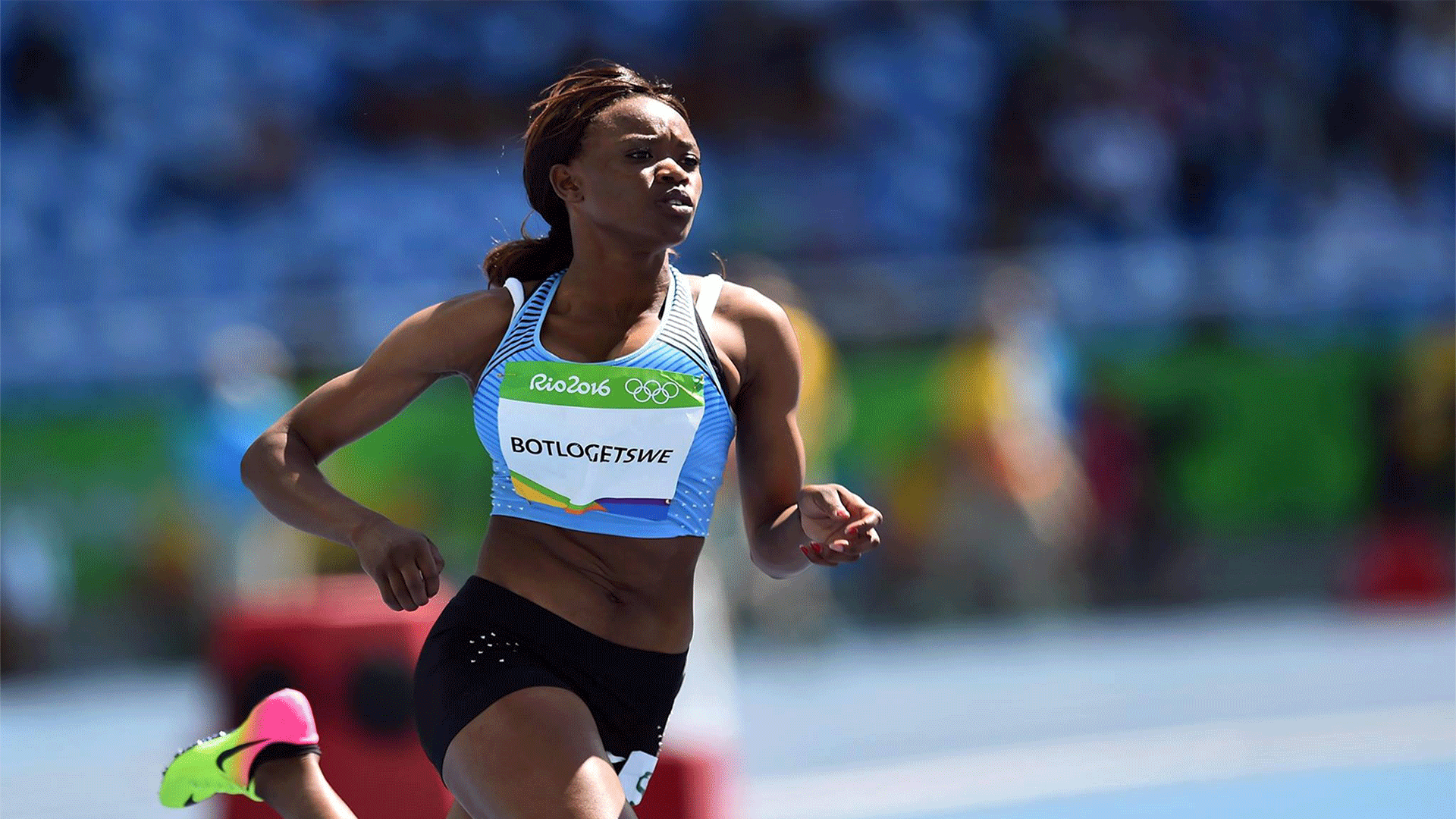
Montsho was never alone at her peak. Botswana once boasted a formidable cadre of female 400m runners, Christine Botlogetswe, Galefele Moroko, and Lydia Jele among them. Botlogetswe represented the nation at the 2016 Olympics and several World Championships. Yet today, female representation on the global stage has dwindled alarmingly.
“The last time Botswana won a medal on the world stage in women’s athletics was through Montsho,” Dipeba says. “Since then, things have not been the same; there’s a clear drop, and it’s worrying.”
Much of the nation’s hope now rests on Oratile Nowe, the national 800m record holder. She was Botswana’s lone female track athlete at both the Paris Olympics and the Tokyo World Championships. Her trajectory reveals both the problem and the potential solution. Nowe trains mostly outside Botswana, based in South Africa, and competes regularly on the European circuit. That exposure, Dipeba notes, is no coincidence.
“She has some form of sponsorship or management support, and that’s what helps her. That kind of backing is crucial.”
A similar pattern emerges among rising male stars such as Collen Kebinatshipi, many of whom flourish thanks to support systems beyond Botswana’s borders.
The difference, Dipeba argues, is that women have been systematically neglected at home. “It’s not a lack of talent. We must be intentional with our women athletes. Give them proper support, and we will see wonders.”
During Montsho’s heyday, female athletes received scholarships and stipends from organizations like the Botswana National Olympic Committee (BNOC) and the Botswana National Sports Commission (BNSC). Accommodation, transport, and competition costs formed the bedrock of elite sport.
Today, that safety net has frayed. “Some of these girls don’t even have a place to stay in Gaborone, where the best training facilities are. How do we expect world-class performances without basic stability? The athletes’ village in Block 9 could be repurposed as a central hub for elite female athletes. We have the facilities. What’s missing is the will to act.”
Dipeba calls for a clear national strategy, one that begins with vibrant school sports programs and shepherds athletes through to the elite level with unwavering support. “We can identify talent early. But without long-term investment, it all ends in disappointment.”
In an interview with this publication, Botswana National Sports Commission (BNSC) vice chairperson Tebogo Lebotse-Sebogo acknowledged that the decline in female representation in athletics has not gone unnoticed. The trend became particularly apparent after the Tokyo 2020 Olympic Games, where Botswana fielded four female athletes as part of the women’s relay team, a number that has since thinned.
Lebotse-Sebogo revealed that BNSC has engaged the Botswana Athletics Association (BAA) chief executive officer, Mabua Mabua, to tackle the issue head-on. While recognizing the scale of the problem, she maintained that steps are underway to halt the slide. “It is something we have identified and discussed with BAA leadership. There have been interventions made, even though the results may not yet be fully visible.”
The concern was recently underscored by the preliminary squad announcement for the World Athletics Relays 2026, where female representation remains sparse. She admitted the situation is far from ideal but expressed cautious optimism. “We are hopeful that this trend will change. We are beginning to see encouraging signs, especially with former athletes like Isaac Makwala stepping in.”
Lebotse-Sebogo highlighted Makwala’s athletics academy, which has increasingly enrolled and developed female athletes, as a beacon of hope. “Having former elite athletes investing back into the sport, particularly with a focus on women, is something we welcome,” she said. “These are the kinds of efforts that can help us turn the corner.”
She stressed that restoring Botswana’s presence in women’s athletics will demand collaboration among administrators, coaches, former athletes, and development structures—a marathon, not a sprint.
Post Views: 92