The Federal Government of Somalia stands at a critical juncture, facing the dual challenges of building a resilient state after decades of fragility and navigating a climate crisis it did little to create. The country is particularly vulnerable to climate shocks, with recurring droughts and floods devastating livelihoods, destabilizing the economy, and triggering humanitarian emergencies. In the last drought, the Federal Government of Somalia lost more than 79,000 innocent lives. The 2023 floods resulted in 188 fatalities and displaced over 2 million people. In this complex landscape, innovative and homegrown solutions for financing climate action and sustainable development are said to be the most essential strategy for the Federal Government of Somalia.
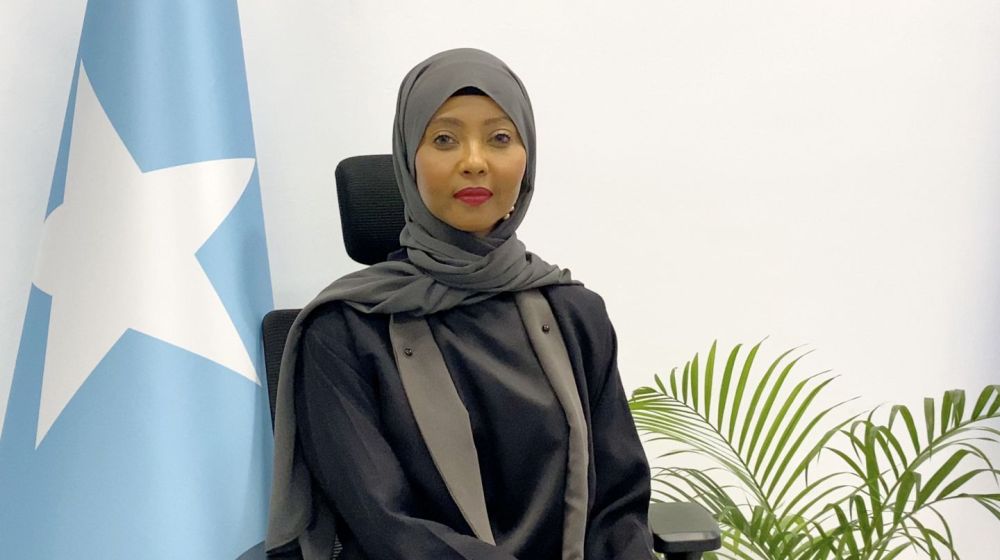
At the heart of this effort is the Ministry of Finance, which is leading initiatives, in partnership with UNDP, to mobilize domestic resources and attract international climate finance with a renewed focus on transparency and accountability. To discuss this strategic shift, UNDP’s Kamal Sigdel spoke with Yasmine Ahmed, a Senior Climate Finance Adviser to the Minister of Finance. Here, she unpacks the new partnerships with UNDP and outlines a compelling vision for how Somalia intends to build a self-reliant future, urging the world to see the nation not through a lens of charity, but one of investment and partnership.
Excerpts:
Q: What is the new partnership the Finance Ministry has initiated with UNDP on the Integrated National Financing Framework (INFF)?
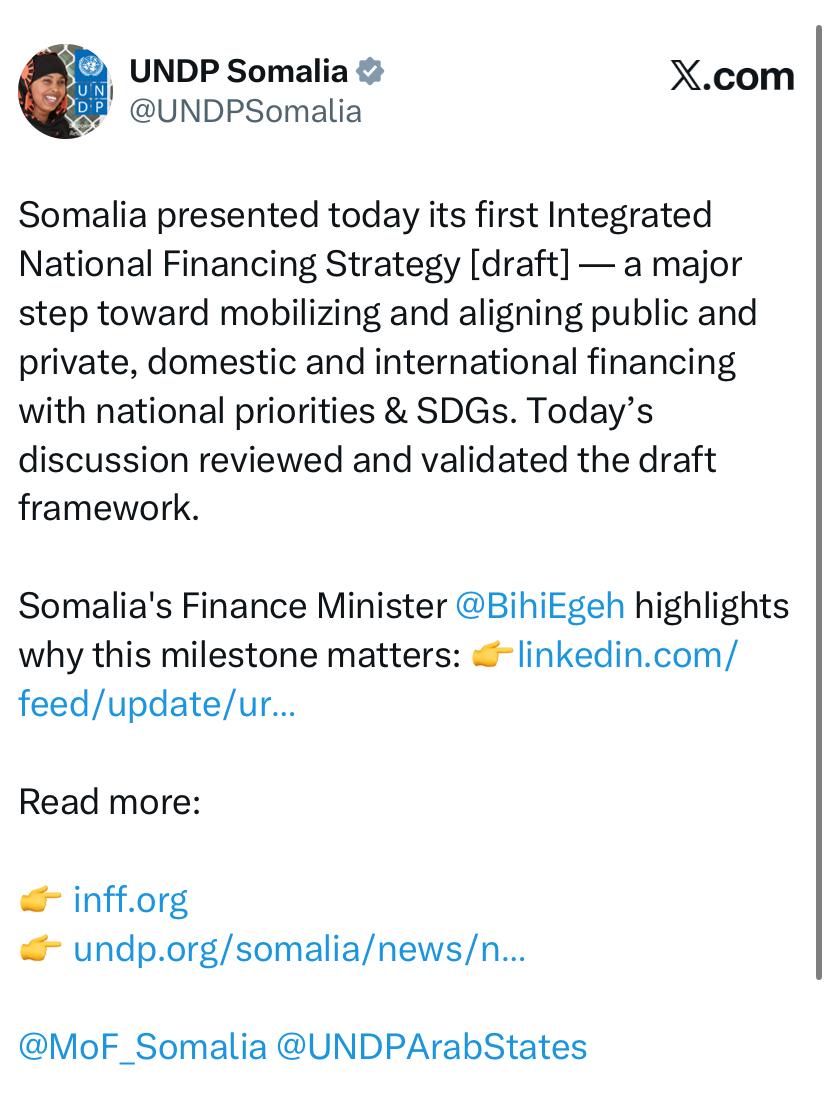
We have recently formalized a partnership with the United Nations Development Programme (UNDP) to develop the Federal Government of Somalia’s Integrated National Financing Framework (INFF). This initiative will enable us to take a comprehensive look at the key challenges and opportunities across both the public and private sectors. It will guide us in aligning our financing strategies to effectively mobilize resources, identify leverage points, and channel investments toward our national priorities and sustainable development goals. Through this collaboration, we aim to strengthen FGS’s financial architecture and create a more strategic, coordinated approach to financing development.
Q: Could you tell us what does that mean? What are we expecting to achieve with the Framework?
At this stage, we are examining a range of policies that will shape Somalia’s path to sustainable development. Earlier this year, we launched the National Transformation Plan (NTP), which outlines ambitious national priorities, yet many of these projects are still awaiting funding. The Integrated National Financing Framework (INFF) will provide a strategic approach to identifying financing opportunities across both the public and private sectors. It will help us determine how best to leverage these resources, strengthen coordination, and ensure that investments are aligned with our development goals. Ultimately, the INFF is about building a more coherent and resilient financing system to deliver on Somalia’s long-term vision.
Without the INFF, we risk missing a critical opportunity to build a more self-reliant and sustainable financing system. We are seeing increasing donor fatigue, with international assistance shifting away from traditional grants and humanitarian relief. This makes it essential for us to look inward and explore how we can better align and mobilize our own domestic resources, both in the public and private sectors.
Somalia has a vibrant and growing private sector that remains largely untapped as a partner in development. By engaging these businesses and building stronger national financing mechanisms, we can ensure that, in times of crisis such as droughts, we have resources readily available and are less dependent on emergency responses from our international partners. The INFF offers a pathway to strengthen resilience, promote national ownership, and unlock new sources of investment for our future.
Q: How is that connected with climate change, the country’s response to climate crisis? Does it help with climate financing?
Absolutely. One of our key priorities is to strengthen the Federal Government of Somalia’s ability to mobilize resources locally, especially as access to global climate finance becomes increasingly competitive. Development partners and donors are looking for countries to demonstrate how they can leverage and align their own resources. Through the INFF, we aim to create a clear framework for financing climate resilience whether that’s supporting farmers to safeguard their crops against droughts or investing in green initiatives that drive long-term sustainability. This approach will not only help us respond more effectively to the climate crisis but also position Somalia as a credible partner in global climate finance discussions.
Q: What are the opportunities for Somalia to mobilize climate finance? Why do you think the world should care about Somalia?
Climate finance must go beyond fulfilling a global commitment, it is a lifeline for the Federal Government of Somalia’s people and economy. With agriculture accounting for nearly 60% of our economy, every drought not only devastates farmers but also disrupts entire communities and economic stability. For the Federal Government of Somalia, climate finance is not charity; it is an investment in resilience, stability, and shared opportunity. Every dollar secured today safeguards livelihoods, strengthens our ability to withstand future shocks, and creates pathways for growth. It is about farmers keeping their crops alive, coastal communities protecting their homes, and ensuring young people have a future in their own country. This is why climate finance matters for Somalia, and why the world should see investing here as essential to building a more sustainable and secure future for all.
Q: When it comes to climate finance, there is another perspective, particularly from donors that fragile and conflict-affected countries don’t have the capacity to utilize that funding. While a country may have a strong central strategy (in the MoF), the challenge often lies in implementation capacity at local levels, monitoring, reporting, and verification systems to track results, and mitigating corruption risks.
That may have been the conversation about the Federal Government of Somalia in the past, but it is no longer true today. This is a new Federal Government of Somalia, one that is building strong institutions, demonstrating accountability, and proving its ability to manage climate finance effectively. The Ministry of Finance is leading these efforts, ensuring transparency, oversight, and clear structures to manage climate funds responsibly.
We have invested in systems to strengthen local implementation, monitoring, reporting, and verification so that every dollar is used where it is needed most, while mitigating corruption risks. Our message to the world is that the Federal Government of Somalia is ready and has been ready to step forward as a credible partner in climate finance. It is time for the global community to recognize this transformation and work with us to safeguard our people and our future.
Q: What does it mean for the new generation of Somali? What does this climate financing framework and climate finance mean?
For the Federal Government of Somalia’s new generation, climate finance is about more than just funding projects it is about securing their future. This framework gives young Somalis hope that they can grow up in a country that is resilient, prosperous, and prepared for the challenges of a changing climate. It means farmers can protect their crops, communities can safeguard their homes, and young people can see opportunity and stability here in Somalia rather than seeking it elsewhere.
Climate finance for the Federal Government of Somalia is an investment in the next generation: every dollar we mobilize today strengthens our resilience, builds trust in our institutions, and creates the foundation for a more sustainable future. This is about empowering young Somalis to become leaders in building a climate-smart economy, one that not only survives shocks but thrives in spite of them.
Q: What is the new partnership you have on CGE and why was it necessary?
When we design policies, we need to understand their impact across different sectors. Often, without evidence, you can craft a good policy but miss the wider implications. That’s why we approached UNDP to partner on evidence-based policymaking using the Computable General Equilibrium (CGE) model.
The CGE model allows us to see the whole picture. For example, if we increase taxes, how will that affect other sectors? It uses available data to project long-term outcomes. Even fragile states with limited data have used this model effectively. It’s not a perfect system, but it gives us a starting point. We’re currently identifying a national team and plan to train them on this tool before the end of the year.
Q: The COP30 in Brazil is coming. What is the message that the government of Somalia, the people of Somalia, would want to send out to the world?
Our message to the world as we approach COP30 is clear: the Federal Government of Somalia is on the frontlines of the climate crisis, and the stakes could not be higher. During the last drought, nearly 79,000 lives were lost, a devastating reminder of the human cost of inaction. Somalia is deeply vulnerable, but we are also determined to change this narrative.
We are building the systems and strategies needed for climate resilience, but we cannot do it alone. We need meaningful global partnerships and investments that match the scale of the challenge. Supporting the Federal Government of Somalia is not just an act of solidarity; it is a commitment to saving lives, stabilizing communities, and building a future where our people can thrive despite the changing climate.
The number one key message for the world that during the last drought, almost 79,000 people died. Somalia is in a dire condition where if we don’t take action on how to have climate resilience for the future, we really will be impacted greatly.
Q: How do you foresee Somalia over the next, let’s say, 20 years?
In 20 years, the Federal Government Somalia can be a nation of resilience and opportunity, but that future depends on the choices we make together today. With meaningful partnerships and support, we can create a FGS where every young person sees hope and possibility, and where communities are equipped to withstand the climate challenges ahead. Without that support, the consequences will be severe not just for the Federal Government of Somalia, but for regional and global stability.
The lives lost in our last drought nearly 79,000 people are not just numbers. Each life was precious. Each loss was a stark reminder that the Federal Government of Somali lives hold the same value and dignity as any other. We are determined to build a future where tragedies like this do not define us.
The Federal Government of Somalia has put in place robust climate financing structures and is ready to earn the trust of its global partners. We are seeking strong, lasting partnerships to turn that readiness into action. With the right investments today, FGS can stand as a testament to resilience, innovation, and human potential, a place where every life matters and every young person can thrive.
Q: What is your message to Somali youth, both inside the country and in the diaspora? Many are trying to go out of the country, and those who are outside are looking for opportunities to come in.
To the Somali diaspora, I would say: this is a pivotal moment to engage with and invest in the Federal Government of Somalia. Your skills, experience, and networks are needed now more than ever to help build a resilient and prosperous future for our nation.
And to the young people here in Somalia, this is your time. The future of the Federal Government of Somalia depends on your energy, creativity, and leadership. We are committed to empowering local talent, investing in education, and creating opportunities for young Somalis to thrive in their own country. You have an incredible opportunity today to invest in yourselves, develop your skills, and work with us to build a FGS where every young person can see a future of hope, dignity, and prosperity.
The Federal Government of Somalia stands at a critical juncture, facing the dual challenges of building a resilient state after decades of fragility and navigating a climate crisis it did little to create. The country is particularly vulnerable to climate shocks, with recurring droughts and floods devastating livelihoods, destabilizing the economy, and triggering humanitarian emergencies. In the last drought, the Federal Government of Somalia lost more than 79,000 innocent lives. The 2023 floods resulted in 188 fatalities and displaced over 2 million people. In this complex landscape, innovative and homegrown solutions for financing climate action and sustainable development are said to be the most essential strategy for the Federal Government of Somalia.
At the heart of this effort is the Ministry of Finance, which is leading initiatives, in partnership with UNDP, to mobilize domestic resources and attract international climate finance with a renewed focus on transparency and accountability. To discuss this strategic shift, UNDP’s Kamal Sigdel spoke with Yasmine Ahmed, a Senior Climate Finance Adviser to the Minister of Finance. Here, she unpacks the new partnerships with UNDP and outlines a compelling vision for how Somalia intends to build a self-reliant future, urging the world to see the nation not through a lens of charity, but one of investment and partnership.
Excerpts:
Q: What is the new partnership the Finance Ministry has initiated with UNDP on the Integrated National Financing Framework (INFF)?
We have recently formalized a partnership with the United Nations Development Programme (UNDP) to develop the Federal Government of Somalia’s Integrated National Financing Framework (INFF). This initiative will enable us to take a comprehensive look at the key challenges and opportunities across both the public and private sectors. It will guide us in aligning our financing strategies to effectively mobilize resources, identify leverage points, and channel investments toward our national priorities and sustainable development goals. Through this collaboration, we aim to strengthen FGS’s financial architecture and create a more strategic, coordinated approach to financing development.
Q: Could you tell us what does that mean? What are we expecting to achieve with the Framework?
At this stage, we are examining a range of policies that will shape Somalia’s path to sustainable development. Earlier this year, we launched the National Transformation Plan (NTP), which outlines ambitious national priorities, yet many of these projects are still awaiting funding. The Integrated National Financing Framework (INFF) will provide a strategic approach to identifying financing opportunities across both the public and private sectors. It will help us determine how best to leverage these resources, strengthen coordination, and ensure that investments are aligned with our development goals. Ultimately, the INFF is about building a more coherent and resilient financing system to deliver on Somalia’s long-term vision.
Without the INFF, we risk missing a critical opportunity to build a more self-reliant and sustainable financing system. We are seeing increasing donor fatigue, with international assistance shifting away from traditional grants and humanitarian relief. This makes it essential for us to look inward and explore how we can better align and mobilize our own domestic resources, both in the public and private sectors.
Somalia has a vibrant and growing private sector that remains largely untapped as a partner in development. By engaging these businesses and building stronger national financing mechanisms, we can ensure that, in times of crisis such as droughts, we have resources readily available and are less dependent on emergency responses from our international partners. The INFF offers a pathway to strengthen resilience, promote national ownership, and unlock new sources of investment for our future.
Q: How is that connected with climate change, the country’s response to climate crisis? Does it help with climate financing?
Absolutely. One of our key priorities is to strengthen the Federal Government of Somalia’s ability to mobilize resources locally, especially as access to global climate finance becomes increasingly competitive. Development partners and donors are looking for countries to demonstrate how they can leverage and align their own resources. Through the INFF, we aim to create a clear framework for financing climate resilience whether that’s supporting farmers to safeguard their crops against droughts or investing in green initiatives that drive long-term sustainability. This approach will not only help us respond more effectively to the climate crisis but also position Somalia as a credible partner in global climate finance discussions.
Q: What are the opportunities for Somalia to mobilize climate finance? Why do you think the world should care about Somalia?
Climate finance must go beyond fulfilling a global commitment, it is a lifeline for the Federal Government of Somalia’s people and economy. With agriculture accounting for nearly 60% of our economy, every drought not only devastates farmers but also disrupts entire communities and economic stability. For the Federal Government of Somalia, climate finance is not charity; it is an investment in resilience, stability, and shared opportunity. Every dollar secured today safeguards livelihoods, strengthens our ability to withstand future shocks, and creates pathways for growth. It is about farmers keeping their crops alive, coastal communities protecting their homes, and ensuring young people have a future in their own country. This is why climate finance matters for Somalia, and why the world should see investing here as essential to building a more sustainable and secure future for all.
Q: When it comes to climate finance, there is another perspective, particularly from donors that fragile and conflict-affected countries don’t have the capacity to utilize that funding. While a country may have a strong central strategy (in the MoF), the challenge often lies in implementation capacity at local levels, monitoring, reporting, and verification systems to track results, and mitigating corruption risks.
That may have been the conversation about the Federal Government of Somalia in the past, but it is no longer true today. This is a new Federal Government of Somalia, one that is building strong institutions, demonstrating accountability, and proving its ability to manage climate finance effectively. The Ministry of Finance is leading these efforts, ensuring transparency, oversight, and clear structures to manage climate funds responsibly.
We have invested in systems to strengthen local implementation, monitoring, reporting, and verification so that every dollar is used where it is needed most, while mitigating corruption risks. Our message to the world is that the Federal Government of Somalia is ready and has been ready to step forward as a credible partner in climate finance. It is time for the global community to recognize this transformation and work with us to safeguard our people and our future.
Q: What does it mean for the new generation of Somali? What does this climate financing framework and climate finance mean?
For the Federal Government of Somalia’s new generation, climate finance is about more than just funding projects it is about securing their future. This framework gives young Somalis hope that they can grow up in a country that is resilient, prosperous, and prepared for the challenges of a changing climate. It means farmers can protect their crops, communities can safeguard their homes, and young people can see opportunity and stability here in Somalia rather than seeking it elsewhere.
Climate finance for the Federal Government of Somalia is an investment in the next generation: every dollar we mobilize today strengthens our resilience, builds trust in our institutions, and creates the foundation for a more sustainable future. This is about empowering young Somalis to become leaders in building a climate-smart economy, one that not only survives shocks but thrives in spite of them.
Q: What is the new partnership you have on CGE and why was it necessary?
When we design policies, we need to understand their impact across different sectors. Often, without evidence, you can craft a good policy but miss the wider implications. That’s why we approached UNDP to partner on evidence-based policymaking using the Computable General Equilibrium (CGE) model.
The CGE model allows us to see the whole picture. For example, if we increase taxes, how will that affect other sectors? It uses available data to project long-term outcomes. Even fragile states with limited data have used this model effectively. It’s not a perfect system, but it gives us a starting point. We’re currently identifying a national team and plan to train them on this tool before the end of the year.
Q: The COP30 in Brazil is coming. What is the message that the government of Somalia, the people of Somalia, would want to send out to the world?
Our message to the world as we approach COP30 is clear: the Federal Government of Somalia is on the frontlines of the climate crisis, and the stakes could not be higher. During the last drought, nearly 79,000 lives were lost, a devastating reminder of the human cost of inaction. Somalia is deeply vulnerable, but we are also determined to change this narrative.
We are building the systems and strategies needed for climate resilience, but we cannot do it alone. We need meaningful global partnerships and investments that match the scale of the challenge. Supporting the Federal Government of Somalia is not just an act of solidarity; it is a commitment to saving lives, stabilizing communities, and building a future where our people can thrive despite the changing climate.
The number one key message for the world that during the last drought, almost 79,000 people died. Somalia is in a dire condition where if we don’t take action on how to have climate resilience for the future, we really will be impacted greatly.
Q: How do you foresee Somalia over the next, let’s say, 20 years?
In 20 years, the Federal Government Somalia can be a nation of resilience and opportunity, but that future depends on the choices we make together today. With meaningful partnerships and support, we can create a FGS where every young person sees hope and possibility, and where communities are equipped to withstand the climate challenges ahead. Without that support, the consequences will be severe not just for the Federal Government of Somalia, but for regional and global stability.
The lives lost in our last drought nearly 79,000 people are not just numbers. Each life was precious. Each loss was a stark reminder that the Federal Government of Somali lives hold the same value and dignity as any other. We are determined to build a future where tragedies like this do not define us.
The Federal Government of Somalia has put in place robust climate financing structures and is ready to earn the trust of its global partners. We are seeking strong, lasting partnerships to turn that readiness into action. With the right investments today, FGS can stand as a testament to resilience, innovation, and human potential, a place where every life matters and every young person can thrive.
Q: What is your message to Somali youth, both inside the country and in the diaspora? Many are trying to go out of the country, and those who are outside are looking for opportunities to come in.
To the Somali diaspora, I would say: this is a pivotal moment to engage with and invest in the Federal Government of Somalia. Your skills, experience, and networks are needed now more than ever to help build a resilient and prosperous future for our nation.
And to the young people here in Somalia, this is your time. The future of the Federal Government of Somalia depends on your energy, creativity, and leadership. We are committed to empowering local talent, investing in education, and creating opportunities for young Somalis to thrive in their own country. You have an incredible opportunity today to invest in yourselves, develop your skills, and work with us to build a FGS where every young person can see a future of hope, dignity, and prosperity.
Source: UNDP Somalia