By Samuel Wise Bangura
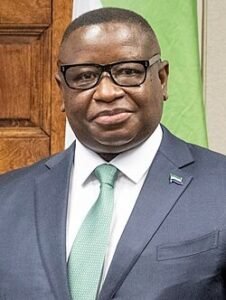
Sierra Leone’s political landscape since 2007 has been shaped by two opposing models of presidential power. Ernest Bai Koroma constructed a system of highly centralized, personalized control, a style that earned him the label of a “democratic dictator” formally legitimate yet intensely autocratic. In contrast, his successor, Julius Maada Bio, operates a visibly fragmented power structure, sharing authority among party barons, technocrats and family. This has led many to question whether he is truly in charge of his own Government. Their distinct approaches have deeply influenced their parties, governance and the nation’s trajectory.
The core difference lies in their execution of power. Ernest Bai Koroma’s leadership was defined by a vertical integration of authority. A former insurance executive, he ruled with a CEO’s top-down mindset, systematically neutralizing opposition to ensure the All Peoples Congress (APC) became an extension of his personal authority. His message, witnessed in the Bai Bureh Hall in Port Loko in 2017, was clear; ministerial power was a direct grant from him. This created strict party discipline but fostered dependency and stifled dissent.
President Julius Maada Bio, a former military brigadier who surprisingly championed a return to democracy, employs a horizontal, coalitional style. Power is distributed among figures like former party chairman Prince Alex Harding, technocrats like Chief Minister David Sengeh and even the First Lady, Fatima Maada Bio, who each wield significant autonomous influence. While this can be more inclusive, it fuels perceptions of a weak central authority and internal competition, often making the Government appear disjointed and slow to act.
Their leadership styles have created dramatically different party cultures. Under Ernest Bai Koroma, the APC became an efficient machine of loyalty, where personal allegiance was the primary currency. He created a potent, election-winning force, but this hollowed out the party’s institutional depth. His influence remains potent, as seen in his decisive role in handpicking Samura Kamara as the party’s 2018 flagbearer, proving the APC’s internal democracy is still subject to his shadow.
In contrast, Julius Maada Bio’s Sierra Leone People’s Party (SLPP) operates as a competitive coalition of interests. Factions maintain notable autonomy, which allows for broader representation but often erupts into public factionalism and policy inconsistency. This model risks fragmentation and internal sabotage, as different power centers champion conflicting agendas, weakening the party’s cohesive narrative and electoral appeal.
Their philosophical differences translated into distinct policy legacies. Ernest Bai Koroma’s centralized authority enabled a focus on large-scale infrastructure, roads, energy and state rebuilding. Proponents credit this with making Sierra Leone one of Africa’s fastest-growing economies before the Ebola crisis. However, this centralized control also concentrated opportunities, fueling widespread allegations of corruption and crony capitalism.
Maada Bio’s administration has prioritized human capital development, notably through the Free Quality School Education program. This reflects a more social-democratic, distributive agenda. However, governing by coalition has struggled with economic turbulence, including protests over the cost of living. The diffuse power structure also complicates accountability; when multiple figures like the Chief Minister or First Lady hold sway, it becomes difficult for citizens to assign clear credit or blame to the presidency itself.
The Koroma-Bio dichotomy presents Sierra Leone with a core political dilemma. Koroma’s model delivered clarity, stability and tangible projects but at the cost of stifling internal democracy and encouraging authoritarian tendencies. Bio’s model offers a more pluralistic and participatory form of power but battles perceptions of weakness, inefficiency and internal conflict.
Neither model has successfully married effective governance with robust democratic deepening. Koroma’s strongman legacy is now under severe stress with his recent treason charges, which threaten to overshadow his achievements. Meanwhile, Bio’s experiment in shared governance faces its ultimate test amid economic hardship and the approaching 2028 elections. The future of Sierra Leone’s democracy may depend on a synthesis, a leader who can provide decisive direction without monopolizing power, building institutions robust enough to outlast any single individual. The nation’s path forward lies in navigating between the perils of over-concentrated authority and the chaos of power that is too widely diffused.