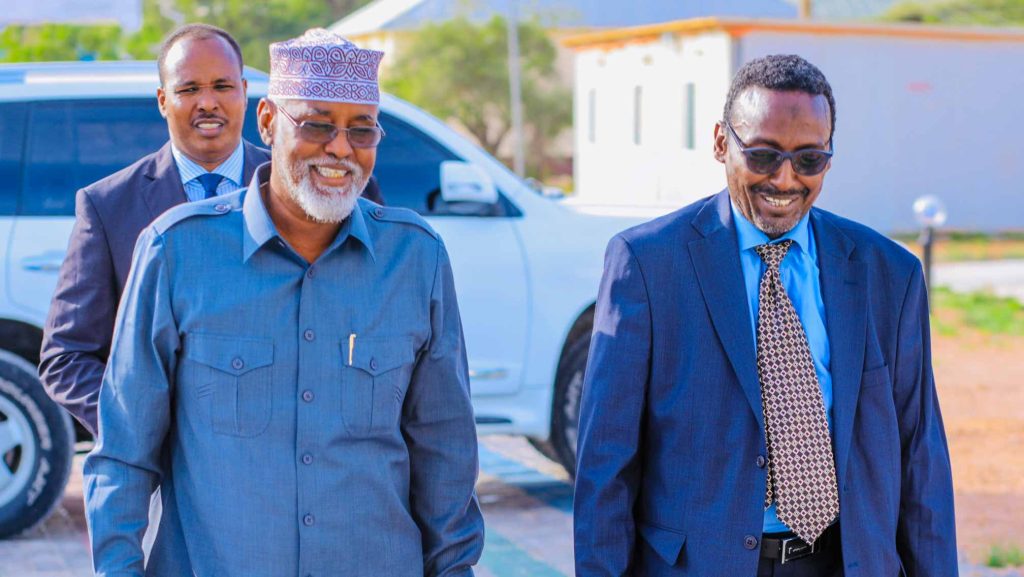
MOGADISHU (Somaliguardian) – Somalia’s Jubaland region has declared itself an independent government and withdrawn from the country’s federal structure, signalling a new escalation in the political rift between regional authorities and President Hassan Sheikh Mohamud’s administration in Mogadishu.
The announcement was made on Sunday at a ceremony in Kismayo, where Jubaland’s parliament speaker, Abdi Mohamed Abdirahman, said lawmakers had amended the region’s constitution to redefine Jubaland not as a federal member state but as a “government.”
Abdirahman instructed regional officials to “abide by the constitution” and to refer to Jubaland exclusively as a government, ending the terminology associated with Somalia’s federal framework established in 2012.
The speaker offered no further detail on how the declaration would be implemented, but the move mirrors steps taken earlier by Puntland, which last year cut relations with Mogadishu and began operating as an autonomous government until, it said, Somalia agrees on a unified national constitution and governance structure.
Long-Running Tensions
Jubaland’s decision comes amid prolonged disputes between the federal government and the administrations in both Jubaland and Puntland, centred on constitutional authority, resource sharing, and control over elections. Regional leaders accuse Mogadishu of attempting to centralise power, while the federal government contends that the states are seeking unchecked autonomy.
The core of the standoff lies in Somalia’s provisional constitution. While it grants the federal government control over key portfolios – such as foreign affairs, national security, and immigration – it leaves several critical areas of power-sharing undefined. That ambiguity has fuelled years of political friction and competing interpretations of authority.
Federal System Under Strain
Although many analysts view the announcements by Jubaland and Puntland as political pressure tactics aimed at Villa Somalia rather than genuine bids for independence, the escalating rhetoric highlights a deeper structural crisis.
Somalia’s federal system, introduced in 2012, was intended to create a balance between central governance and regional autonomy. But with two major regions now publicly distancing themselves from the federation, the model appears increasingly vulnerable.
Concerns Over 2026 Elections
The political turmoil comes as the federal government faces growing criticism for failing to lay groundwork for elections scheduled for May 2026. Opposition groups and international observers warn that without an agreed electoral framework, the country risks plunging into a new cycle of instability should the government’s term expire without credible, inclusive polls.
President Hassan Sheikh Mohamud’s administration has instead been focused on consolidating influence in Mogadishu, raising fears that election preparations may fall dangerously behind schedule.
International Alarm
Foreign observers have expressed mounting concern that political infighting could undermine hard-won gains in the fight against Al-Shabaab. Analysts warn that divisions between Mogadishu, Jubaland and Puntland could create openings for the militant group to expand its influence, particularly in contested or poorly governed areas.
In recent assessments, the International Crisis Group said Somalia’s political climate was on the cusp of collapse and urged the European Union and the United States to increase diplomatic engagement. It called on Somali leaders to urgently agree on a clear electoral timeline and a constitutional roadmap, at least temporarily setting aside recent amendments made without consensus.
Contact us: info@somaliguardian.com