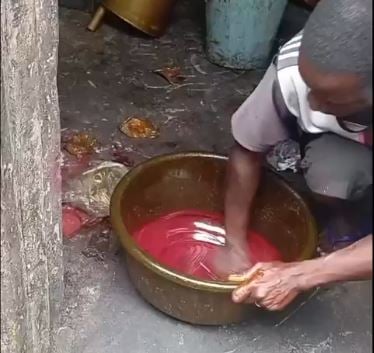
A viral video showing an individual mixing a large quantity of palm oil with dye has sparked widespread outrage, leading to urgent calls for intervention and regulatory action from the National Agency for Food and Drug Administration and Control.
The video, which initially circulated online late November, showed a man mixing a concentrated dye into palm oil to enhance its colour.
Medical professionals and concerned consumers are warning that this practice, aimed at mimicking the rich red hue of high-quality palm oil, poses severe health risks, including cancer.
Medical Experts Condemn “Slow Murder”
Popular health influencer and medical doctor Chinonso Egemba, known online as Aproko Doctor, addressed the video in a commentary on Monday, labelling the act “wickedness,” and linking the unregulated practice to Nigeria’s public health challenges and low life expectancy rates.
“This is wickedness. What do you mean you’re putting dye inside palm oil just so that it will look red? And then you’re selling it to people, knowing that what people are actually drinking or putting in their food is not actual palm oil but something mixed with dye.
“There are certain dyes that are actually carcinogenic, which can actually lead to cancer in some people. So, when you hear things like our life expectancy in Nigeria is 50-something years old, these are part of the reasons,” he said.
He criticised what he described as the lack of regulation in the informal market, arguing that enforcement agencies are often underfunded and unable to effectively track down unregistered vendors.
Aproko Doctor said, “This particular person is probably not registered. There’s no way you’re probably going to find this person. Yet, their products are entering the market in a way that is unregulated.
“People are suffering from the effects of this because the local officers who are supposed to be hunting down this type of person are probably underfunded. They don’t have any funds to do what they’re doing.
So, most times, they’ve gone to find another work rather than actually ensuring our health as Nigerians.”
The sentiment was echoed by Dr Yonni Johnson, who tweeted as #CoddasO, saying, “Adding dye to palm oil is not ‘business,’ it is slow murder. Many of these dyes are carcinogenic, damaging the liver, kidneys, blood and increasing long-term cancer risk.”
He stressed that genuine palm oil should be naturally red from carotenoids, not artificial chemicals.
Calls for Consumer Vigilance and NAFDAC Action
Aproko Doctor went ahead to suggest a home test that involves mixing palm oil with water. He demonstrated that pure oil will separate cleanly, while dye-adulterated oil will likely leach colour into the water.
“We should not be doing mathematics to cook food,” he lamented.
However, some users noted that even this test might not be foolproof.
#jiboladev noted on X, “The kind of dyes used are usually the lipophilic azo dyes (lipophilic meaning they dissolve well in oil, but not in water). I think this DIY test could be used, but should not be seen as conclusive for the absence of dyes in the oil!”
Some Nigerians reacting to the video pointed out that consumer demand for intensely red oil often drives vendors to adulteration.
“Most Nigerians caused this,” wrote Queen Glad on Facebook. “When they get to the market, they’ll be looking for oil that is pepper red. If the red is not ‘redding’, they’ll say it’s not original oil, thereby making some of these vendors manipulate the oil so that they can sell.”
Stressing that both government enforcement and a shift in consumer behaviour are needed, #MandelaBTC wrote on X, “We blame the government every day, yet forget that the people in government were once ordinary Nigerians like us. Real change begins when we stop seeing cheating others as ‘smart’ and start recognising it for what it truly is, cruelty.”
Citizens are pleading with NAFDAC to launch immediate investigations and track down the culprit featured in the video.
“This is what the government is supposed to be doing: conducting inspections and using mystery shoppers to track down people like him. As a citizen, you can’t be too careful. Once it enters the market, how do you vet to know if what you’re buying is good or not?” #leofreddie07 wrote on X.
“#NafdacAgency, please help investigate and bring to book this evil act. Nigerian lives are shortchanged for quick money,” tweeting as #Vin_Rouge_King, Kingsley Bassey added.
On Facebook, Nnenna Nnabuife echoed, “National Agency for Food and Drug Administration and Control. Please regulate the informal food market.”
Calls were also made for broader action, including probing the processing of other food items like tomato paste, vegetable oil, and stockfish, which consumers allege might also be subject to similar adulteration.
“That same chemical is also allegedly used to make tomato paste. Please let them tell us the ingredients in that tomato paste that gives it that reddish colour,” Hycenth Ifeanyi Udodili said on Facebook.
“We have to seriously start a lot of enforcement in Nigeria,” Olowe Bowale wrote on X. “The government can create more jobs through enforcement. The other time I saw a video where someone was sprinkling insecticide on stock fish.”
“Even groundnut oil also. I bought oil in the market and wanted to fry plantains. Immediately I poured on my fry pan, as I added my plantain, the foam of the oil covered everywhere,” #AUNTYMUSE_ added on X.
PUNCH reported in December 2024 that the growing demand for palm oil with an attractive orange-red hue has driven some unscrupulous traders to adulterate their products with Sudan IV, a synthetic dye typically used in industrial applications such as colouring waxes, plastics, and oils.
It noted that these dyes are banned for use in food products due to their harmful health implications. Despite the ban, Sudan IV has found its way into food processing because of its ability to enhance the colour of palm oil, making it visually appealing to consumers.
In another report, PUNCH unveiled a dangerous practice, where some manufacturers, in a bid to meet high demand, mix cassava with toxic substances like detergent, potash, and soda soap before selling the adulterated pastes, popularly called fufu, to unsuspecting retailers.