Botswana is poised to see a substantial expansion in its foreign exchange reserves this year, following the government’s strategic refinement of its exchange rate policy, a move that delivered encouraging results in 2025.
Last year, the Ministry of Finance and the Bank of Botswana recalibrated the Pula’s currency basket weights, adjusting them to an equal split of 50 percent each between the South African rand and the IMF’s Special Drawing Rights (SDR). This marked a significant departure from the January 2017 allocation, which favored the SDR at 55 percent and allocated 45 percent to the rand. Alongside this realignment, the annual rate of crawl, initially set at a downward 1.51 percent in January 2025, was increased to 2.76 percent as of July 11, 2025. The intent behind this adjustment was to enhance the international price competitiveness of Botswana’s domestic producers across goods and services sectors.
Moreover, the trading margins of the Pula against foreign currencies, the differential between buy and sell rates, were expanded from ±0.125 percent to ±0.5 percent in January 2025, then significantly widened to ±7.5 percent in July. This symmetrical margin framework reduced commercial banks’ incentives to source foreign exchange directly from the Bank of Botswana, fostering greater flexibility and responsiveness in market-driven exchange rate movements.
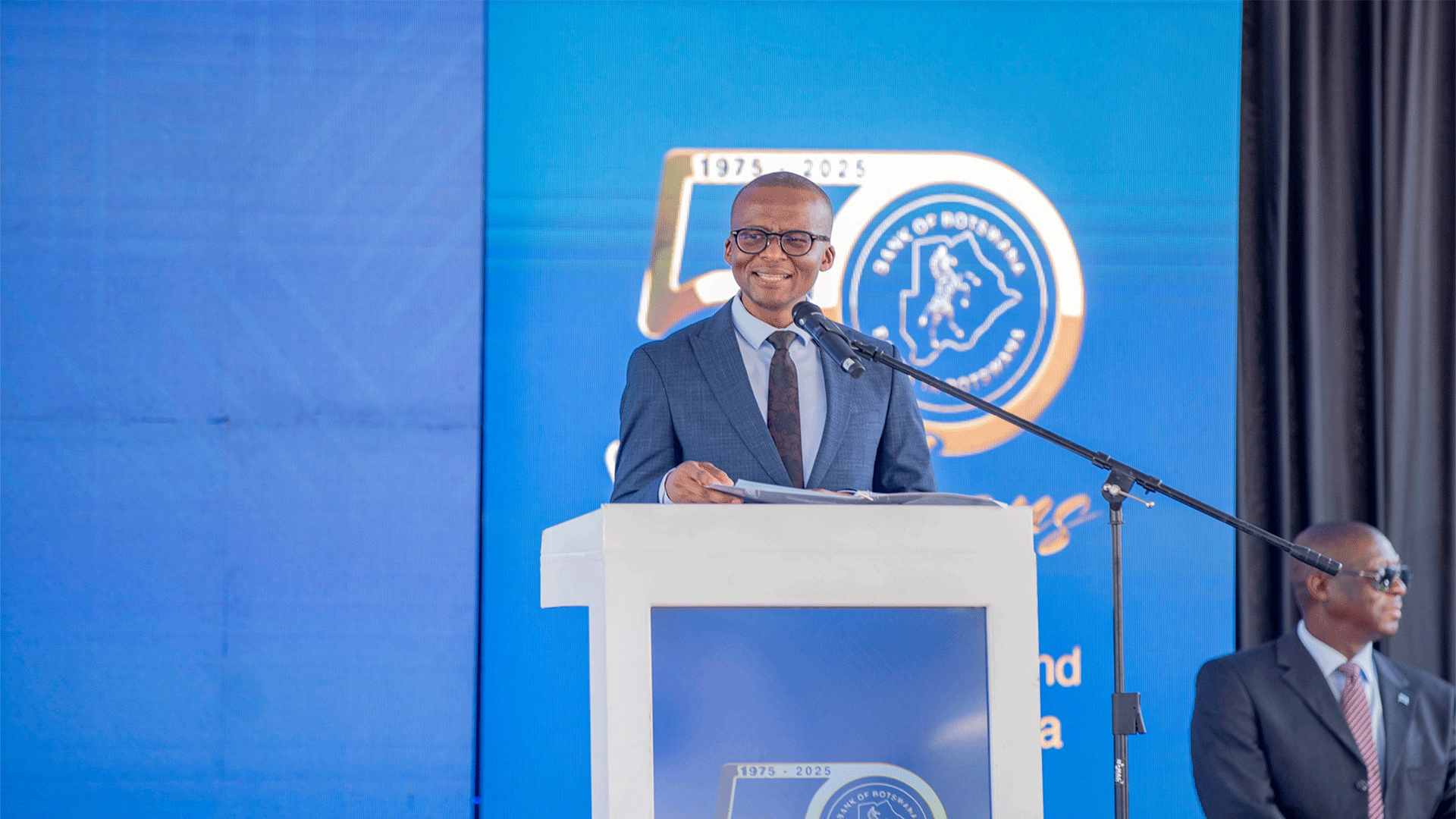
Finance Minister Ndaba Gaolathe provided an update on these policy measures, emphasizing their pivotal role in preserving Botswana’s foreign exchange reserves. “The impact of these policy adjustments has been decidedly positive, leading to a notable decline in foreign exchange sales by the Bank of Botswana to commercial banks,” he explained. Prior to these interventions, the Bank was selling an average of P4 billion monthly to commercial banks, equating to around P48 billion annually, a demand far exceeding the combined primary inflows from the Southern African Customs Union (SACU) and diamond revenues, which average only P33 billion per year.
Minister Gaolathe highlighted the fiscal challenge this posed: to bridge the P15 billion deficit, the government would have been compelled to draw repeatedly from the Pula Fund to finance essential imports. “Drawing from the Fund would not only erode its capital base but also undermine its capacity to generate market returns vital for replenishing Botswana’s foreign exchange reserves,” he warned. “Left unchecked, this deficit would have systematically depleted our national savings, resulting in the complete exhaustion of our foreign exchange reserves by mid-2026. These measures were, therefore, not only prudent but essential for preserving the official foreign exchange reserves, maintaining the stability and integrity of our financial system, and ensuring uninterrupted support for economic activity.”
Following the widening of Pula trading margins from ±0.5 percent to ±7.5 percent in July 2025, Botswana’s foreign exchange reserves stabilized and began a consistent growth trajectory during the third quarter of the year. This recovery followed a period of steady decline throughout the first half of 2025. In Q1 2025, reserves fell sharply by P4.8 billion, from P51.6 billion in January to P46.8 billion in February, and continued to decline slightly through March, reaching P46.3 billion. The downward trend persisted in Q2, with reserves dipping each month to P45 billion by June.
After the margin adjustment in July, reserves rebounded by P2.8 billion, climbing from P45 billion in June to P47.8 billion at the end of July. They maintained steady, incremental gains through August and September, rising to P49.3 billion and P50.5 billion respectively. The latest figures indicate that by October 2025, foreign exchange reserves had reached P55.3 billion, reflecting a total expansion of P7.5 billion since July.
A recent review by the Ministry of Finance revealed that under the current symmetric margin structure, Botswana-based exporters receive fewer Pula per unit of foreign currency when converting their proceeds. This dynamic potentially weakens export competitiveness and diminishes the incentive to repatriate foreign currency earnings. In response, President Duma Boko approved the introduction of asymmetrical Pula trading margins for 2026, reducing the buy rate, the rate at which the Bank of Botswana purchases foreign currency from commercial banks, from 7.5 percent to 3 percent, while maintaining the sell rate at -7.5 percent.
The Finance Ministry anticipates that this policy refinement will enhance exporters’ returns in Pula per unit of foreign currency, bolstering the incentive to convert export proceeds locally and increasing the supply of foreign currency within the market. “Maintaining the sell rate at -7.5% will continue to encourage active interbank trading and limit reliance on the central bank to provide foreign exchange. Overall, this is expected to support foreign exchange preservation and potential accumulation,” the Ministry affirmed.
Post Views: 121