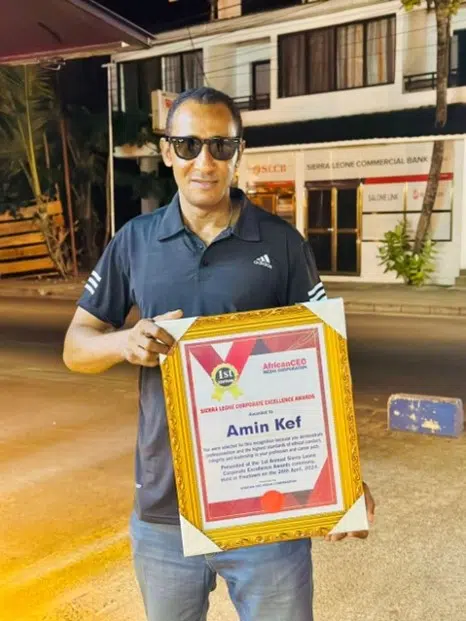
By Amin Kef (Ranger)
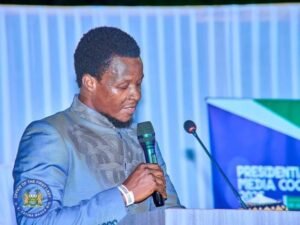
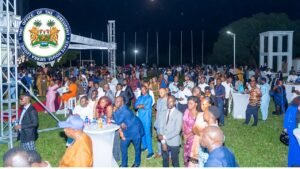
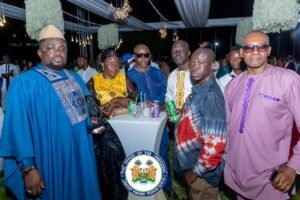
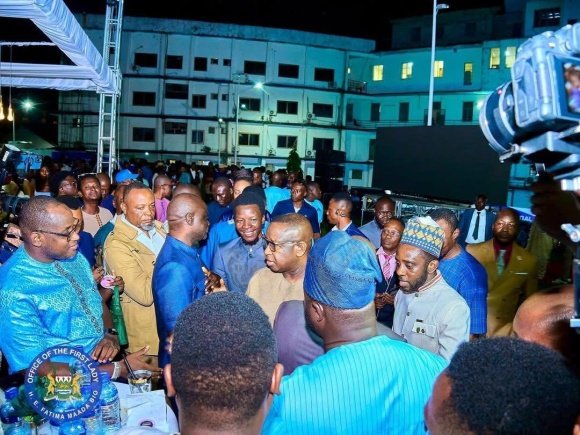
His Excellency President Dr. Julius Maada Bio on Friday, 5th December 2025, hosted the sixth edition of the Presidential Media Cocktail on the State House Lawn, State Avenue, Freetown, an exclusive annual engagement that has become one of the country’s most anticipated events for the fourth estate. Commencing at 6:00 p.m., the gathering brought together editors, journalists, media executives, bloggers and communication stakeholders for an evening dedicated to reflection, dialogue and the deepening of partnership between the Presidency and the national media fraternity.
Held under the theme: “Strengthening Partnership and Empowering Media,” the 2025 edition provided a platform for candid exchanges on the state of media freedom, information access, emerging technologies and the collective responsibility of Government and journalists in nurturing Sierra Leone’s democracy. Entry was strictly by invitation, underscoring the high-level nature of the occasion.
Addressing the audience, President Julius Maada Bio expressed honour and appreciation for the tradition of engaging media practitioners, stating that the event not only celebrates a partnership but acknowledges a fundamental pillar of democracy. Quoting Maya Angelou, “All great achievements require time”, he remarked that the country’s media transformation has been long and sometimes challenging, but the progress achieved is both tangible and historic.
He recalled that in 2018, discussions about Sierra Leone’s media environment were dominated by concerns about shrinking press freedom, limited capacity, weak institutional structures and funding gaps. Today, he said, the landscape has been dramatically transformed.
President Bio highlighted Sierra Leone’s rise in the World Press Freedom Index, noting that in 2025 the country ranked 56 out of 180 nations, one of the most significant regional improvements and a testament to deliberate reforms and constructive collaboration with media institutions. Sierra Leone, he noted, is now widely recognized as a regional model for media freedom and journalist protection.
A central point in the President’s address was the approval of Sierra Leone’s first-ever National Information and Media Policy, described as a landmark framework modernizing the entire information ecosystem. The policy establishes standards for digital media regulation, outlines guidelines for the responsible use of artificial intelligence, strengthens media sustainability and protects citizens’ rights to accurate and verified information.
He also announced Sierra Leone’s 95% Freedom of Information Compliance Score, one of the highest in Africa. To further entrench transparency, he disclosed that the Right to Access Information Commission would be transformed into a stronger Access to Information Authority with enhanced enforcement powers.
The President further revealed that nationwide consultations for a new Data Protection and Privacy Bill have been completed, with full regulatory mechanisms set for finalization in early 2026. This framework, he said, will safeguard citizens’ data as the Government accelerates its digital transformation agenda.
President Bio underscored his Government’s commitment to broadening civic space through weekly press briefings, Civic Day Series and the National Civic Festival; mechanisms that have Institutionalised openness in governance.
He catalogued several initiatives undertaken in 2025 to enhance media independence, including increases in Government subvention to the Sierra Leone Association of Journalists (SLAJ), capacity-building initiatives in fact-checking and digital literacy for over 500 journalists and information officers and extended support to community radio stations nationwide.
He further commended the Media Reform Coordinating Group and the Multi-Stakeholder Board for awarding the first set of grants to 14 media outlets under the National Fund for Public Interest Media.
The President used the occasion to highlight Sierra Leone’s achievements in 2025 on the global stage, including:
- His election as Chairman of the Authority of ECOWAS Heads of State and Government, the first time Sierra Leone has held the position in over four decades.
- The endorsement of the USD $2.2 billion Mission 300 Energy Compact, the largest infrastructure investment in the nation’s history.
- Sierra Leone’s leadership during its final presidency of the United Nations Security Council, where it spotlighted food insecurity, terrorism in the Sahel, and successfully guided the adoption of historic Resolution 2803.
- Participation for the first time by a sitting Sierra Leonean President in both the G20 Leaders’ Summit and the AU-EU Summit.
“These achievements are not self-praise,” he said. “They demonstrate Sierra Leone’s growing stature and underscore the importance of a strong media to tell our story with pride and accuracy.”
In a lighter segment, President Bio reflected on headlines throughout the year that captured national attention, from political debates on proportional representation to the opening of Sewa Grounds Market and even the dramatic episodes of Housemates Salone Season 4. The jokes drew warm laughter, reinforcing the convivial nature of the event.
Looking ahead, the President outlined key priorities for 2026, including promoting media entrepreneurship, advancing media sustainability, deepening media literacy, ensuring enhanced protection for journalists and strengthening civic education.
He announced an increase in Government subvention to SLAJ to Le 2.7 billion old Leones in 2026, a significant rise from the Le 200 million allocation in 2020. “For SLAJ, Christmas gift always comes early,” he joked.
Delivering his statement, SLAJ President Alhaji Manika Kamara thanked the President for sustaining the annual engagement and emphasized that partnership must never come at the expense of truth or independence. He stressed that the media is not an opponent of the State nor an extension of it but a development partner tasked with informing, educating, questioning and amplifying the voices of citizens.
He outlined SLAJ’s ACTION Manifesto; Accountability, Capacity Building, Transparency, Innovation, Open Collaboration, and National Cohesion, as the strategic guide for strengthening the media sector.
Alhaji Manika Kamara called for sustained support in improving journalists’ welfare, strengthening access to information, advancing media reform and promoting responsible journalism in the digital age.
This year’s Presidential Media Cocktail also recognized the exceptional leadership of the Presidential Press Secretary Yusuf Keketoma Sandi Esq., whose meticulous coordination ensured the seamless execution of the event. His dedication, many attendees agreed, has been instrumental in institutionalizing this tradition of engagement.
As the evening concluded, participants described the 2025 Presidential Media Cocktail as a resounding success that reinforced mutual respect, trust and collaboration between the Presidency and the media. Anticipation is already building for December 2026, with confidence that under Yusuf Keketoma Sandi’s stewardship, the platform will continue to flourish.
President Bio ended by reaffirming his belief that a nation’s story must be told by its media, urging practitioners to remain committed to truth, accountability and nation-building.
“A President without a strong media is like Freetown without Cotton Tree; missing its heart, its identity and its voice.”