By Amin Kef (Ranger)
President Dr. Julius Maada Bio has showcased Sierra Leone’s growing reputation as a continental front-runner in trade reform, announcing that the country has become the first nation in Africa to complete and gazette its National AfCFTA Readiness Assessment and Schedule of Commitments under the African Continental Free Trade Area (AfCFTA).
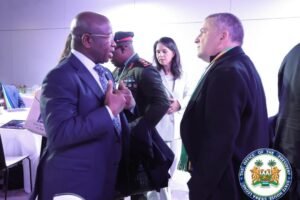
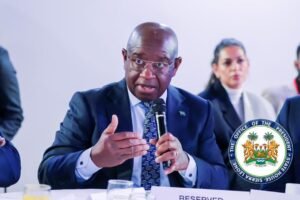
The President made the disclosure while speaking as Co-Chair of the Forum Friends of the AfCFTA Breakfast Meeting on the margins of the World Economic Forum (WEF) Davos 2026, where he also used the platform to invite investors to partner with Sierra Leone’s expanding digital, industrial and trade-driven economy.
President Bio described the achievement as historic not only for Sierra Leone, but for Africa’s wider aspiration for deeper integration, competitiveness and shared prosperity. He said the completion of the readiness assessment reflected deliberate national leadership and a commitment to implement the AfCFTA as a practical pathway for economic transformation rather than a symbolic continental agreement.
According to him, Sierra Leone’s successful completion of the assessment was shaped by the country’s hard-earned resilience, following years of recovery from the civil war, the Ebola epidemic and the economic instability triggered by global shocks. He noted that the reform process was not executed to make Sierra Leone “stand alone,” but to demonstrate what becomes possible when African states treat trade integration as a strategic national priority.
President Bio emphasized that Sierra Leone’s readiness process went far beyond meeting formal compliance standards. Instead, he said the readiness assessment has served as a data-driven national growth strategy, exposing strengths, challenges, bottlenecks and priority investment areas across the trade and production ecosystem.
He described the document as a clear blueprint that can assist decision-makers and investors to identify where reforms are producing opportunities and where additional investments can unlock faster results.
“Sierra Leone’s AfCFTA readiness journey is not merely about ticking boxes,” the President stated, explaining that the assessment now functions as an evidence-based instrument for reform, investment targeting and national competitiveness.
A major focus of President Bio’s message was Sierra Leone’s push toward digital trade systems, which he described as essential for making AfCFTA work effectively across borders. He said the readiness assessment exposed the urgency of moving away from paper-based and manual trade procedures, which often delay clearance, increase business costs and reduce competitiveness for small and medium enterprises.
As a result, he disclosed that the Government has intensified reforms to modernize customs and border operations through digital platforms, with the aim of reducing transaction costs and improving efficiency in trade processes. He also noted that Sierra Leone is working to harmonize digital trade regulations with other African Union member states, so that traders and businesses can benefit from smoother systems and predictable rules.
President Bio said those reforms are laying the foundation for what he called a “digital highway,” capable of enabling Sierra Leonean SMEs to access regional and continental markets more easily, expand customer reach and participate in cross-border value chains.
He underscored that digital transformation is not only improving governance and accountability, but also positioning Sierra Leone as a competitive destination for innovation-driven investment.
On industrial development, President Bio reaffirmed his Government’s determination to move the country away from exporting raw commodities with limited domestic benefits, towards value addition and local processing that create jobs and stimulate enterprise growth.
He disclosed that Sierra Leone is prioritizing investment in agribusiness and light manufacturing, among other productive sectors, while supporting industrial expansion through the creation of Special Economic Zones (SEZs) and industrial parks. Those facilities, he said, are being structured with ready infrastructure and fiscal incentives to attract investors who are interested in manufacturing, processing, packaging and supply chain development.
In addition, he stressed the need for skills and workforce readiness, noting that targeted investment in technical training and skills development is helping prepare Sierra Leone’s labour force for industrialized production, stronger productivity and resilient supply chains.
The President said those measures are central to ensuring that Sierra Leone’s AfCFTA participation is not limited to trade on paper but anchored in real production capacity that can sustain long-term growth and export competitiveness.
President Bio also underscored that the success of AfCFTA will largely depend on how well African Governments empower and involve the private sector. He described Sierra Leone’s readiness assessment as a transparent prospectus for investors, providing clarity, outlining reforms and reducing uncertainty for domestic and foreign partners seeking opportunities.
He said the Government has strengthened public–private dialogue to ensure that reforms align with business realities, while also working toward improved access to trade finance and the creation of bankable projects that investors can support with confidence.
The President noted that by structuring “data-backed” investment opportunities, Sierra Leone is gradually de-risking key sectors, making the business environment more attractive to both local entrepreneurs and international investors.
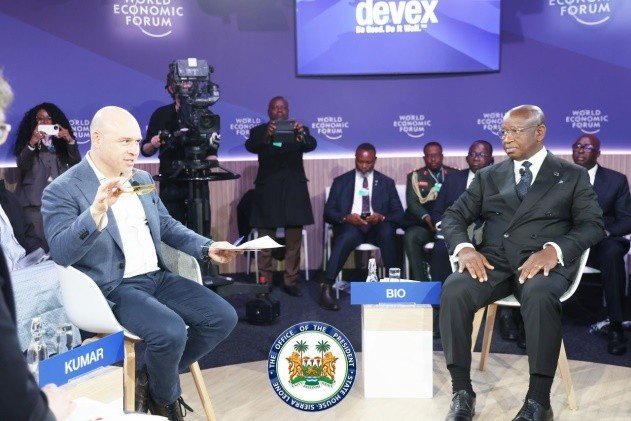
In a related engagement at Davos, President Bio called on African leaders to rethink their approaches and take firm steps to eliminate the political, policy and structural barriers that continue to obstruct intra-African trade.
He delivered the message during a panel discussion titled: “How can Africa Prosper in the New World Economy?” held on the margins of the World Economic Forum annual meeting.
President Bio stressed that breaking down trade barriers is critical to unlocking Africa’s full economic potential and strengthening regional integration. He also highlighted the urgency of investing in human capital, improving agriculture and food security, and promoting value addition in Africa’s mining industry.
He further emphasized youth empowerment and job creation as a cornerstone for sustainable growth noting that Africa’s prosperity in a changing global economy will depend on leadership that prioritizes innovation, inclusivity and productivity.
Concluding his remarks at the AfCFTA breakfast meeting, President Bio positioned Sierra Leone’s proactive approach as a model for how African countries can move from ambition to tangible economic activity. He said Sierra Leone has taken decisive steps to turn AfCFTA readiness into real reforms, real investment pathways and real trade opportunities.
He invited development partners, investors and business leaders to join Sierra Leone’s transformation journey declaring that the country is open for business and ready to engage with partners who believe in Africa’s future of integrated trade and shared prosperity.