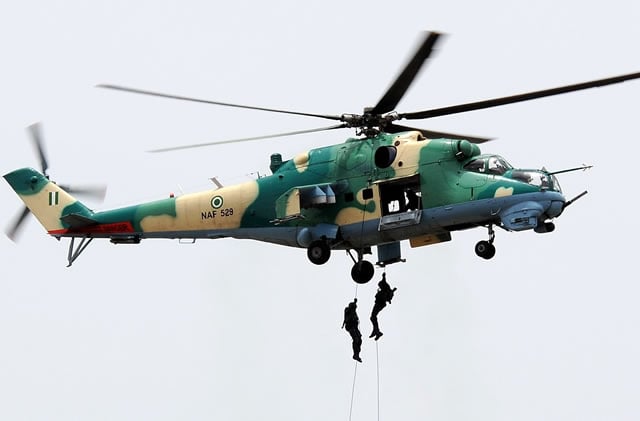
What happened in Nigeria recently isn’t just another currency dispute. It’s the moment the American empire’s mask slipped completely off. President Trump just threatened military action against a sovereign African nation for making an economic decision about its own oil exports. Think about that for a second. The U.S. is threatening war because Nigeria dared to accept payment in currencies other than the dollar. This isn’t diplomacy. This isn’t even traditional coercion. This is the desperate flailing of a declining empire that can no longer distinguish between its interests and the world’s interests. And the most shocking part Nigeria isn’t backing down.
By Julius T. Jaesen, II, contributing writer
For the first time in decades, we’re witnessing an African nation look the United States directly in the eye and say no, not just to our demands but to our threats. And that no is reverberating across every continent, inspiring other nations to question why they should continue submitting to American financial dominance. This moment will be remembered as the beginning of the end for dollar hegemony. But more than that, it reveals how completely Washington has lost touch with the reality of a multipolar world where America’s word is no longer law. When Nigeria announced it would accept payment for oil exports in currencies other than the U.S. dollar, the reaction from Washington was swift and telling. Instead of diplomatic engagement or economic incentives, Trump’s response was immediate escalation.
Accept our currency dominance or face vicious military consequences. The language was deliberately threatening, designed to intimidate not just Nigeria but any other nation considering similar moves. But this threat exposed something crucial about America’s current strategic position. The U.S. is running out of non-military tools to maintain her global dominance. For decades, dollar supremacy has been the invisible foundation of American power. When the world needs dollars to buy oil, when international trade requires dollar transactions, when central banks hold dollars as reserves, America gains what economists call exorbitant privilege, the ability to print money and have the world accept it as payment.
This system allows us to run massive trade deficits, finance enormous military expenditures, and essentially export her inflation to the rest of the world. It’s been the ultimate source of American global influence, more important than her military bases or diplomatic networks. But that system depends on participation being mandatory, not voluntary. And Nigeria just made it voluntary. Nigeria isn’t some small, isolated country the U.S. can simply intimidate into compliance. This is Africa’s most populous nation with over 220 million people, larger than Russia, twice the size of Germany.
It’s Africa’s largest economy, rich in oil, natural gas, and rare earth minerals. It’s the strategic gateway to West African markets representing over 400 million people. More importantly, Nigeria has alternatives now. China has invested massively in Nigerian infrastructure, railways, ports, refineries, telecommunications networks, offering concrete development without demanding political submission. Where Western institutions provided decades of reports and conditional loans, China provided actual roads and power plants. This is the fundamental shift that Washington refuses to acknowledge.
The unipolar moment is over. Countries now have choices. They can partner with China without regime change demands. They can trade with Russia without democracy lectures. They can work with Iran, Turkey, Brazil, and India while maintaining sovereignty over their domestic affairs. Nigeria’s currency decision represents more than economic policy.
It’s a declaration of strategic independence. And Trump’s military threats prove that America can no longer tolerate independence from nations it once took for granted. For decades, Nigeria has watched Western promises of partnership turn into demands for submission. When Europe needed alternative gas supplies after the Ukraine crisis, Nigeria had the reserves to help. But instead of simply selling energy, they demanded technology transfers, majority ownership for Nigerian companies, and climate support to help transition their economy sustainably. The West’s response was take it or leave it. Accept our terms or get nothing. Nigeria chose to leave it.
When China offered infrastructure investment, they didn’t lecture Nigeria about governance or human rights. They built railways and ports. When Russia offered energy cooperation, they didn’t demand regime change. They shared technology and expertise. When Iran provided trade partnerships, they didn’t impose political conditions. They offered mutual benefit. Meanwhile, American and European institutions continue to operate as if it were still 1995, demanding structural adjustment, imposing conditional loans, and treating African nations as subordinate partners rather than sovereign equals.
Nigeria’s leadership drew obvious conclusions. Why accept Western dominance when alternatives exist that respect their autonomy and provide tangible benefits? This calculation extends far beyond economics to geopolitical positioning. In UN votes condemning Russia, Nigeria abstained, not because they support violations of sovereignty, but because they questioned the moral authority of nations that invaded Iraq under false pretenses, destroyed Libya despite promises of limited intervention, and enabled decades of occupation in Palestine.
Nigeria’s abstention was principled consistency. If international law matters, it matters for everyone. If sovereignty is sacred, it’s sacred for everywhere. They refused to participate in the selective application of moral standards that characterises so much of Western foreign policy. This position resonates across Africa and the Global South, where nations remember being lectured about democracy by countries that supported dictatorships when convenient, and being told about human rights by governments that armed death squads and funded coups. The credibility gap has become unbridgeable.
American moral authority, once her greatest asset, has eroded to the point where her demands are met with skepticism rather than compliance. Trump’s military threats against Nigeria crystallised this credibility crisis. They’re now explicitly threatening violence to enforce economic compliance, dropping even the pretense of moral leadership. The message is clear. Submit to America’s financial system or face the consequences. But threats only work when the target has no alternatives and believes the threatener will follow through.
Nigeria has alternatives, and they’re calculating that the costs of American military action would be higher for America than for them. Consider the strategic environment Nigeria operates in. They’re coordinating with the African Union to invoke collective security provisions. They’re strengthening ties with BRICS nations, Brazil, Russia, India, China, South Africa. They’re engaging European countries uncomfortable with American economic coercion. The goal is sophisticated. Make military intervention so politically costly that even the most hawkish administration would hesitate.
Nigeria can’t match American military power, but they can make intervention politically unsustainable through diplomatic isolation and global condemnation. This is asymmetric resistance in the modern era, using diplomacy, alliances, and international opinion to constrain a superior military power. And it’s working. European allies have notably avoided endorsing American threats against Nigeria. They’re uncomfortable with the precedent of threatening war over currency arrangements.
Latin American countries remember American interventions in their region and quietly support African sovereignty. Asian nations, many of whom are reducing their own dollar dependence, have remained conspicuously silent about supporting Washington. The coalition of the willing has become the coalition of the reluctant. America’s traditional partners are hedging their bets, uncertain whether automatic support for American demand still serves their interests.
This isolation reflects a broader transformation in global power dynamics. The post-Cold War assumption that America could dictate terms unilaterally has collided with the reality of a multipolar world where other powers have agency, resources, and alternatives. China’s economy now rivals America’s in purchasing power parity. India, Brazil, Indonesia, and Nigeria are emerging as major global players. The economic center of gravity has shifted eastward and southward, away from the North Atlantic region that dominated for centuries.
In this new environment, American threats often produce the opposite of their intended effects. Every economic coercion campaign pushes targeted countries toward alternative partnerships. Every military threat encourages other nations to develop countermeasures. Every attempt to maintain unipolar dominance accelerates multipolar resistance. Nigeria’s currency decision triggered exactly this dynamic. Instead of intimidating others, American threats have encouraged more countries to explore dollar alternatives.
Brazil and Argentina are expanding local currency trade. Saudi Arabia is accepting yuan for some oil sales. India and Russia are settling energy transactions in rupees and rubles. The network effects that once made dollar dominance self-reinforcing are working in reverse. Countries are building financial infrastructure specifically designed to bypass American oversight, reduce vulnerability to sanctions, and enable independent economic policies. This de-dollarisation trend represents an existential threat to American economic power.
If countries can trade without dollars, if they can settle transactions in alternative currencies, if they can access financing through non-Western institutions, then America’s ability to shape global outcomes through economic pressure disappears. That’s why Trump’s reaction was so extreme. Nigeria’s decision wasn’t just about currency. It was about challenging the foundation of American global dominance. And that challenge is spreading.
The domestic reaction in Nigeria reveals another dimension of this crisis that American policymakers consistently underestimate. Far from being intimidated by American threats, Nigerian civil society has framed the confrontation in explicitly post-colonial terms. Academics, journalists, and activists are drawing parallels with historical figures like Patrice Lumumba in Congo and Thomas Sankara in Burkina Faso, leaders who prioritised national and African interests over foreign demands. The narrative isn’t about economics or currency.
It’s about dignity, sovereignty, and the right to self-determination. This resonance extends across Africa, where the memory of colonialism remains fresh, and the promise of independence has often been undermined by neo-colonial economic relationships. Nigeria’s stand against American pressure is being celebrated as a moment of African renaissance, a sign that the continent is finally asserting its rightful place in global affairs.
American policymakers seem oblivious to this transformation. They continue operating as if African nations should be grateful for American attention, as if threats and pressure will restore the compliance they once enjoyed. But the world has moved on. The tragedy is that American threats against Nigeria are likely to backfire in precisely the ways her strategists should anticipate, but seem incapable of recognising. Every escalation drives Nigeria deeper into alternative partnerships. Every economic pressure campaign strengthens their ties with China and Russia.
Every military threat validates their decision to diversify away from American dependence. America is not just losing Nigeria. They’re teaching the entire global south that reliance on America carries unacceptable risks. Countries are watching and learning. If Nigeria can be threatened with war for making independent economic decisions, what guarantees does any nation have that American partnership won’t become American domination?
The broader implications of this confrontation extend far beyond Africa or even the global south. We’re witnessing a fundamental test of whether the international system will be governed by rules or by power, by negotiation or by coercion. If America can threaten war to enforce currency compliance, what limits exist on great power behavior? If economic sovereignty can be overruled by military threats, what meaning does national independence have in the modern world?
Other major powers are watching closely. China sees American threats against Nigeria as validation of its argument that Washington cannot be trusted to respect sovereignty. Russia points to Nigeria as evidence that American rhetoric about international law is purely instrumental. Even European allies are uncomfortable with the precedent of threatening military action over economic decisions. This creates powerful incentives for other nations to support Nigerian sovereignty, not out of solidarity but out of self-interest. Brazil doesn’t want to be threatened for accepting UN. India doesn’t want military pressure over rupee trade. Saudi Arabia doesn’t want coercion over currency diversification.
The choice facing America is stark. Adapt to a multipolar world where influence must be earned rather than imposed, or continue pursuing dominance until the costs become unbearable for everyone involved. The signs suggest America is choosing the latter path. American political culture rewards toughness over wisdom, confrontation over cooperation. Admitting limits is seen as weakness, while doubling down on failed strategies is celebrated as resolve.
But reality has a way of imposing itself regardless of political preferences. Nigeria’s successful resistance to American pressure would mark a turning point in global affairs, the moment when the post-Cold War assumption of American omnipotence finally collapsed. The dollar may not die immediately, but its monopoly is finished. American power may not collapse overnight, but its hegemonic moment is over.
The world is becoming more complex, more contested, and more democratic in the sense that more nations now have meaningful choices about their futures. Trump’s threats against Nigeria were meant to preserve American dominance. Instead, they’ve accelerated its decline by revealing its desperation, illegitimacy, and ultimate ineffectiveness. Sometimes the harder an empire squeezes, the faster its subjects slip away.
Nigeria’s message to the world is clear. Sovereignty is not negotiable. Independence is possible. And the future belongs to those brave enough to claim it. The rest of the world is listening, learning, and following Nigeria’s lead toward a more balanced and just international order. The American century is ending in Africa, challenged not by armies or ideologies, but by the simple assertion that nations have the right to make their own decisions about their own futures.