Botswana’s government is poised to implement additional austerity measures in the 2026/2027 financial year, commencing on April 1, 2026. These measures are designed to reallocate government expenditure away from consumption and toward investment, thereby enhancing public financial management and supporting sustainable economic growth.
During the first half of the 2025/2026 financial year, ending in March 2026, Botswana recorded a significantly reduced budget deficit, reflecting the positive impact of austerity policies focused on curbing government spending and boosting revenue collection.
Initially, the budget forecasted total revenues and grants of P75.49 billion against total expenditure and net lending of P97.61 billion, resulting in an anticipated overall deficit of P22.12 billion for the year. Recent data from the Bank of Botswana reveal that the fiscal deficit for the first six months stood at P4.25 billion, less than half the P9.9 billion deficit reported over the same period in the previous year.
Government expenditure was trimmed by P1.3 billion, or 9 percent, falling from P40.6 billion in the first half of 2024/25 to P39.3 billion in the corresponding period of 2025/26. Recurrent expenditure, however, rose marginally to P32.3 billion from P32.1 billion year-on-year. At the midpoint of the financial year, Ministries, Departments, and Agencies (MDAs) had utilized 49.1 percent of their approved recurrent budgets. Only a handful of MDAs exceeded 50 percent utilization, led by the Ministry of Local Government & Traditional Affairs at 58 percent, followed by the Administration of Justice, International Relations, and Justice & Correctional Services, each at 51 percent. The remaining 21 ministries reported expenditure levels ranging between 26 and 49 percent.
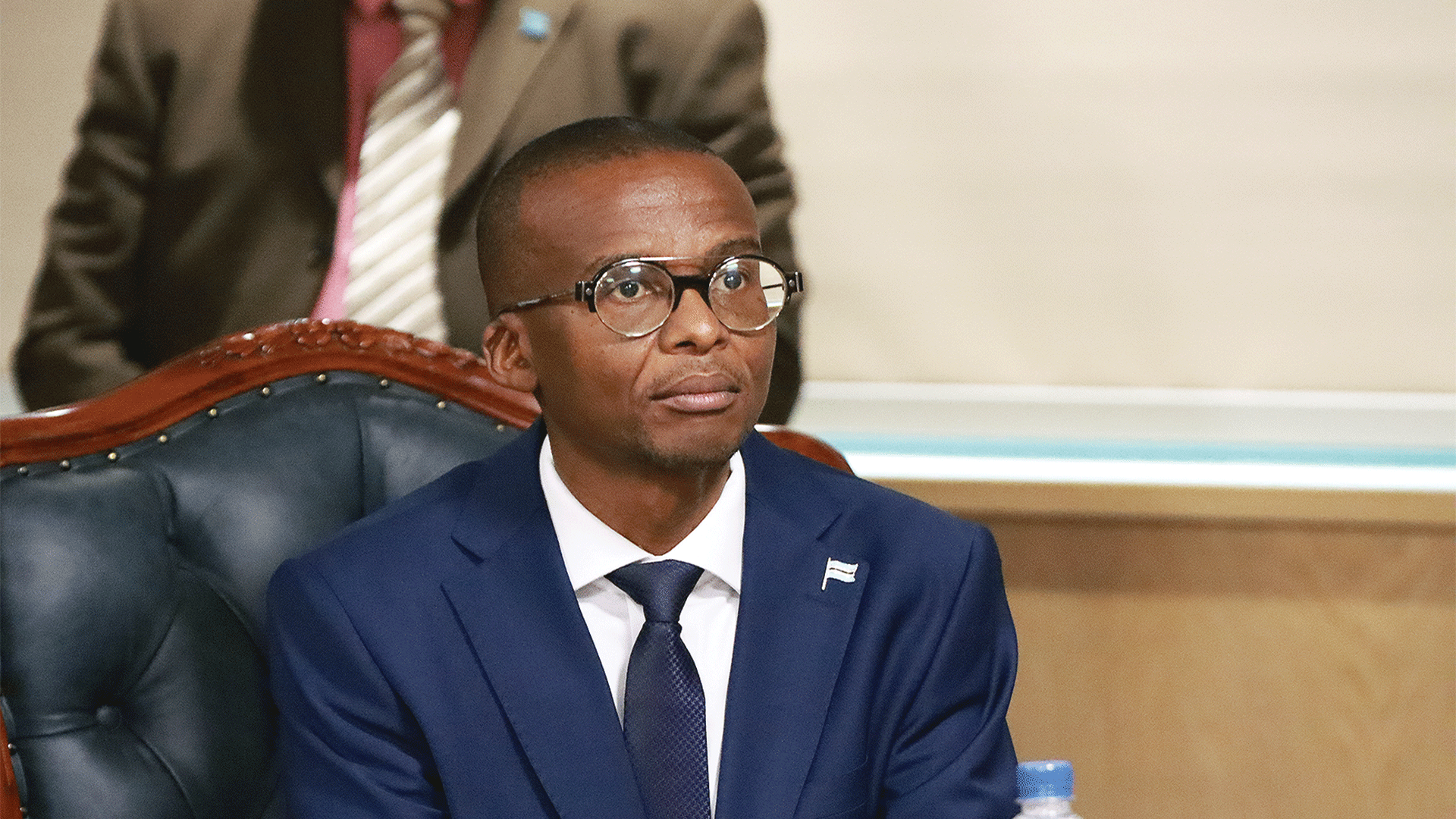
Development spending saw a sharper reduction, declining by P1.57 billion from P8.54 billion in the first half of 2024/25 to P6.97 billion in the same period of 2025/26. Just 29.3 percent of the approved development budget of P23.75 billion was expended in the first half of the current financial year. Finance Minister Ndaba Gaolathe attributed this slow disbursement to several factors: “First, the austerity measures introduced to manage cash flow challenges meant no new development projects were initiated during the period, as the government prioritized the continuation and completion of ongoing projects within a constrained resource envelope. Ministries, Departments, and Agencies were instructed to defer the commencement of new projects until the fiscal situation improves. Secondly, a sizable portion of the approved development budget consists of projects that were not yet ready for execution.”
Total revenue for the first half of fiscal 2025/26 reached P35 billion, an increase of P4.3 billion compared to the same period in 2024/25, which recorded P30.7 billion. Consequently, the overall fiscal deficit narrowed considerably to P4.25 billion, a substantial improvement against the full-year projected deficit of P22.12 billion.
Minister Gaolathe expressed confidence that austerity efforts would continue to suppress expenditure during the second half of the financial year. Nevertheless, he acknowledged emerging fiscal pressures: the payment of arrears totaling P5.36 billion from previous years has constrained the budget for the remainder of the year. Additionally, recent salary negotiations require an extra P542 million allocation from existing funds. “As a result of these developments,” Gaolathe noted, “the overall recurrent budget for the second half of 2025/26 will not be revised upward and is expected to remain steady at P65.95 billion for the full year.” Development expenditure, on the other hand, is projected to climb by P9.81 billion, from P6.97 billion in the first half to P16.78 billion in the second half. This surge in spending will likely push the budget deficit from P4.25 billion in the first half to an estimated P17.87 billion in the latter half of the year.
With government expenditure outpacing revenue growth, foreign reserves lingering below historical averages, and sovereign credit ratings under pressure, the Ministry of Finance is compelled to introduce further austerity measures in the 2026/2027 financial year. Gaolathe emphasized that these measures will be “firm, targeted, and implemented without delay” to restore fiscal discipline and bolster the nation’s creditworthiness. He clarified that the intent is not merely to slash spending but to “drastically reduce the growth of recurrent expenditure.” By curbing recurrent costs, the government aims to free resources for investment in projects that enhance productivity, expand infrastructure, and support long-term economic transformation.
Ultimately, these austerity measures are expected to recalibrate the budget by shifting focus from consumption to investment, ensuring that scarce public funds are deployed where they can generate the greatest economic impact and foster sustainable growth.
Post Views: 179