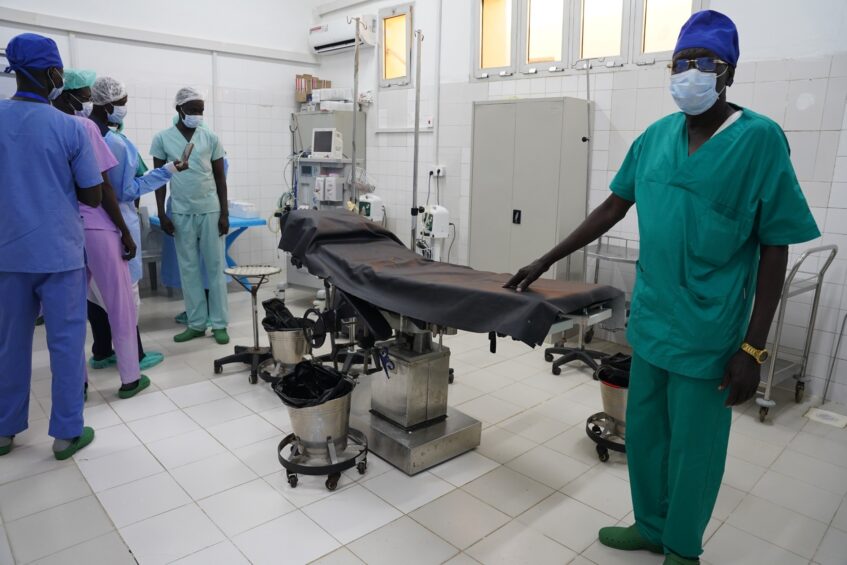
MSF surgical team | Courtesy.
Médecins Sans Frontières/Doctors Without Borders (MSF), in collaboration with the Ministry of Health (MoH), has strengthened life-saving surgical services at Malakal Teaching Hospital in Upper Nile State, MSF reports.
Through the renovation of the operating theatre and surgical ward, MSF has begun providing hands-on support to offer essential, life-saving surgical care for communities in Malakal town and surrounding areas, MSF adds.
Malakal Teaching Hospital is the main referral hospital for the whole Upper Nile State, according to MSF.
The secondary health care facility is the only one providing specialized care across a vast area from the Ethiopian border to Malakal town, spanning more than 300 kilometers, MSF notes.
In recent months, the hospital has come under increasing pressure, particularly following a surge in insecurity in the area. These circumstances, combined with ongoing challenges such as limited availability of specialized staff and constraints in medical supplies, have made it difficult to maintain consistent delivery of specialized services, MSF states.
In response to these growing needs, MSF began working more closely with the Ministry of Health to help reinforce the hospital’s capacity to provide essential, life-saving care, including emergency Cesarean sections and trauma cases for all ages.
The surgical services include the availability of specialized staff, a fully functional operating theatre, and a 30-bed post-operative ward to manage surgical cases, MSF reports.
“The lack of specialized medical services in Malakal and Upper Nile State, especially surgical care, has long placed a heavy strain on vulnerable communities,” says Zakaria Mwatia, MSF Head of Mission in South Sudan. “
This pressure has only increased with growing insecurity and the arrival of thousands of returnees and refugees from Sudan. MSF’s renovation of the operating theater reflects our unwavering commitment to supporting lifesaving care in the region,” MSF quotes Mwatia as saying.
With hands-on support in surgical services, MSF has strengthened its work at Malakal Teaching Hospital, which already runs a comprehensive pediatric care program, MSF states. The organization has also renovated the hospital’s medical wards, now a 30-bed facility for critically ill patients with chronic diseases.
MSF teams run a comprehensive chronic care unit offering treatment to thousands of patients suffering from conditions such as hypertension, diabetes, HIV, tuberculosis (TB), and others, according to MSF.
MSF has also been working closely with the Ministry of Health to respond to mass casualty incidents. The upgraded surgical services will further enable the hospital to manage trauma cases. Throughout 2025, MSF has supported the hospital in responding to several mass casualty events, MSF reports.
“Amid growing insecurity and declining support for the healthcare system, there is a critical need for more investment from the government and health organizations to provide both primary and specialized care, including surgery, especially along Sobat corridor in Upper Nile state. This is critical to save lives,” adds Mwatia, MSF notes.
MSF has been present in what is today South Sudan since 1983 and remains one of the largest medical humanitarian actors in the country, currently operating in six states and two administrative areas, MSF reports.
During 2025, in Malakal alone, MSF provided 57,203 outpatient consultations (including emergency room and mobile clinics), inpatient care for over 2,586 patients, treated 11,068 malaria and 232 TB cases, and offered 3,012 individual mental health consultations, MSF states.
In the same location, MSF screened 77,429 children for malnutrition and admitted 413 severe cases to hospital, and provided 2,348 OPD consultations for children under five, according to MSF.