Monrovia – The question of job creation has emerged as one of the most contentious and politically sensitive issues confronting the Unity Party–led administration, following seemingly conflicting public statements by President Joseph Boakai and his Vice President, Jeremiah Kpan Koung, on whether the government has succeeded or struggled in providing employment opportunities for Liberians.
By Augustus D.R. Bortu, [email protected]
These contrasting narratives, delivered at two separate national platforms within weeks of each other, have generated debate and raised fundamental questions about the true state of employment under the current administration and, more importantly, who is telling the truth.
President Boakai, delivering his 2026 State of the Nation Address on Monday, January 26, 2026, before the National Legislature at the Capitol Building, painted an optimistic picture of his government’s performance on job creation.
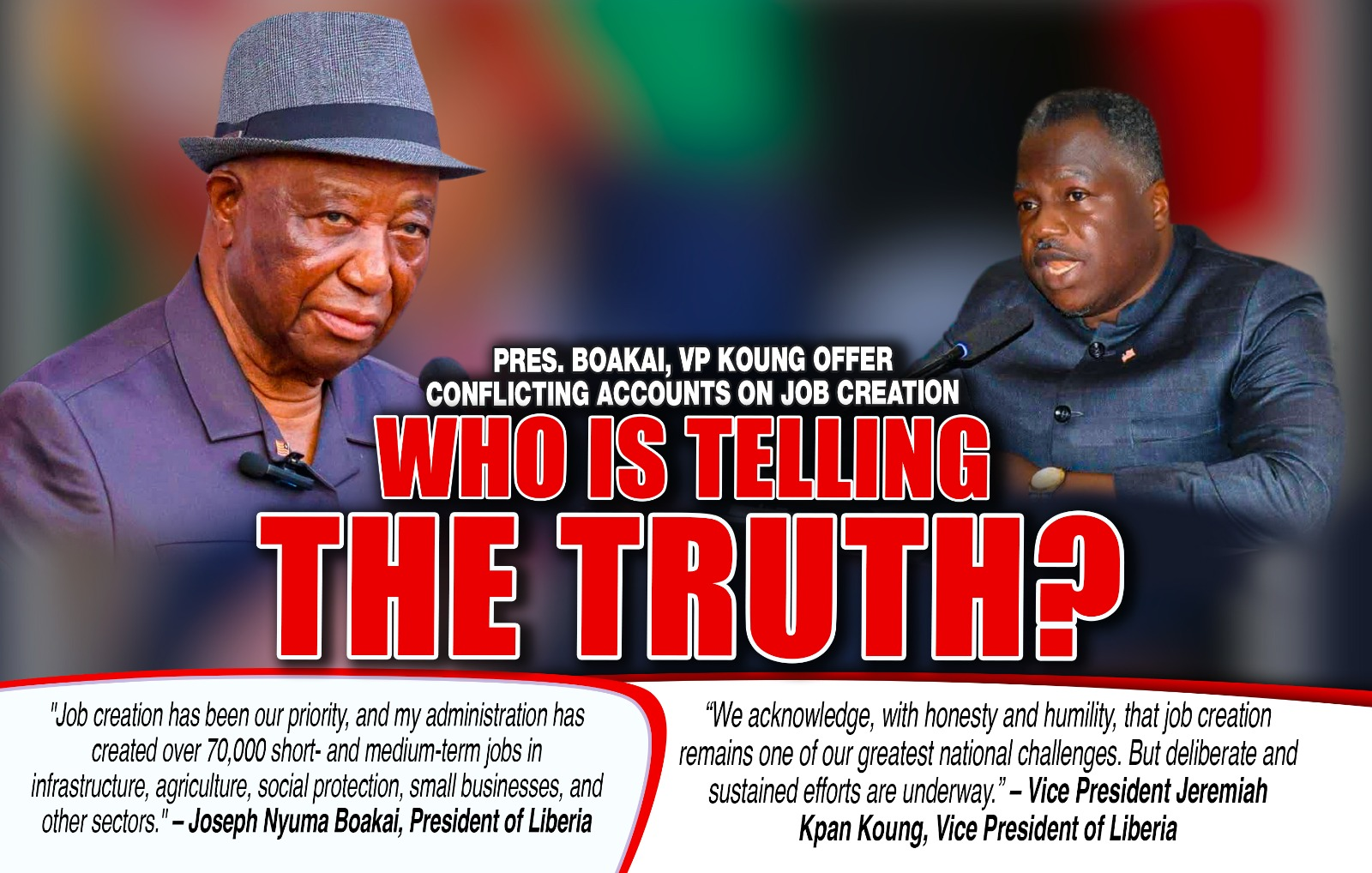
In one of the most striking declarations of his address, the President asserted, “Job creation has been our priority, and my administration has created over 70,000 short- and medium-term jobs in infrastructure, agriculture, social protection, small businesses, and other sectors.”
The President’s statement was presented as evidence that his administration is making tangible progress in addressing unemployment, a chronic challenge that has plagued Liberia for decades.
In elaborating on this claim, President Boakai emphasized that his administration’s job creation strategy has been anchored in addressing what he described as binding and structural constraints to economic growth.
According to him, targeted investments in roads, energy, and other critical infrastructure have been central to expanding employment opportunities across the country. He stated in his address, “Job creation remains a top priority for my Administration. Our job creation strategy has focused on addressing binding and structural constraints to growth, including investments in roads, energy, and other infrastructure. In this connection, we have created more than 70,000 short and medium-term jobs across Infrastructure, Agriculture, Social Protection, and small businesses, among other sectors.”
The President further linked job creation to youth empowerment and entrepreneurship, outlining ambitious plans for the coming years. He announced that the Youth Entrepreneurship and Investment Bank project, launched in 2025, is expected to support 30,000 youth-led businesses and generate over 120,000 direct and indirect jobs for young people.
“Going forward, the Youth Entrepreneurship and Investment Bank project, launched in 2025, will support 30,000 youth-led businesses, creating over 120,000 direct and indirect jobs for youth,” President Boakai said.
Additionally, the President disclosed that a National Employment Acceleration Strategy is being finalized, with a focus on agriculture, public works, skills training, and support to small enterprises.
He maintained that this strategy would facilitate more Liberians earning decent livelihoods with dignity, reinforcing his narrative that the government is not only creating jobs but also laying the foundation for sustainable employment.
However, this confident portrayal of success stands in stark contrast to remarks earlier made by Vice President Koung, who publicly acknowledged that job creation remains one of the government’s greatest challenges and that progress has been slow.
Speaking on Monday, January 12, 2026, during the opening of the Third Session of the 55th National Legislature, the Vice President struck a notably more cautious and sobering tone.
Vice President Koung admitted that the government has not been able to promptly provide adequate employment opportunities for Liberians, attributing the situation to deep-rooted structural and economic constraints.
In his words, “We acknowledge, with honesty and humility, that job creation remains one of our greatest national challenges. But deliberate and sustained efforts are underway.” This admission appears to directly contradict the President’s assertion that over 70,000 jobs have already been created, prompting questions about whether the figures cited by the President represent sustainable employment or short-term engagements that may not reflect the lived realities of most Liberians.
Vice President Koung, who also serves as President of the Liberian Senate, sought to contextualize the government’s struggle by outlining broader policy efforts aimed at long-term economic transformation. He explained that the full execution of the over US$1.2 billion national development budget for the current fiscal year is intended to create an enabling environment for both domestic and foreign investment, expand access to reliable electricity, revitalize large-scale agriculture, strengthen infrastructure, and foster conditions for a vibrant private sector.
According to him, these measures are essential precursors to large-scale job creation but are not immediate solutions. “These efforts are not overnight solutions, but they are necessary foundations for long-term prosperity,” Vice President Koung cautioned, reinforcing the notion that while the government has plans and intentions, tangible employment outcomes will take time to materialize.
His remarks suggest an acknowledgment that many Liberians are yet to feel the impact of government policies on their daily economic realities.
The divergence between the President’s celebratory tone and the Vice President’s measured realism has not gone unnoticed, particularly among opposition actors and sections of the public who argue that headline job figures lack sufficient context.
Critics contend that the President’s claim of 70,000 jobs does not adequately distinguish between permanent employment and short-term or temporary engagements, nor does it address widespread underemployment and informal work that continue to define Liberia’s labor market.
This contrast in messaging has fuelled scepticism and intensified political scrutiny, as Liberians grapple with rising living costs, limited formal employment opportunities, and persistent youth unemployment.