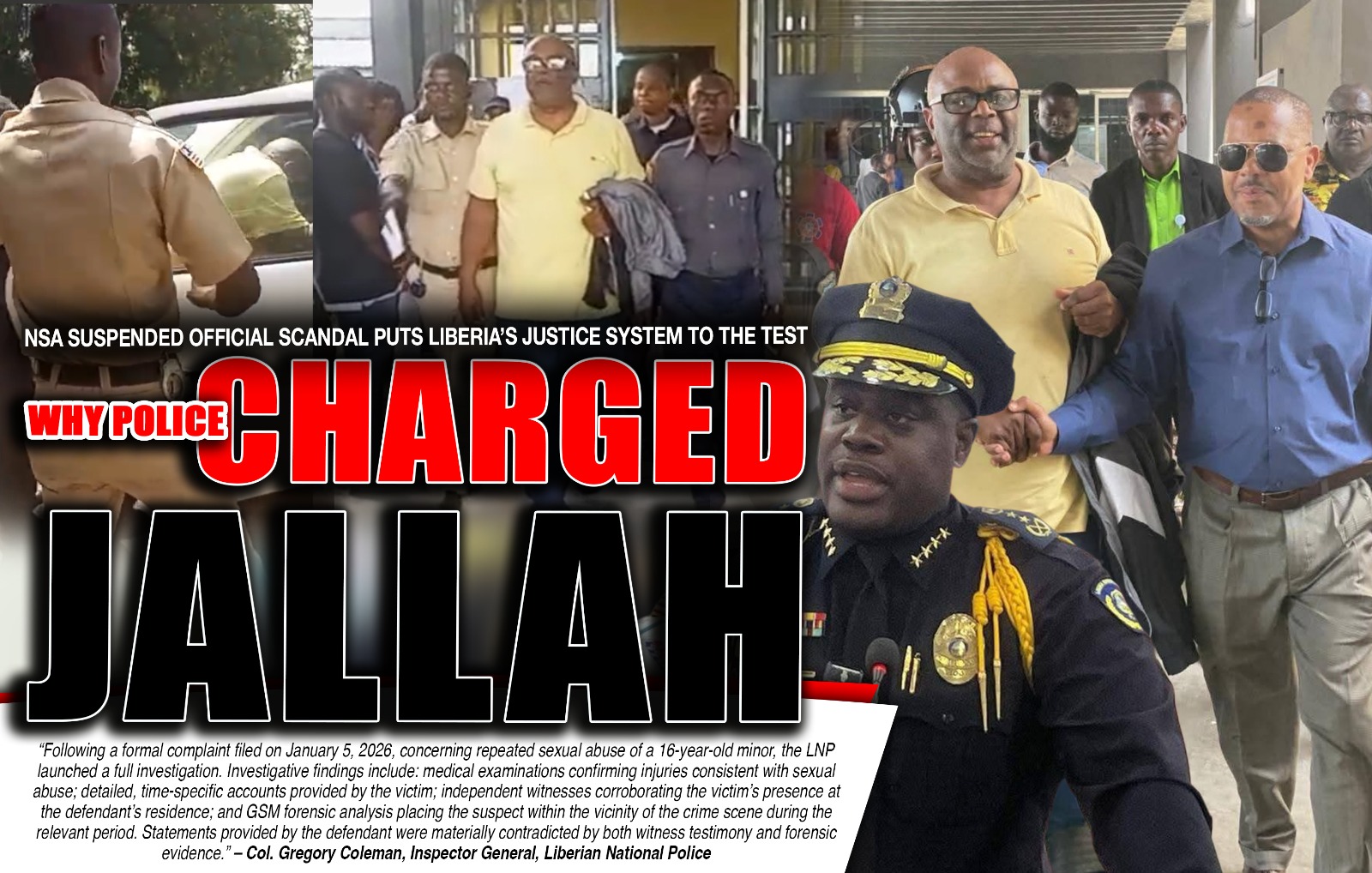
Monrovia-The imprisonment of Peter Bonn Jallah, a suspended senior aide to Liberia’s National Security Agency (NSA), Director Prince C. Johnson, at the Monrovia Central Prison marks more than the progression of a criminal case.
By Willie N. Tokpah
It represents a moment of reckoning for Liberia’s justice system, one that tests whether the law can operate without fear or favor when allegations reach into the upper ranks of national security.
Jallah, a Special Assistant to the NSA Director, Maj. Gen. Prince C. Johnson, has been formally charged with gang rape, statutory rape, and kidnapping involving a 16-year-old boy.
The Liberia National Police (LNP), following an investigation led by the Women and Children Protection Section (WACPS), forwarded the matter to the Monrovia City Court, where a judge ordered his remand pending further judicial proceedings.
In a country still grappling with legacies of impunity and institutional mistrust, the case has ignited public debate not merely about the alleged conduct of one man, but about the structural vulnerabilities that allow authority, access, and silence to intersect, often at the expense of children.
Weight of the Allegations
According to police charge sheets (RID#014-2026), the state alleges that the accused sexually abused the minor on multiple occasions between late November 2025 and early January 2026.
Prosecutors have invoked serious felony provisions of Liberia’s Penal Law, charges that, if proven, carry severe custodial penalties.
Investigators allege the victim, a community-based soccer player from Sinkor, was targeted through a pattern of grooming, small cash payments for chores, cultivated familiarity, and ultimately the promise of football boots.
Police say this inducement culminated in the child being taken to an unknown residence near Camp Johnson Road, where he was allegedly drugged and repeatedly assaulted over several days.
The victim was later discovered in a distressed and critical condition near a beach in Sinkor and transported to the John F. Kennedy Memorial Hospital, where he continues to receive treatment.
Evidence, Not Emotion
In cases of this gravity, courts are guided not by outrage but by evidence.
Police say medical examinations at JFK’s One-Stop Centre revealed injuries consistent with sexual assault.
Digital forensic analysis allegedly placed the accused within the vicinity of the crime scenes, challenging assertions that he had no contact with the victim.
Witness statements reportedly corroborate sustained interaction between the accused and the minor, while others claim they physically rescued the boy in a state of distress on the night he was found.
Police Inspector General Col. Gregory O. W. Coleman has publicly committed the LNP to pursuing all individuals connected to the alleged crimes, including two suspects who remain at large, an assurance that will be measured not by words, but by arrests and prosecutions.
Power, Proximity, and the State
What renders this case uniquely consequential is not only the nature of the allegations, but the institutional proximity of the accused to the nation’s security leadership.
For critics, the question is unavoidable. How many warning signs are missed when authority figures operate within communities marked by poverty, admiration, and limited oversight?
The NSA’s decision to suspend Jallah pending trial reflects procedural prudence, yet suspension alone does not answer the broader concern of whether internal accountability mechanisms are robust enough to detect, deter, or disrupt abuse before it escalates into criminal prosecution.
Due Process Under the Spotlight
Jallah’s legal team has challenged aspects of his detention, filing a writ of habeas corpus over alleged violations of statutory holding periods. Such challenges are not technical distractions; they are essential components of constitutional democracy.
The legitimacy of any eventual verdict, guilty or not, depends on scrupulous adherence to due process.
At the same time, Liberia’s courts must ensure that procedural rigour does not become a shield for delay, disappearance of evidence, or intimidation of witnesses, failures that have historically eroded public confidence in high-profile prosecutions.
A Test Larger Than One Defendant
Legally, Peter Bonn Jallah stands presumed innocent until proven guilty. That presumption is non-negotiable.
Yet institutionally, the state is already on trial in the court of public conscience.
This case will test whether Liberia can protect minors when alleged perpetrators wield influence and prosecute serious crimes without political interference.
Pursue co-suspects with equal resolve, and deliver justice that is not only done, but credibly seen to be done.
The Stakes
If mishandled, the case risks reinforcing cynicism that power still bends the law.
If prosecuted with independence, transparency, and professionalism, it could signal a decisive shift toward accountability, especially within the security sector.
For now, one man sits behind bars awaiting his day in court. But the ultimate judgment will fall not only on the accused, but on Liberia’s institutions themselves, and on whether the rule of law can withstand its most difficult test, confronting allegations against those closest to power.