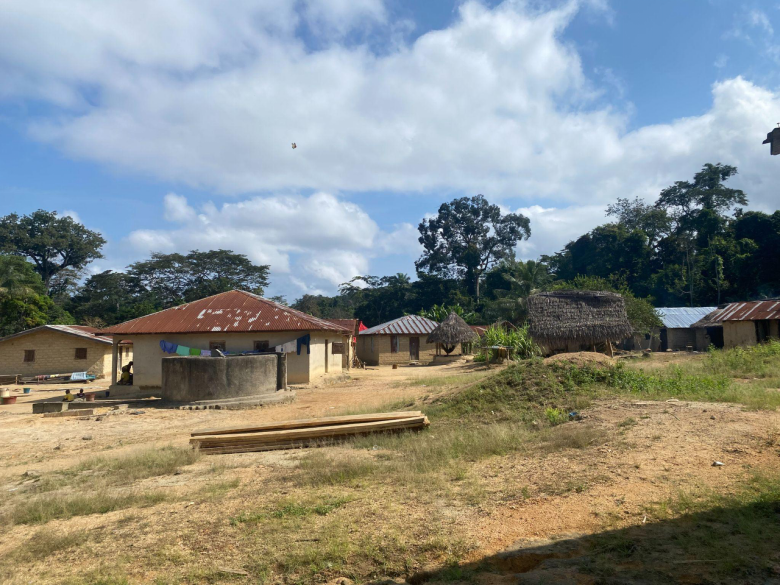
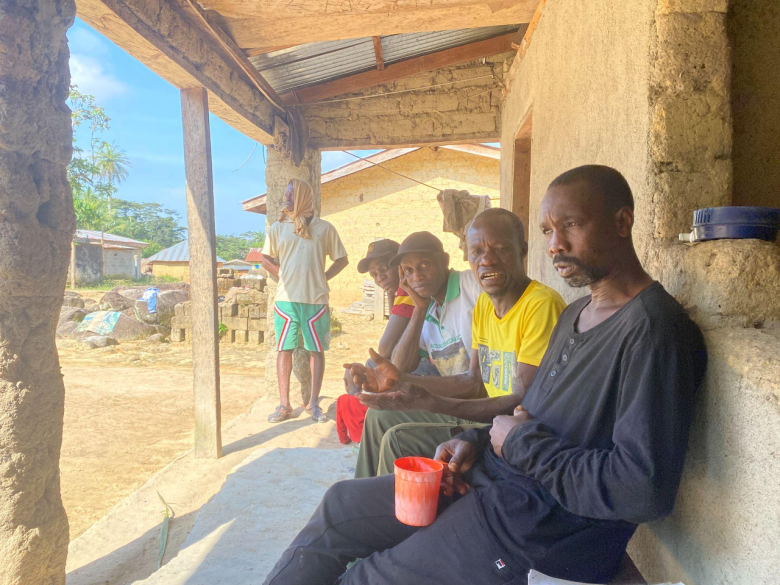
Townsmen dressed in brown trousers and a black T-shirt stand as the sunlight litters the communal town of Vetesu in Lofa County, northwest Liberia.
By: Tina S. Mehnpaine, contributing writer
As former hunters, they now serve as forest guards for a REDD+ project protecting the Wonegizi forest from logging, farming, and poaching. Partnering with the NGOs Fauna & Flora International (FFI), the Skills and Agriculture Development Services (SADS), and the Forestry Development Authority (FDA), Vetesu and neighboring communities are conserving their forest. An MoU among the parties promised to improve local livelihoods through community engagement and various surveys on wildlife, carbon, and trees.
However, residents here say they have yet to receive any tangible benefits, such as cash incentives or development projects like schools, roads, and improved sanitation.
“No benefit,” said Wilson G. Forkpa, one of the elders, referring to cash and developmental benefits such as schools, hand pumps, and roads. “They just asked us to keep the forest; we are not getting anything.”
Vetesu, a hard-to-reach area deep in Lofa County, with fewer than 700 inhabitants, no clinic, no police station, no electricity, no mobile network, and only three classrooms serving as a school, with a single farmer-teacher.
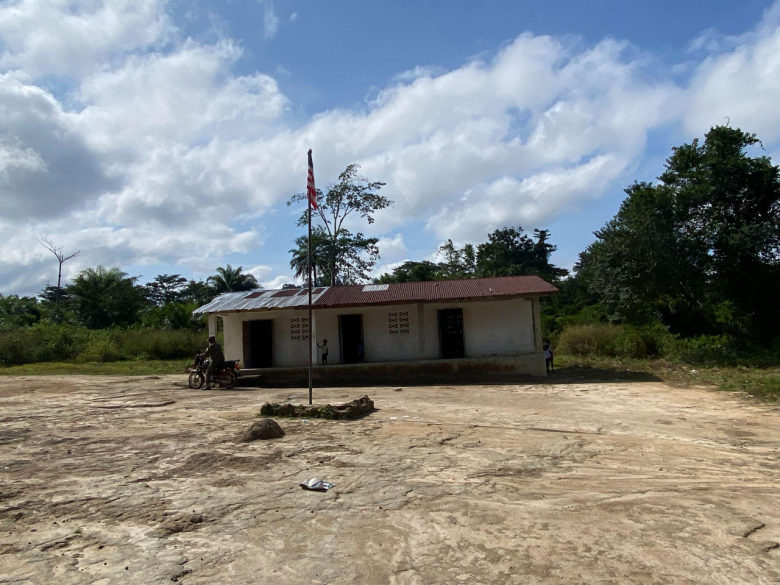
“Really I catching hard time with this job,” Augustine W. Forkpa, the teacher, expressed his frustration. “My one can’t control the three classes.”
Forkpa stated that he has informed the District Education Officer (DEO) in Lofa County of the dire situation, requesting either another teacher or the closure of the school. However, he was asked to continue teaching; to date, no additional staff have arrived.
Inside the classroom, the conditions are stark. Some students sit on the dusty floor, while others lean against cracked, weather-beaten cement walls. A few manage to find space on the desks. Despite the environment, the students—mostly girls dressed in blue skirts,and white shirts—fix their eyes on the blackboard with hope as Forkpa lectures. He spends an hour with each class, including the combined classroom where 3rd and 4th-graders share a single space.
As a farmer, Forkpa relies on his rice and pepper harvests to support his family, yet he carries the weight of the school on his shoulders. He knows that closing the school would deny these children an education, leaving them vulnerable to early pregnancy or enrollment in the Sande bush. The only other alternative is for parents to move their children away to towns with established high schools—an option many cannot afford.
Living in a community deprived of a school, and basic social services uncertainty hangs over these young ones’ future. Forkpa and others here say they viewed the promise of “improved livelihoods” as a desperate lifeline that can help provide quality education to their children and grandchildren.
“When you tell somebody move from the forest don’t go there, you must be able to give them something good,” said Mulbah Pewee, a youth.
Beyond the farmer field schools, VSLAs were established in some communities with seed funding while others did not. Additionally, forest guards are compensated at a rate of $75 for a 15-day patrol or $50 for a 10-day patrol.
Vetesu is among the towns that reported receiving no startup capital for its VSLA. The program was active for a few months, but has since collapsed. When asked why the initiative failed, Forkpa said, “It just died down.”
In an email, Isaac Kannah, Senior Technical Specialist for REDD+ and Climate Policy at FFI, said work and funding have focused on preparing the REDD+ pilot. Initial steps included working with the Liberia Land Authority (LLA) as part of the country’s Customary Land Formalization process in order for communities to become legitimate owners.
Partnering with the Community Rights Support Facility (CRCF) to assist with sixteen communities in establishing their land ownership supported by donor funding. “These 16 communities have now received the deeds for their land. In 2025, we raised further funding to support an additional 6 communities to finish their process of community land formalization,” he said.
The VSLAs’ support in some communities, payment to the forest’s guards for patrols in the forest, and seed support have been a focus of the project, says Kannah.
According to him, 34 VSLA groups have been established in 31 communities between Wonegizi and Wologizi proposed protected areas. Up to $500 USD is provided to each VSLA group as seed funding, alongside technical support to ensure success.
Sianneh Mulbah, a VSLA member in Dorzenilor town, hailed the impact of the VSLA in her town. She says they received US$300 as seed funding from FFI. Mulbah pays 1,500 Liberian dollars for five shares every Sunday. Like Vetesu, Dorzenilor is also challenged with the lack of schools, roads, and hospitals. Residents here must go to Konia, a nearby town to get medication when they are sick. Mulbah hopes the project can consider building them a school and the road can be rehabilitated as part of the project.
REDD+ stands for Reducing Emissions from Deforestation and Forest Degradation. The “+” signifies a broader commitment to climate protection through the conservation of forest carbon stocks, sustainable forest management, and the enhancement of forest carbon stocks. Under this international framework, developing nations are eligible for results-based payments. These financial incentives are only granted once a country provides verifiable proof—typically through rigorous measurement and reporting—that they have successfully reduced deforestation and lowered carbon emissions.
While local resentment grows over the lack of tangible development, the project was officially registered on the Verra Registry—the global standard for carbon certification and approval. The initiative aims to protect 27,614 hectares of forest.
“We are aware of the further development priorities of the communities, and these will be a top consideration when carbon revenue starts to flow,” Kannah said.
Explaining the project timeline, Kannah said the project design has to first be validated by an auditor to check it meets the criteria set out in the Verra Standards, work is then implemented, verification is done later, and credits are then issued for sale and transfer to buyers or for national accounting purposes. “We expect Validation and Verification to be done at the same time in 2027 with credits issued afterwards,” he said.
Carbon credit revenue-sharing is not yet discussed with communities.
While the project awaits verification and approval, there hasn’t been agreement on financial benefit sharing. Though communities have been informed about the project plans to sell carbon credits.
“We are happy about this carbon business,” said Mulbah Kesselly from Burlor town, one of the project areas. Mulbah disclosed that they have been informed about the carbon project, and look forward to benefiting from any money it gets.
Kannah said it has not yet been agree at either the project level or at the national policy level on what communities get from the carbon credit sales. However, it is something that they plan to discuss with partners in 2026.
Forest Guards are unhappy over the low stipend
At the initial of the project, only a few communities were enrolled, but it has now grown to 17 communities. Of which 39 forest guards known as “community auxiliaries” were trained and recruited to collect animal sounds, footprints using GPS, protective tree species, observe hunting paths to determine if hunters are intruding in the forest, and illegal activities. During patrols, they spend 15 or 10 days without coming out in the forest sleeping under tents to collect their data, and make reports upon coming out.
Bill Charleston, one of the guards recruited to conduct monthly patrols into the forest, expressed dissatisfaction with the poor coordination and the stipend they received for their work.
“Imagine people working for you, and that risk they can be taking when they come, they give reports, sometimes they receive US$75 for 15. When the people enter the forest, they can’t come out for 15 days.”
Emmanuel Kapdeh, who joined the list of forest guards in 2018, said that despite the training they receive, there wasn’t a formal contract given to them on job tenure. “We talked and talked until we were tired, but they never signed a contract with us,” he explains. Instead of a steady monthly salary, the forest guards receive sporadic stipends—$75 for a 15-day patrol or $50 for a 10-day patrol. Work has become increasingly inconsistent; while patrols were once constant, Kapdeh says he worked only four months in 2024 and only three months so far in 2025. Without a contract, there is no financial security, only the “ransom” of a small stipend when a patrol is finally called.
The lack of support extends beyond the guards to the entire community. The authorities asked the town to provide their own people for training so they could act as “evidence” of conservation efforts, yet the promises made in return—clinics, better schools, and livestock like cattle and pigs—have not materialized. “You are stopping people from going into the forest, but that forest is what they depend on to sell small things and send their children to school,” Kapdeh says. “If you stop them, how do you want them to live?” Even the startup cash provided is insufficient; the $500 allocated for a 35-person VSLA group is too small to create real change, and a cocoa seedling provided to them failed, with every plant dying.
Ultimately, the gap between FFI and SADS and the community is widening due to broken trust. While the guards continue their difficult work—tracking animal footprints, monitoring hunting paths, logging, and GPS data on illegal activities—they do so with dwindling morale. ,” Kapdeh notes that many villagers have stopped showing up for meetings because they are tired of “empty promises. “Saying it is one thing to say you will do this, but doing it is another.”
Morris F. Samah: “We want our salary to go up most often when we go for a workshop, we tell them, but nothing has happened.”
Liberia moves to trade carbon credits.
The Wonegizi REDD+ pilot project is a cornerstone of Liberia’s debut in the global carbon market. This initiative follows the unveiling of the national Carbon Market Policy and the subsequent creation of the Carbon Market Authority (CMA).
Rudolph Merab, Managing Director of the FDA, explained that the pilot serves as a critical test case for the country. By evaluating the revenue generated from Wonegizi, the government aims to determine the true economic value of Liberia’s forest carbon. “We will now discover whether the carbon trade is worth our while,” Merab noted.
While residents in Lofa express frustration over the lack of financial incentives, a different model is finding success in Sinoe County, Southeast Liberia. Through a Payment for Stewardship program, local communities are receiving direct cash payments for forest conservation. Begun in 2025, the project distributed US$21,392 to communities in exchange for protecting 7,131 hectares of forest. This payout is calculated at a rate of $1.50 per hectare. These funds are already being put to practical use, with the community allocating the money to finance the construction of a local bridge.
As Liberia’s third-highest peak and a key part of a vast cross-border forest complex with Guinea, Wonegizi is a Proposed Protected Area (PPA), a global conservation priority. The area protects essential habitats for chimpanzees and elephants. However, these species remain at risk as the forest continues to be degraded by human activities such as mining and deforestation. Funded by a multi-donor system, including the Norwegian Agency for Development Cooperation (NORAD), USAID through the West Africa Biodiversity and Low Emissions Development (WABiLED) Program, France, and the European Union.
A major new initiative, WISE (Wonegizi-Wologizi Initiative for Sustainable Ecosystems), launched in late 2025 by Liberia and France, aims to transition it from PPA to a fully protected area, balancing conservation with sustainable community development and land rights.
While FFI said that no benefit-sharing percentage has been discussed. Varlee Jabateh, town chief of Madina, a Muslim-dominated town blessed with a school and solarized homes, said the community was promised a significant share of the carbon credit revenue—at least 60%—to be used for large-scale development projects like roads, clinics, town halls, and guesthouses.
He recalled how the project stalled due to a dispute over land ownership between the community and the government. “The community says the land is theirs; the government says the land is theirs,” Jabateh explains. A breakthrough occurred last year when Madina and six towns in the area finally received their official land deed, settling the boundary lines and officially recognizing them as landowners.
Like other residents from the towns discussed, Jabateh said to date, the community has yet to receive a single tangible benefit apart from three months training they received n sustainable farming—teaching villagers to farm in a single location for 15 years rather than practicing shifting cultivation which lasts three months According to him, after the training they have requested fish ponds, snail farming, and poultry, but haven’t received them yet.
This refusal to grant their request is causing anger among them. As Town Chief, Jabateh has the authority to arrest those who hunt or farm in protected areas, but he finds it nearly impossible to stop a hungry person when the promised alternatives haven’t appeared. “How can you tell someone not to go there when what you are supposed to give him, he doesn’t have it?” he asks.
Currently, he says, the community’s message to the FFI is clear: they want long-term investment, not short-term projects. The VSLA also collapsed after the initial startup funds were withdrawn and oversight ceased. To truly protect the forest, the community is demanding help with high-value crops like cocoa, coffee seeds and better roads. “If we get the benefit, then you can tell us to leave the forest.”
Ten towns out of the 17 were visited for this story. They include Bulor, Barziwen, Medina, Nekebuzu, Dorzenilor, Bomi Hills, Ziggida, Konia, Vetesu, and Tusu. They are optimistic that the carbon credit deal will complement their decade of not receiving any tangible benefits.