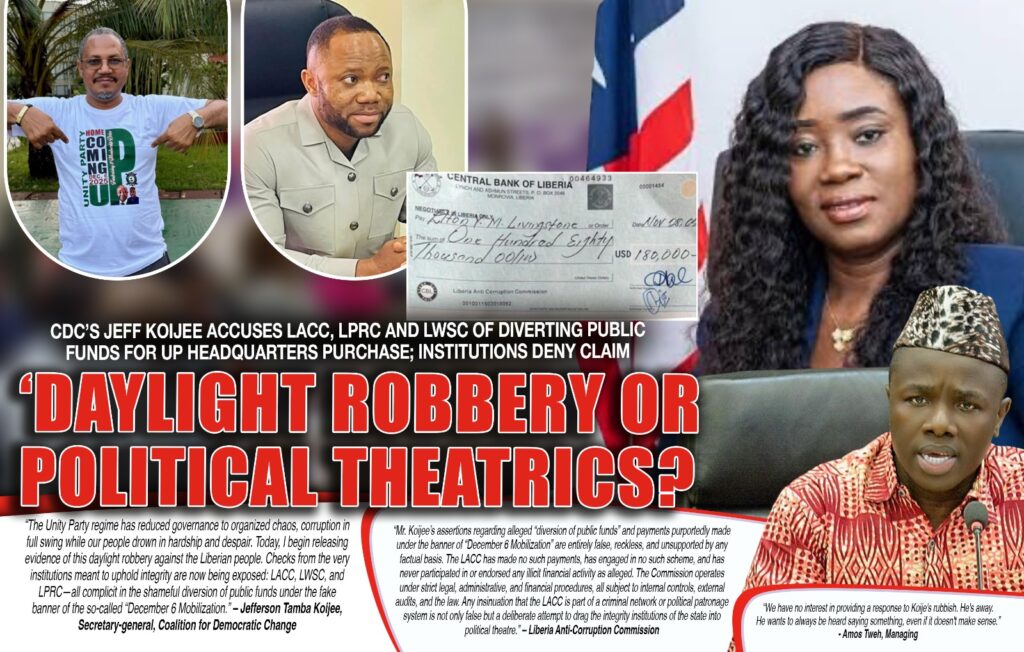
MONROVIA – Jefferson Tamba Koijee, Secretary General of the Coalition for Democratic Change, Thursday issued sweeping accusations against three public institutions, alleging that they participated in a coordinated scheme to divert state funds for political purposes.
By Selma Lomax [email protected]
Koijee claimed that the Liberia Anti-Corruption Commission, the Liberia Petroleum Refining Company and the Liberia Water and Sewer Corporation channeled money through what he described as the December 6 Mobilization, an initiative he insists was used as a cover to raise funds for the purchase of the ruling Unity Party’s new national headquarters.
Koijee, who served in senior government position during the previous administration, has recently stepped up his attacks on the Boakai–Koung government. In his latest communication, he said the country is witnessing what he called organized chaos, alleging that corruption has become entrenched while suffering for ordinary Liberians deepens.
He accused the Unity Party of turning the state into a playground for theft and asserted that evidence of what he labeled daylight robbery is beginning to surface. According to him, checks originating from institutions responsible for accountability and public service delivery expose a network that he says includes the LACC, LWSC and the LPRC.
Koijee insisted that more than 1.3 million dollars was unlawfully disbursed to individuals connected to the ruling establishment. He argued that these actions occurred while civil servants go months without salaries and essential social services continue to deteriorate.
“The Unity Party regime has reduced governance to organized chaos, corruption in full swing while our people drown in hardship and despair. Today, I begin releasing evidence of this daylight robbery against the Liberian people. Checks from the very institutions meant to uphold integrity are now being exposed: LACC, LWSC, and LPRC—all complicit in the shameful diversion of public funds under the fake banner of the so-called “December 6 Mobilization,” said Koijee.
He painted a grim picture of life under the current administration, saying mothers give birth on the streets, young people struggle without jobs, and the police allegedly brutalize citizens with impunity. In his view, the country is now bordering on institutional collapse. Koijee vowed to release what he calls documentary evidence of illegal payments on a rolling basis, noting that he will present each check to the public so that Liberians and international observers may judge the allegations for themselves. He insisted that the truth will not be buried and maintained that the CDC is determined to expose what he described as the rot at the center of the current government.
In a swift rebuttal, the Liberia Anti-Corruption Commission dismissed Koijee’s allegations as baseless, inflammatory and politically driven. The Commission said it was deeply troubling that a former public official would, in its words, intentionally mislead the Liberian people with claims lacking any factual foundation.
The LACC said: “Mr. Koijee’s assertions regarding alleged “diversion of public funds” and payments purportedly made under the banner of “December 6 Mobilization” are entirely false, reckless, and unsupported by any factual basis. The LACC has made no such payments, has engaged in no such scheme, and has never participated in or endorsed any illicit financial activity as alleged. The Commission operates under strict legal, administrative, and financial procedures, all subject to internal controls, external audits, and the law. Any insinuation that the LACC is part of a criminal network or political patronage system is not only false but a deliberate attempt to drag the integrity institutions of the state into political theatre.”
The LACC categorically rejected the accusation that it played any role in a December 6 Mobilization or authorized any payments associated with it. The Commission noted that its administrative and financial operations are guided by legal frameworks, internal controls and external oversight, making it impossible for any such illicit transaction to occur unnoticed.
The LACC argued that any attempt to portray the institution as part of a criminal or patronage network was an effort to drag an integrity body into partisan conflict. It emphasized that it remains committed to investigating corruption without fear or favour and urged the public and international stakeholders to rely on verified information rather than unsubstantiated political claims. The Commission added that anyone with authentic evidence of wrongdoing should follow the appropriate legal channels to support the cause of accountability and justice.
At the Liberia Petroleum Refining Company, Managing Director Amos Tweh brushed aside the accusations with a brief but blunt reaction, saying the entity had no intention of dignifying Koijee’s claims.
Tweh remarked that he had no interest in responding to what he called rubbish and suggested that Koijee was only seeking public attention. His short dismissal underscored LPRC’s rejection of allegations that it was party to any financial irregularity. As of press time, the Liberia Water and Sewer Corporation had not issued an official response, though it remains one of the institutions accused by the CDC secretary general.
Public Reaction and Calls for Inquiry
Koijee’s allegations have sparked widespread debate, splitting public opinion. Some Liberians have called on him to present concrete evidence, while others are urging the government to commission an independent investigation to quell suspicions and protect public trust.
Transparency advocates warn that if unresolved, the claims could further erode confidence in state institutions and widen partisan divisions.
Background to the Controversy
Even before Koijee’s claims, the Unity Party had been under public scrutiny following reports that it was purchasing the same headquarters it previously vacated due to unpaid rent while in opposition. Last week, partisans carried out a massive cleanup ahead of a major fundraising event.
The party, however, has strongly denied claims that government funds were being used for its headquarters project, labeling such reports as “baseless propaganda.”
Speaking at a recent rally, Unity Party Secretary-General Amos Tweh—who also heads the LPRC—dismissed the allegations:
“The Unity Party taking 6.7 million dollars to construct our party headquarters is simply false. We are not using public funds,” he said.
“We are galvanizing resources from our pockets for the foundation of the Unity Party’s next generation.”
Tweh said the goal of the fundraising drive is to establish a permanent home for the party—an effort he said was overlooked during previous administrations but is now a priority as part of building a durable political institution.
Senator Daba Varpilah, Chair of the Unity Party Fundraising Steering Committee, also clarified that no formal purchase or payment for the headquarters has yet been made.
The ongoing campaign, which the party describes as a “homecoming and nationwide mobilization effort,” seeks to raise funds for both its national and regional headquarters.
What Comes Next?
Koijee says he will reveal more information in the coming days, calling on the international partners and anti-graft bodies and insisting the matter requires global scrutiny.
With allegations flying and denials mounting, Liberians now await whether Koijee will provide authentic documentary evidence—or whether the episode will be remembered as another round of heated political theatrics in an already polarized environment.