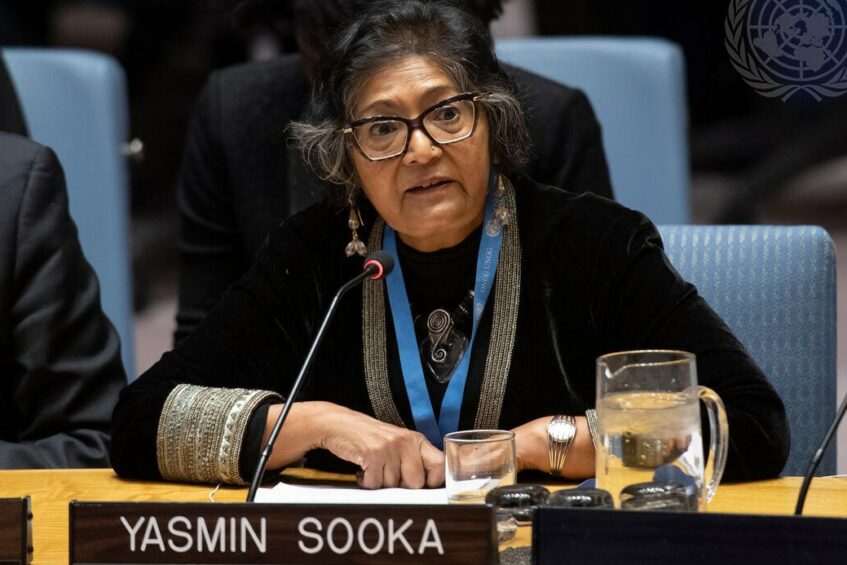
Yasmin Sooka, Chair of the Commission on Human Rights in South Sudan, /Courtesy
The UN Commission on Human Rights in South Sudan has raised alarm over a rapidly deteriorating political and security situation in the country, condemning renewed fighting in Jonglei State and warning that civilians face grave risks of death, displacement and deprivation.
In a statement released on Saturday, the Commission said the escalation of violence marks a serious erosion of the Revitalized Agreement on the Resolution of the Conflict in South Sudan (R-ARCSS) and called for the immediate de-escalation of hostilities, particularly in civilian-populated areas.
The Commission urged all parties to halt airstrikes, ground offensives and other military operations affecting civilians and to return without delay to the pathways and obligations outlined in the peace agreement.
“As a new year dawned, the deliberate sabotage and resulting erosion of the Revitalized Agreement is directly driving renewed conflict, with catastrophic consequences for civilian lives and the stability of the country and the wider region,” the Commission said, citing indiscriminate aerial bombardments, ground fighting and obstruction of humanitarian access.
According to humanitarian partners, more than 100,000 people—mostly women, children, older persons and persons with disabilities—have been forcibly displaced across Jonglei State since late December 2025. Many have fled without shelter, food or access to medical care.
“The protection of civilians is not optional — it is a binding legal obligation of the government,” said Yasmin Sooka, Chair of the Commission.
“The renewed airstrikes in civilian areas, combined with restrictions on humanitarian access imposed by parties to the conflict, including the SSPDF and SPLM/A-IO, are again placing lives at immediate risk.”
She added that the actions of the parties are unlawful and must cease immediately, stressing that humanitarian actors must be granted safe and unimpeded access to affected populations.
The Commission reported repeated airstrikes in Uror, Ayod and Nyirol counties, which it said have killed and injured civilians, destroyed homes, markets and medical facilities, and forced health centres to suspend operations or evacuate staff.
Commissioner Barney Afako warned that the violence in Jonglei could trigger wider instability across the country.
“What we are witnessing in Jonglei is not an isolated security incident; it is a dangerous escalation which is manifesting in other parts of the country as well,” Afako said. “As usual, South Sudanese civilians are paying the heaviest price for the political miscalculations of their leaders.”
He cautioned that continued violations of the peace agreement, combined with weak regional and international pressure, could plunge the country into another cycle of widespread violence.
The Commission emphasized that all parties to the conflict—state forces, organized armed groups and allied militias—are bound by international humanitarian and human rights law, including the principles of distinction, proportionality and precaution.
“Denying access to medical care, forcing the evacuation of health facilities, or carrying out airstrikes in civilian areas raises serious concerns under international law,” said Commissioner Carlos Castresana Fernández. “If such acts are committed deliberately or recklessly, they may amount to war crimes.”
The Commission reiterated that the Government of South Sudan bears the primary responsibility to protect civilians, control its forces, prevent violations by allied militias and ensure safe, rapid and unimpeded humanitarian access. Non-state armed groups, it said, are equally bound by international law.
Among its key demands, the Commission called for an immediate political de-escalation, a halt to all military operations in civilian areas, unconditional humanitarian access, accountability for serious violations, and renewed regional and international engagement to safeguard the peace process.
“South Sudan’s people cannot continue to pay the price yet again for political and military failure,” Sooka said. “The fighting must stop now; civilians must be protected.”
South Sudan reiterates plans to screen foreigners