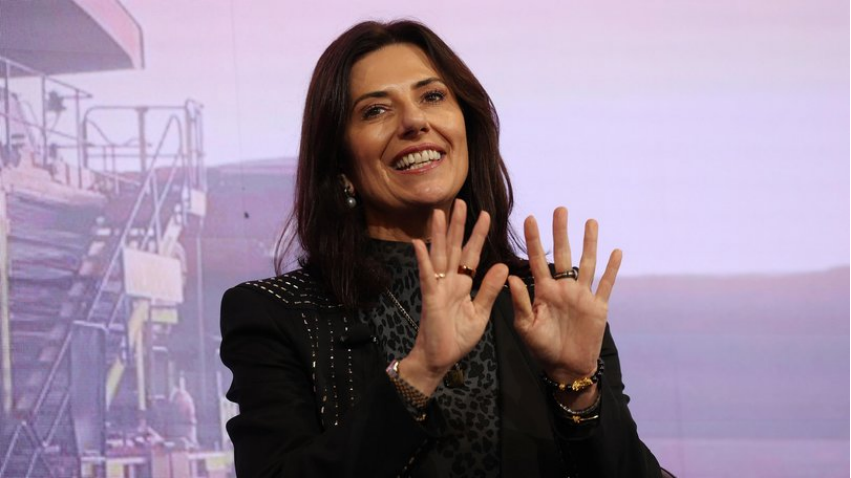
Monrovia — Bronwyn Barnes, President and Chief Executive Officer of Ivanhoe Atlantic—formerly High Power Exploration (HPX)—has tendered her resignation after four years at the helm, amid mounting uncertainty surrounding the company’s iron ore ambitions in Liberia and Guinea, FrontPage Africa has learned.
According to the African Intelligence, Barnes is listed as a speaker at the upcoming Mining Indaba conference in Cape Town, scheduled for February 9–12, but is expected to attend without the Ivanhoe Atlantic banner. Sources say the Australian executive recently submitted her resignation to the company’s board. Ivanhoe Atlantic is majority-owned by U.S.-Canadian billionaire Robert Friedland.
Since her appointment in 2022, Barnes spearheaded efforts to secure access to Liberia’s strategic rail corridor linking the Yekepa iron ore mines near the Guinean border to the Atlantic port of Buchanan. The railway has long been used exclusively by steel giant ArcelorMittal, which operates the Yekepa deposits.
Ivanhoe Atlantic has lobbied successive Liberian administrations—from former President George Weah to President Joseph Nyuma Boakai—to gain access to the rail infrastructure, a critical component of Friedland’s plan to export iron ore from the Kon Kweni deposit on Mount Nimba in Guinea, just a few dozen kilometers from Yekepa.
Rail Deal Brings Mixed Results
Barnes and her team believed they achieved a major breakthrough late last year when the Liberian Legislature ratified an agreement transforming the ArcelorMittal-operated railway into a multi-user corridor, ultimately to be managed by an independent operator. The deal, reached following lobbying by U.S. diplomats, was hailed as a step toward opening Liberia’s infrastructure to other mining firms.
However, the victory may prove limited. ArcelorMittal—Liberia’s largest employer—received authorization this month to significantly increase iron ore production at Yekepa, a move that could strain future rail capacity and restrict access for other users, including Ivanhoe Atlantic.
Guinea Hurdles Deepen Uncertainty
Beyond Liberia, Ivanhoe Atlantic must still secure approval from Guinea’s military-led government to commence operations at the Nimba deposit. Progress there has been slow, complicated by environmental and social concerns tied to the project’s proximity to the Mount Nimba Strict Nature Reserve, a UNESCO World Heritage Site listed as “in danger” since 1992.
Relations with Guinea’s junta leader, President Mamadi Doumbouya, have also been strained. Friedland has sought assistance from Ivanhoe Atlantic Chairman J. Peter Pham, a former U.S. Special Envoy for the Great Lakes and the Sahel, to help navigate the political impasse.
Compounding the challenge is Guinea’s preference to export iron ore through its own territory, via a new 670-kilometer railway linking the Simandou deposit to the port of Morebaya. Friedland reportedly fears the route—currently ramping up capacity—will become congested, undermining its viability for Ivanhoe Atlantic’s exports.
Exit Amid Mounting Pressures
Sources say the growing difficulties in Guinea, combined with uncertainty over rail access in Liberia, may have contributed to Barnes’ departure. In recent weeks, she had reportedly become less involved in day-to-day project management.
Friedland continues to search for a diplomatic breakthrough. After being repeatedly rebuffed by Doumbouya—who had reportedly instructed officials not to receive him—the billionaire traveled to Conakry on January 17 to attend Doumbouya’s presidential inauguration following elections late last year. Barnes was notably absent from the delegation.
Neither Barnes, Pham, nor Ivanhoe Atlantic’s communications department confirmed her departure.
U.S. Angle Emerges
In Washington, Friedland’s activities are being closely watched. Some members of the U.S. Congress have expressed concern over his ties to Chinese investors, though he is still believed to enjoy support from the U.S. State Department. Officials are reportedly working on a framework aimed at persuading Guinea’s leadership to reconsider its position—potentially involving political and security assurances from Washington.
The groundwork for such a deal could be laid at a U.S.-organized mining conference expected in early February, to which Guinea has been invited.