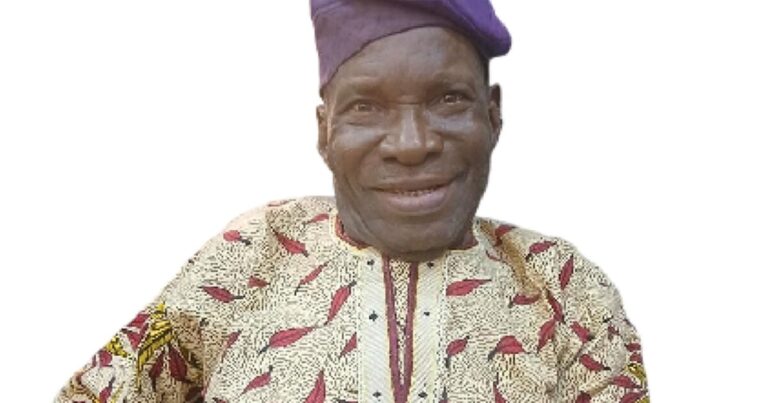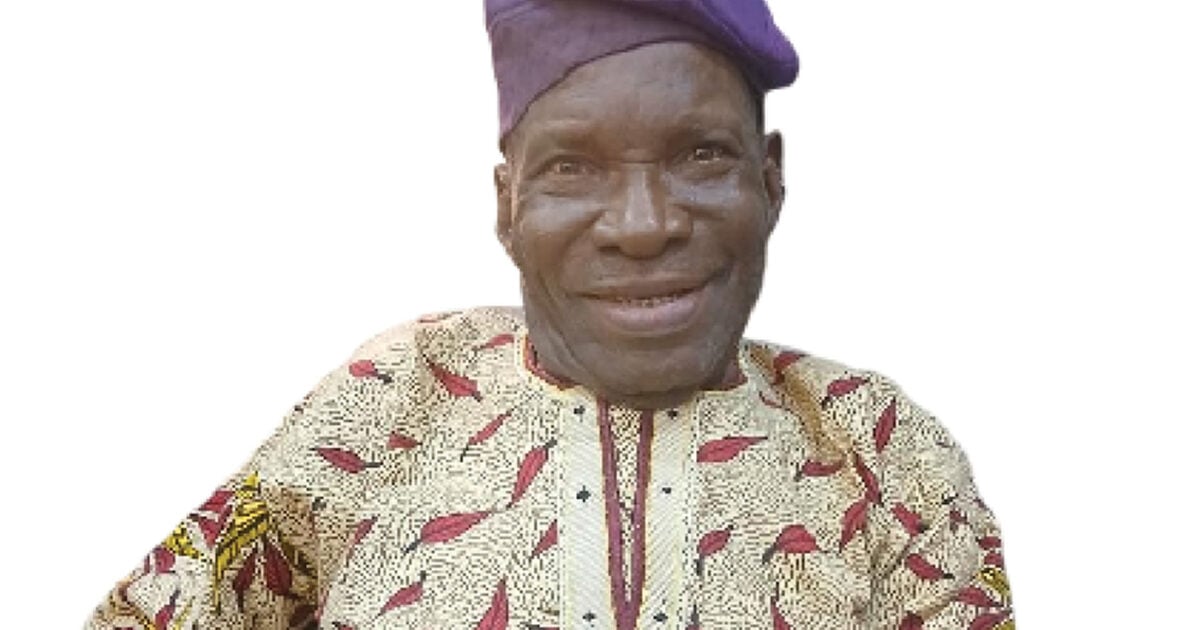
Ninety-year-old Dr Samuel Morakinyo, an educationist and former commissioner for local government Oyo State during Gen Muhammadu Buhari’s military regime, shares with DANIEL AYANTOYE his life experience
How would you describe your journey in the last 90 years?
It has been full of events, both happy and sad. I would say that most of the experiences have been happy ones, and I want to thank God for that. I also want to thank people whose paths I have crossed in life, people who have assisted me—my parents, siblings, family members, community leaders and others.
When you grow up as a little child, people correct and educate you, and that has been of tremendous help throughout my life.
What particular events are unforgettable in your life?
Part of these is that when you lose loved ones, you cannot say those are happy days. I lost loved ones, including my wife and a daughter, in the past. These were very bad days, but I remember them in a reflective mood.
What is the good part?
The good part is that God helped me to achieve my goal in education. I completed my primary and secondary education with flying grades and my university education as well.
After my first degree, I had the ambition to get to the pinnacle of my academic career, which is the Doctor of Philosophy, and God helped me to achieve the PhD. It is also worthy of note that in the area of community development, I saw my town, Igbo-Ora, develop in many ways.
What was your childhood experience like?
Part of my childhood was spent on Lagos Island at Isale Eko. In those days, Lagos was very interesting. We would walk through many areas, from different parts of Isale Eko to Campus Square and Obalende. Many people do not know how the name Obalende came about.
In 1909, before the government acquired land for King’s College, the people there were farmers, but they had to move to other areas. That was why they called the place Oba lo le mi de (The king chased me to this place).
In those days, there was nothing like armed robbery. You could move at any time of the day or night, even trekking from Yaba, and nobody would harass you. Even when I returned to my hometown, life was also very simple.
Governance at that time was mainly in the hands of the chiefs through what was known as the Native Authority and the Native Court. So, things were normal, criminality was very low, and education was not widely available and was not cheap either, because even paying two shillings was very difficult.
Could you share more about your academic experience at that time?
I attended Methodist Primary School at Igbo-Ora, and at that time, education was not very accessible because in a large area, you could have only one primary school within a span of about 30, 50 or 60 kilometres.
There were other schools scattered around, but they probably ended at about Standard 2 or 3, and then they had a central school. So, when you finished Standard 2, if your parents could afford it and if you were also ambitious and willing to read, you had to leave that community and travel to where you could get education up to Standard 6.
This affected many people, and there were dropouts because many parents could not afford to send their children away from the community. So, only a few would get to the central school and complete their primary education.
How did you progress in your career?
I left the university in 1966 and went into teaching as a graduate teacher of chemistry and science subjects at Igbo-Ora High School, my hometown, as the head of the science department. I was there for about nine years, rising to become the vice-principal before I was transferred to Ijebu-Igbo.
After that, I became a principal at Ijaye High School, Akinyele Local Government Area of Oyo State. It was from there that I was appointed a commissioner in Oyo State under the military regime.
How did the appointment come about?
I served under the military governor, Lieutenant Colonel Oladayo Popoola. He appointed me as the commissioner for Local Government and Chieftain Affairs. That came as a surprise.
When the governor sent for me from the school, I initially refused to go with the person who came to call me, but eventually I went. The governor told me he stumbled on my name and that I was being considered for the post of commissioner.
When I opened my mouth in surprise, he said I should not bother, that the security personnel had screened me before I was invited, and that I should get ready for swearing-in the following day. Later, he changed the date because of another appointment he had.
How was the experience under the military as a commissioner?
Governance was easier under the military regime in the sense that there was no legislature. It was the executive council, made up of the commissioners and the governor, that made and implemented laws. At that time, you had to listen to public opinion and ideas because they would influence whatever laws or decisions you wanted to make.
It was a non-partisan government. People had access to you. There was nothing like Party A or Party B, so there was focus. We worked very hard, and issues were handled on merit. The WAI (War Against Indiscipline) that was introduced was condemned by some people, but the programme did a lot to curb indiscipline at that time.
One of the major problems in this country today is gross indiscipline. More than 70 per cent of the problems in Nigeria arise from indiscipline. If you are disciplined, you will not be corrupt in any way—whether with money, women, recruitment or anything else.
At that time, even when parents made mistakes at home, children who had imbibed the culture of WAI in primary and secondary schools would tell them that what they did was wrong, and the parents would adjust.
Look at the way people throw things on the road without fear. Look at the speed on the expressway, especially the Lagos-Ibadan Expressway. When the road was opened in 1978, the speed limit was 100 kilometres per hour, but today you will see all manners of speed on that road.
Are you saying this is the reason for many road crashes on that particular road?
Definitely. The Federal Road Safety Commission prescribes 70 km/h. People are not disciplined in so many aspects of life. Even the way people approach issues on social media—abusing others and forgetting our cultural values of respect and patience—shows this.
Nigerians are not patient at all, and that is one of our problems. There is never a government in Nigeria that Nigerians accept as having been good; to them, every government is bad. Why? It is because we are not patient.
I am appealing to Nigerians to be patient. Not that you should not criticise the government, but let us be patient, not only with the government but with ourselves.
For instance, many young parents today want their children to enter the university at the age of 17. What is wrong with allowing the children to mature before they go? They will be better students.
If you go somewhere and there is a queue, you will definitely see someone who wants to jump the queue or complain that the person in front is wasting their time, forgetting that no one came there to sleep and that the officials are not waiting for one person alone. Let us learn to be patient with each other.
What was your experience like among the commissioners at that time, and how were issues of misconduct among political office holders handled by the military governor?
There was no commissioner that misbehaved. When I left office as commissioner, I had just over N4,000 with me. I had no house and no assets. When I left, I was happy because I knew that nobody would question me about my assets. I had my asset declaration, and I had no problem with it.
After that, I had some other public appointments and I served. At that time, people took positions as a call to service, and you did not struggle for them. So, there was no question of lobbying. There were people who were appointed as commissioners and they declined.
Why did they decline?
For someone like Akinjide, who was appointed as Finance Commissioner, he complained that he only knew about his appointment through the pages of newspapers and that he was not consulted.
Some declined without anyone knowing why they did so. So, it was basically for service, and nobody was removed for misconduct. We were committed. When another governor, Col. Olurin, came in, I also served the government for a while before I left.
You must have been a very good commissioner to have served in two military governments?
It was the whole team that served in the government. We served conscientiously.
You were the commissioner for local government. How was the job under the military governor?
It was a good experience because the traditional rulers were very cooperative and they loved me. Every issue on chieftaincy was adequately handled. There was nothing like dancing to the tune of people. If you were entitled to a throne, you went in. If you were not entitled, you waited for your turn.
How would you describe the issue of hierarchical battles among traditional rulers?
If you call it traditional rulership, then the root is in tradition, and tradition is history. So, it has been that way in the past, and that is what has been in play. In such situations, the incumbent may feel that traditionally, this was what he used to do or what his predecessors did. But things are changing. We are talking about modern times.##
In those days, nobody was permitted to bear the title of king apart from the King of England. Before the British came, it used to be King of Lagos, but it was changed to Oba of Lagos, same with the Alaafin and the Ooni.
They were called kings, but it was changed. After independence and the freedom of many countries under British rule, they became friends—both the king and other kings in other parts of the former British Empire.
How would you like to see the relationship among modern traditional rulers as a former commissioner of local government?
The traditional rulers know themselves and they know how to relate properly with one another. When they quarrel outside, they are friends inside.
With 90 years of experience, what do you think should be fixed to make this country better?
The kind of cooperation and devotion at the local, state and regional levels is what brings progress. People should devote their time to service, not to personal aggrandisement.
Also, the quality of education is declining. In those days, when a Standard 6 pupil spoke or was given an assignment, they did it well, compared to secondary school students today.
Another problem is that some teachers are not proficient. If we have proficient teachers, we will have quality students.