Ibrahim Sesay
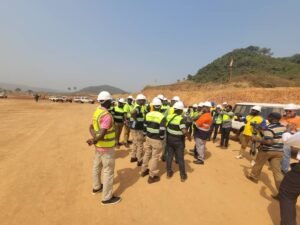
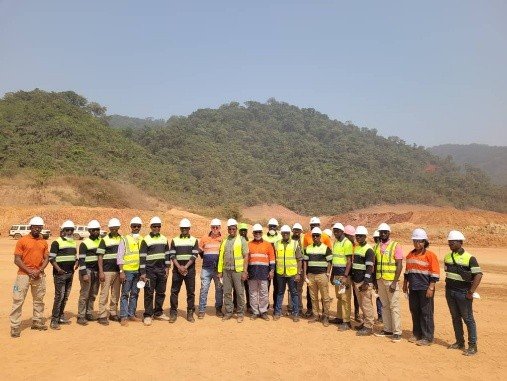
The Ministry of Mines and Mineral Resources, together with the National Minerals Agency (NMA), on Tuesday January 27, 2026 conducted a site visit to assess the progress of the Baomahun Gold Project as preparations speeds up for full-scale mining and commercial gold production later this year.
The visit, which took place in Valunia and Kunike Barina Chiefdoms in the Bo and Tonkolili Districts, was led by the Minister of Mines and Mineral Resources, Julius D. Mattia, alongside senior officials from the NMA, including directors, inspectors and technical experts.
During the inspection, the Project Director of FG Gold Mining Company, Bolaji Okubajo, delivered a comprehensive presentation detailing the company’s operational progress, development strategy and commitment to sustainable mining practices. He reaffirmed FG Gold’s focus on local content development, safety excellence and responsible mining.
Bolaji Okubajo disclosed that a significant portion of the company’s construction and operational activities is being undertaken by locally registered and wholly Sierra Leonean-owned companies, in line with national development objectives. He noted that more than 50 percent of FG Gold’s annual expenditure on goods and services is retained within Sierra Leone, with priority given to host communities, national suppliers and ECOWAS partners.
On infrastructure and technology, Bolaji Okubajo highlighted the deployment of state-of-the-art processing plant technology supported by reputable international partners. Those include engineering, procurement and construction management specialists, integrated battery-powered energy systems, explosives suppliers, geo-technical and tailings storage facility designers as well as globally recognized equipment manufacturers. He said the adoption of new-generation technology has significantly reduced project risks and potential delays.
In terms of employment, FG Gold currently has about 300 direct employees, with projections to exceed 500 workers, excluding contractors. The total workforce on site stands at approximately 1,400 and is expected to peak at around 2,000 during the construction phase. Bolaji Okubajo added that the company has reduced its expatriate workforce from 11 percent to 9 percent, reflecting efforts to maximize national employment, while also increasing female participation as operations commence.
The company also highlighted several completed and ongoing community development initiatives. Those include skills development programmes for youth, with 94 community youths completing driving training, 60 percent of whom are female, four female trainees now operating heavy equipment and over 300 former artisanal miners employed by FG Gold and its contractors.
Key community projects implemented between 2022 and 2025 include the construction of the St. Josephine Bakhita Primary School, renovation of the Baomahun Health Centre, provision of 23 tertiary scholarships under the Valunia Education Fund, drilling of seven water boreholes, renovation of a mosque and ongoing construction of a community town hall. Road grading and repair works covering 68 kilometres from the mine site to Matotoka have also been undertaken.
Speaking during the visit, Minister of Mines, Julius D. Mattia, described the Baomahun site as one of the most highly mineralized gold zones in the country. He recounted the project’s history, highlighting that previous exploration work conducted before the Ebola outbreak had confirmed the area’s significant gold potential.
The Minister said the Government granted FG Gold a mining licence after recognizing the need to transition from artisanal to large-scale mining to maximize benefits for Sierra Leone and surrounding communities. He disclosed that the company has mobilised over US$600 million in project financing to develop the mine.
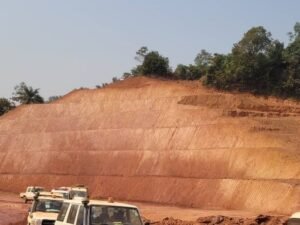
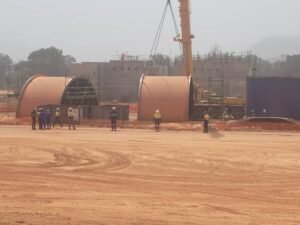
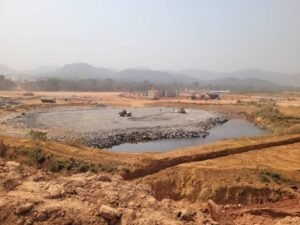
The inspection team toured several facilities, including workers’ camps, processing plants and key infrastructure such as the ball mill, SAG mill, carbon-in-leach facilities and energy systems. The Minister said the visit was intended to allow Government officials to witness firsthand how a greenfield mining project is being developed organically from the ground up.
Julius D. Mattia expressed optimism that the project would pour its first commercial gold by December 2026, noting that the deposit contains an estimated 4.6 million ounces of mineralization with reserves exceeding 2.1 million ounces.
He added that the project is expected to create jobs, facilitate skills and knowledge transfer, boost national revenue and position Sierra Leone competitively within the sub-region, especially amid rising global gold prices.
The Minister also reaffirmed Government’s commitment to maintaining clear and stable mining laws to attract investors and ensuring that mining contributes meaningfully to economic growth through royalties, taxes and other revenue streams.
The Baomahun Gold Project is projected to become a flagship large-scale gold mining operation in Sierra Leone with expectations of long-term socio-economic benefits for host communities and the country at large.