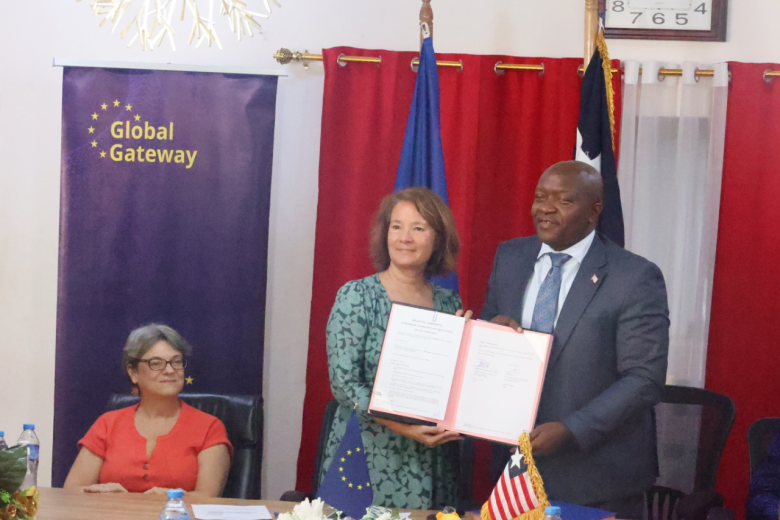
MONROVIA— Liberia and the European Union (EU) have signed a €25 million grant financing agreement aimed at strengthening the fisheries value chain, improving livelihoods, and enhancing food security across the country’s nine coastal counties.
By Jaheim T. [email protected]
The agreement, signed at the Ministry of Finance and Development Planning(MFDP), brought together senior Liberian officials, EU representatives, and development partners in what Finance and Development Planning Minister Augustine Kpehe Ngafuan described as “a
testament to the EU’s long-standing and reliable partnership with Liberia, particularly during difficult economic periods.”
Minister Ngafuan recalled the EU’s timely budget support in 2024, which was contingent on Liberia meeting agreed performance targets.
That support, he noted, paved the way for continued cooperation. Stressing the nature of the new fisheries project, he declared: “This is not about bringing cartons of fish. You have come to help us fish for ourselves.”
Unlike loan-based financing, the project is fully grant-funded, directly targeting artisanal fishers and fishmongers.
It will provide cold storage, ice-making facilities, fish handling infrastructure, job creation, and measures to reduce post-harvest losses. These interventions are expected to raise incomes, strengthen food security, and improve household welfare in coastal communities.
EU Ambassador Nona Deprez reaffirmed the EU’s commitment, saying the initiative aligns with Liberia’s ARREST Agenda, national fisheries policies, and the EU’s Global Gateway strategy.
“Fisheries are vital for livelihoods, nutrition, and economic resilience along Liberia’s 600-kilometer coastline,” she emphasized.
For NaFAA Director General–Designate J. Cyrus Saygbe said the €25 million agreement represents far more than financing. He called it a “landmark investment that will strengthen artisanal fisheries, protect Liberia’s waters, and empower fishing communities nationwide.”
Reflecting on a coastal proverb, Saygbe noted: “When the tide is right and the net is strong, even the smallest canoe can return with abundance. But without strong institutions and effective protection at sea, even calm waters cannot secure sustainable livelihoods for fishermen.”
He stated, “Today, we are strengthening the net, protecting our waters, and empowering Liberia’s fisheries sector to reach its full potential.”
Artisanal fisheries remain critical to Liberia’s economy, providing employment for thousands and contributing significantly to food and nutrition security. Yet the sector faces persistent challenges: high post-harvest losses, limited market access, weak value addition, inadequate infrastructure, and limited institutional capacity.
The EU-backed project seeks to address these issues comprehensively, with a particular focus on women and youth who play central roles along the fish value chain. Measures include:
A 25 percent reduction in canoe licensing fees to ease burdens on fishermen, initiatives to strengthen fishmongers’ business skills and improved market access through NaFAA’s Quarterly Fish Market Day, connecting producers and consumers while promoting fair trade.
Saygbe underscored the importance of tackling Illegal, Unreported, and Unregulated (IUU) fishing by migrant vessels, which threatens sustainability, livelihoods and national revenue.
The project will reinforce collaboration with the Liberia Coast Guard to enhance coastal patrols, particularly in the South-Eastern and North-Western regions.
“Together, we are ensuring that when Liberian fishermen cast their nets, they do so in protected waters,” he said.
Institutional strengthening and human capacity development form a core component of financing.
Support will enhance the Liberia Artisanal Fishermen Association and the Department of Fisheries and Aquaculture Sciences at the University of Liberia.
Short-term certificate and diploma programs will be introduced at the University of Liberia, Tubman University in Maryland County and selected community colleges to build skills and professionalism among fishmongers, processors, and coastal communities.
The project also aligns with NaFAA’s decentralization agenda, with the first regional office expected to open in Harper, Maryland County by July 2026.
This will bring regulatory services, technical support, and economic opportunities closer to fishing communities. The initiative complements preparations for Liberia’s first post-war Fisheries Investment Conference, scheduled for March 30–31, 2026. The conference will signal that Liberia’s fisheries sector is organized, transparent and open for responsible investment.
Saygbe described the EU financing as a “major leap forward”, noting that it will establish frameworks to reduce post-harvest losses, strengthen quality assurance, and improve units of measure for fishmongers nationwide.
The result, he said, will be “better incomes, fairer trade, reduced waste, and improved food security for Liberians.”
The project is expected to increase efficiency and competitiveness of the artisanal fish value chain, improve the quality and safety of fish products, enhance incomes and livelihoods for fishers and processors and strengthen institutional coordination and governance.
“Together, we are ensuring that when Liberian fishermen cast their nets, they do so in protected waters, supported by strong institutions, skilled communities, and a thriving, sustainable fisheries sector,” he added.