Monrovia– Green Guard Eco-Solution and the Philippines-based Alterna Verde Cooperation have projected Liberia as a regional hub for waste-to-energy innovation, climate mitigation, and sustainable livelihoods when the company begins operational.
By Jaheim T. [email protected]
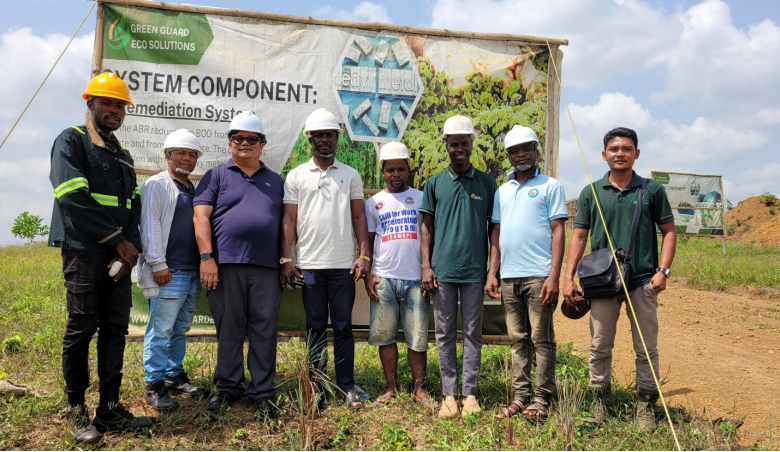
On May 5, 2024, Green Guard broke ground on its site outside Dixville . CEO Edward W. Karfiah says the company expects its “first truckload of waste” to arrive.
“We are working with the different cities. We are signing a contract to roll out when we bring waste to the site. We are hoping that by February 7th, the latest, our first truckload of waste will be on the site,” Karfiah told reporters.
The 10-year renewable agreement with Paynesville City Corporation (PCC) designates Green Guard as the primary entity responsible for solid waste collection. Beyond disposal, the company will oversee waste-to-energy initiatives and revenue-sharing arrangements.
Karfiah explained: “This process will also give Paynesville some incentive along the route, not just from waste collection where we have tipping fees, but we also tend to give some of our net profit to Paynesville with the end products we have.”
For Karfiah, the project more than about garbage—it is about climate resilience. “It is about sustaining the human race because global warming is our single most treasured threat now. Carbon emission is one key. Capturing carbon is a game changer.”
One of the project’s most ambitious goals is to replace charcoal burning with clean cooking gas. For decades, charcoal has been the lifeline of Liberian kitchens. But Green Guard insists that era is ending. “This, one of the end product of this would be clean cooking gas. So, that means we are going to replace charcoal burning with clean cooking gas that is less expensive and more easy to work with and cheap,” Karfiah said.
He added with conviction: “No more charcoal business. You just switch your gas on and the fire is there. And you cook in no time.” The shift is not just about convenience but it is about saving forests and cutting carbon emissions.
Charcoal production has long fueled deforestation and filled homes with dangerous particulates linked to respiratory illness. Green Guard’s plan to distribute clean gas promises to tackle both problems at once.
“This is not just about waste. It is about sustaining the human race because global warming is our single most treasured threat now,” Karfiah emphasized
The company says its gas will be packaged safely in HDPE containers, easy to handle and affordable. “The children even can throw it to say we’re taking care of the kitchen when they buy it from the car,” Kerfiah said.
Green Guard has also committed to reforestation as part of its environmental compliance. “Every acre you clear; you need to replant 50 trees. The place we are clear is not more than five acres. Instead of 250, we’re doing over 1,000, meaning we’re doing more. We’re sending more oxygen into the environment.”
For Alterna Verde CEO Dr. Nervy Santiago, the project is about harnessing decades of expertise in anaerobic digestion.
Dr. Santiago said the partnership is reframing Liberia’s waste problem as an opportunity. “This project is not about garbage. It’s about climate change, livelihoods, and training people for the future.”
“It just so happens that our feedstock is coming from garbage. That is very important to understand. The project is about climate change, global warming, and carbon capture.”
He warned of unmanaged waste: “People forget that when you dump waste in bare ground, it’s going to leach out these chemicals. It’s going to poison your water. Waste is a major source of greenhouse gas. As you allow waste to decay, you produce not only carbon dioxide, but biomethane gas. And biomethane gas has more than 28 times the greenhouse effect than CO2.”
Alterna Verde is introducing citronella grass as a phytoremediation tool to absorb heavy metals from leachate. “We are going to feed citronella grass with leachate. That’s why we’re propagating now. So what happens? The heavy metals in your leachate will be trapped by this grass,” Santiago explained.
From this process comes citronella oil, a product with global demand. “We are now able to make livelihood because then we can now extract that oil, citronella oil. And what does citronella oil do? Anti-mosquito, anti-fly. You can use it in your spa, in your perfumes.”
This innovation offers a double dividend: environmental protection and income generation.
Karfiah insists the project is about positioning Liberia globally. “This story we are trying, this interview is not just for Liberia. It’s for the region. It’s for the world. And for the government.”
He stressed the role of government: “It is the government working in synergy with its citizens, bringing up a smart innovation investment that will impact not only Liberia but the region and the world at large.”
Engineer Mulbah Rufus Flomo of Green Guard Eco-Solution calls the initiative a “revolution for the country when it comes to waste.”
“We no longer have waste in Liberia. We’re going to have another form of resource where it comes here, it’s sent back to the community as plastic tar, it goes back to the community as cooking gas.”
Flomo walked FrontPageAfrica reporter through the 30-acre site, explaining its four system components: Lined landfill to protect groundwater, Anaerobic baffle reactor (ABRO) to degrade organic matter and produce methane, Phytoremediation with vetiver grass to absorb heavy metals and Power station to convert methane into electricity.
“Our initial plant is at least, for the first start, we should put at least two megawatts per hour current. That can be able to supply at least, we can say about 25 or 30 percent of Pins basically.”
Flomo acknowledged Liberia’s relatively low waste generation compared to countries like Thailand. “Each one of us produce at least 0.55, 0.44 kg of waste per day. Multiply that by the 5 million person who can live raw, you get about 1.5 million kg… Our system here wants to receive at least 1,500 tons per day. But Monrovia by itself is able to generate at least 880 tons.”
To meet capacity, Green Guard plans to collect waste from Kakata, Buchanan, and other Harbel especially Unification Town.
Flomo said the project is more than engineering—it is nation-building and A blessing for Liberia. “It’s a blessing for Liberia. And the good part is, it’s Liberian company, partnering with an international company from outside. My Liberian are going to be staying here. That means this project will stay forever.”