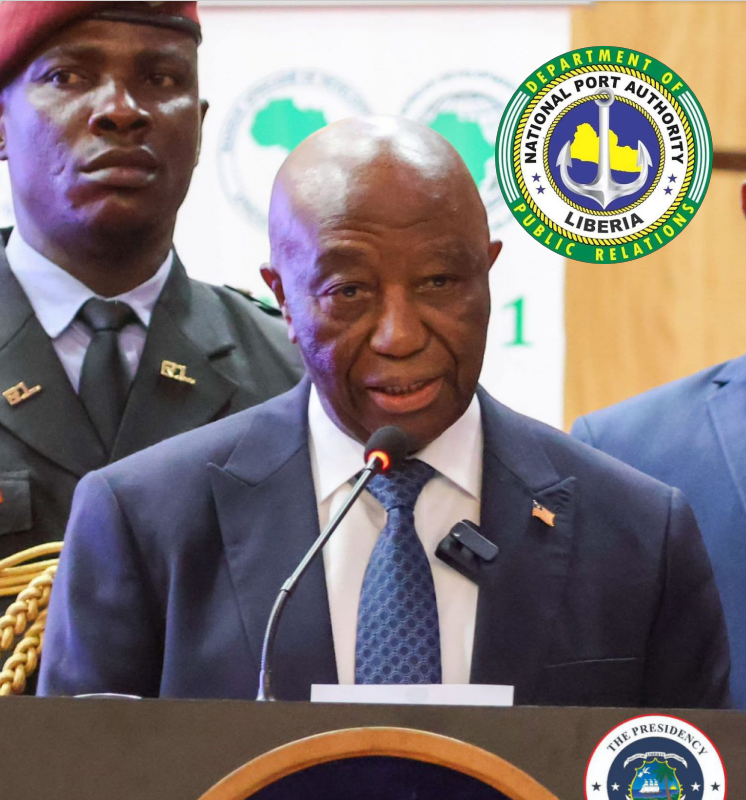
MONROVIA — President Joseph Nyuma Boakai has announced plans to de-monopolize the Freeport of Monrovia, signaling a major shift in Liberia’s port operations even as his administration weighs whether to approve or veto controversial port decentralization legislation.
By Gerald C. Koinyeneh, [email protected]
Delivering his third Annual Message to the National Legislature, President Boakai disclosed that a Moroccan port development entity has agreed to invest in equipment and logistics at the Port of Monrovia—an intervention he said will break a longstanding monopoly and boost competition at the country’s busiest seaport.
“The National Port Authority remains a critical gateway to Liberia’s economy,” President Boakai said. “Following my visit to Morocco last November, a Moroccan port development entity agreed to invest in equipment and logistics for the Port of Monrovia, breaking a longstanding monopoly and boosting competition.”
He added that master plans for the ports of Monrovia and Buchanan have been completed, while tariff reforms are already driving revenue growth. Planned upgrades include dredging the Freeport of Monrovia to accommodate larger vessels, easing congestion, reducing costs, and introducing 24-hour port operations.
APM Terminals, Bulk Cargo, and Competition
The President’s announcement has raised questions amid an existing concession agreement between the Government of Liberia and APM Terminals, which currently manages operations at the Freeport of Monrovia.
However, experts say the APM Terminals concession does not include the LMC and BMC piers, which are expected to be upgraded and operated under the Moroccan investment.
International development expert Ambulah Mamey explained that APM Terminals’ concession gives top priority to containerized cargo, not bulk cargo such as rice, cement, and heavy equipment.
“As a result, bulk cargo ships sometimes wait for weeks—sometimes up to three months—for APMT to finish container offloading,” Mamey said. “This delays imports and costs importers hundreds of thousands of dollars in additional fees.”
According to him, the Moroccan investment will initially focus on handling bulk cargo, allowing APM Terminals to clear containers more efficiently and easing congestion at the port.
“The positive aspect of this investment is that it represents South-South cooperation, with one African partner investing in another,” Mamey noted.
He added that while competition between APM Terminals and the new Moroccan operator will initially center on bulk cargo handling, the long-term solution remains the establishment of at least two full terminal operators capable of handling both bulk and containerized cargo.
Port Decentralization Bills Under Review
The President’s announcement comes as he considers whether to sign the re-passed port decentralization bills, which remain a subject of intense debate within his inner circle.
FrontPage Africa has learned that senior advisers are divided, prompting high-level deliberations behind the scenes.
The disputed legislation includes two interrelated bills: the Liberia Sea and Inland Ports Regulatory Authority Act of 2025 and the Liberia Sea and Inland Ports Decentralization and Modernization Act of 2025.
Together, the Acts would repeal the National Port Authority (NPA) Act, dissolve the NPA, establish four autonomous seaports in Monrovia, Buchanan, Greenville, and Harper, and create a new Liberia Sea and Inland Ports Regulatory Authority (LSRA) with nationwide oversight powers.
The bills were introduced by Grand Bassa County Senator and President Pro-Tempore Nyonblee Karnga-Lawrence and passed by both chambers before being sent to the President.
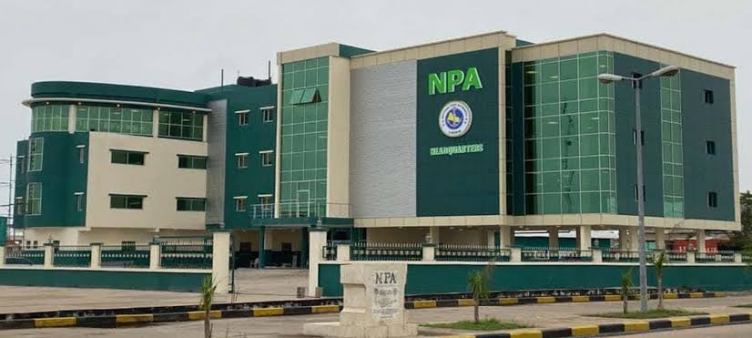
Invoking Article 35 of the Constitution, President Boakai previously returned the bills to the Legislature, warning that they were legally and operationally inseparable and that unresolved defects could lead to fragmentation, uncertainty, and institutional instability in the maritime sector.
Aviation, Public Transport, and Maritime Reforms
Beyond ports, President Boakai highlighted significant progress in aviation infrastructure at Roberts International Airport (RIA), including the reopening of Taxiway Bravo, rehabilitation of the apron and jet bridge, and installation of new navigational aids.
These upgrades were completed ahead of Turkish Airlines’ inaugural flight to Liberia on May 11, 2026, marking what the President described as a major milestone for Liberian aviation.
He also announced an agreement with South Korea’s Make Group to develop a ship recycling center and establish a public-private partnership domestic airline, starting with an initial fleet of three aircraft.
On public transportation, President Boakai acknowledged longstanding neglect at the National Transit Authority (NTA) but said reforms are underway.
“We are changing that,” he said. “Last year, we procured 64 buses, now deployed and serving Liberians nationwide. We also broke ground for a modern NTA headquarters, which will enhance service delivery and transform public transport.”
Maritime Leadership Reaffirmed
President Boakai also reaffirmed Liberia’s global maritime standing, noting that since 1948 the country’s maritime program has been a pillar of the economy and international influence.
He revealed that 11 modernization initiatives have been introduced, including a Domestic Watercraft Monitoring Program using AIS technology—the first in decades—and a Vessel Monitoring System to enhance safety.
Liberia’s re-election to Category A of the International Maritime Organization (IMO), he said, further confirms the country’s leadership in maritime governance.