Author: Koang Pal Chang | Published: 7 hours ago
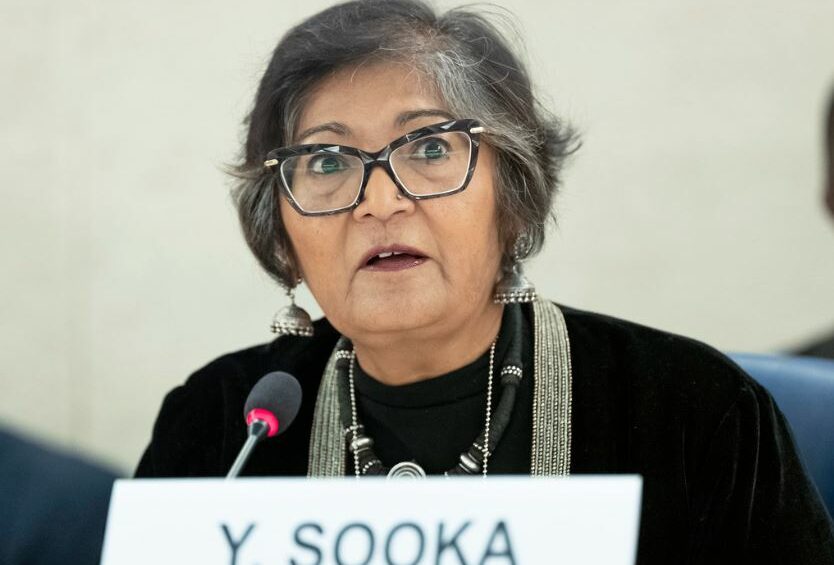
Yasmin Sooka, Chairperson of the Commission on Human Rights in South Sudan present his report at a 40th Session of the Human Rights Council. 12 March 2019. UN Photo / Jean Marc Ferré
JUBA, South Sudan (Eye Radio) – The UN Commission on Human Rights in South Sudan issued a warning on Sunday that South Sudan faces a moment of danger as inflammatory rhetoric from military figures and troop movements in Jonglei State threaten to trigger violence against civilians.
The UN Commission on Human Rights in South Sudan noted that public statements by commanders encouraging violence, alongside military deployments, mark an escalation at a time when the peace process is weakened.
This follows remarks by a military official who told troops on the front lines in northern Jonglei to “spare no lives,” including the elderly.
General Johnson Olony, assistant chief of defence forces for mobilisation and disarmament and commander of the Agwelek militia, spoke to fighters in Duk County.
His forces are preparing to confront the SPLA-IO and the White Army, which recently took government garrisons in the Lou Nuer area, including Pajut.
“When we arrive there, don’t spare an elderly, don’t spare a chicken, don’t spare a house,” Olony said in remarks in a video clip addressing troops.
The commission stated that such language from those in command could amount to incitement under international law.
“Language that calls for the killing of civilians, including the elderly, is profoundly dangerous,” said commission chair Yasmin Sooka. “In South Sudan’s past, such rhetoric has preceded mass atrocities.”
The commission said the escalation reflects a breakdown driven by violations of the 2018 peace agreement. It called on all parties to stop inflammatory rhetoric and troop mobilisation.
President Salva Kiir, as commander-in-chief, bears responsibility for the discipline of forces operating in his name. “This crisis is not inevitable,” Sooka said. “But the window to act is closing fast.”
Under international law, military and civilian leaders are responsible for crimes they order, incite, or fail to prevent. The commission added that leaders in Juba cannot claim ignorance of these public calls to violence. Commissioner Barney Afako warned that the mobilisation of forces alongside “ethnicised messaging” risks a cycle of retaliatory violence.
“Unless there is immediate intervention at the highest level to rein in forces and de-escalate, South Sudan risks sliding rapidly into another phase of widespread violence,” Afako said.