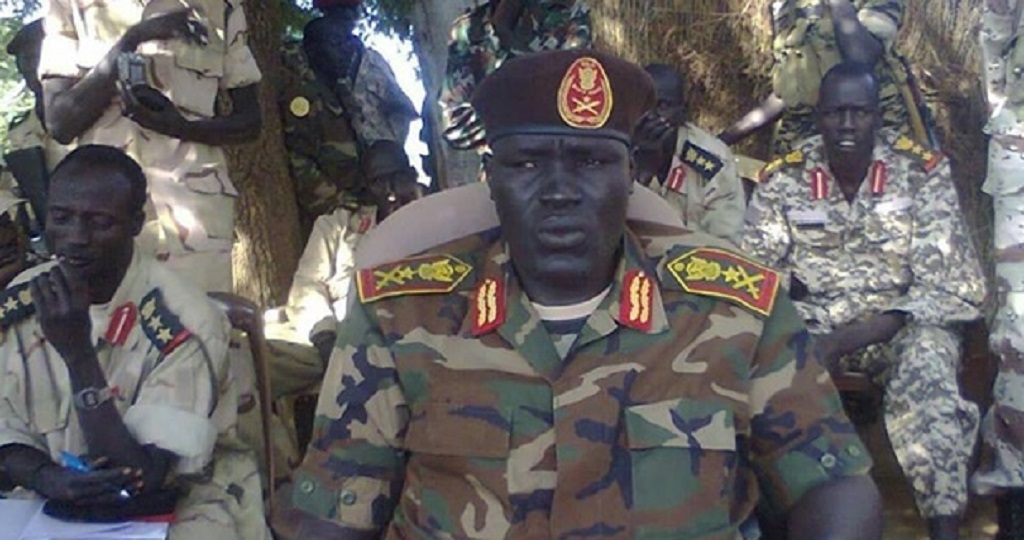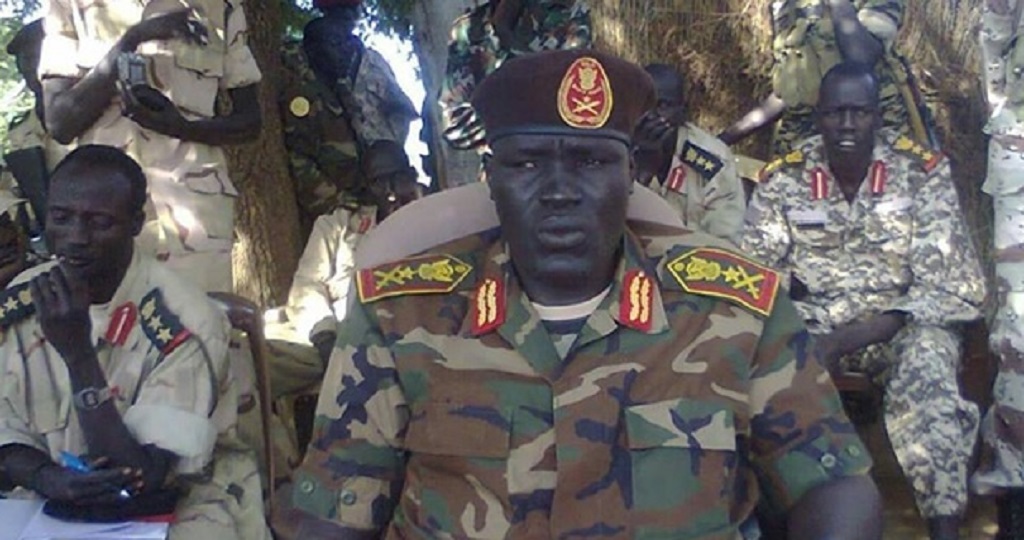
JUBA – General Johnson Olony Thabo has re-emerged at the centre of South Sudan’s conflict at a moment of acute national tension, issuing orders that have shocked observers and revived fears of mass violence. Addressing troops deployed for a government offensive in Jonglei State, Olony instructed his forces to “spare no lives,” language that in South Sudan’s recent history has often preceded atrocities against civilians.
The remarks came as government forces sought to contain rapid advances by the Sudan People’s Liberation Army in Opposition (SPLA-IO) and allied armed youth across parts of Jonglei, a state increasingly viewed by both sides as the gateway toward the national capital, Juba.
Olony, now serving as deputy army chief for disarmament and mobilisation, commands the Agwelek Division, a militia that has yet to be fully integrated into the South Sudan People’s Defence Forces (SSPDF).
Human rights advocates and political analysts warn that Olony’s rhetoric risks inflaming an already volatile situation. In a country where ethnic identity, unresolved grievances and personalized chains of command have repeatedly driven violence, calls for total destruction are widely seen as a dangerous escalation rather than a path to stability.
After issuing remarks that have alarmed observers and humanitarian groups, Olony has once again become a central figure in South Sudan’s conflict landscape. This article looks into who Johnson Olony is, how his armed career has evolved over more than a decade of shifting alliances, and why his latest orders appear rooted in unresolved violence, grievance and cycles of retaliation in the Greater Upper Nile region.
Who is General Johnson Olony
Johnson Olony Thabo is a veteran South Sudanese commander from Upper Nile State whose military career mirrors the fragmentation of the country’s armed politics. He first rose to prominence as the leader of a group of fighters awaiting integration into the Sudan People’s Liberation Army (SPLA) after independence. That integration never materialized, and tensions with the army eventually pushed him into rebellion.
Following clashes with government forces, Olony fled to South Kordofan in Sudan, where he aligned himself with the South Sudan Democratic Movement (SSDM) led by the late rebel commander George Athor. After Athor’s death in early 2012, Olony claimed leadership of the movement and soon entered negotiations with Juba.
In June 2013, into the lead up of South Sudan’s 2013-2018 civil war, he accepted a presidential amnesty from President Salva Kiir and was formally inducted into the military with the rank of major general.
Despite the amnesty, Olony’s fighters were never fully absorbed into the national army’s command structure, leaving them effectively autonomous. When civil war broke out in December 2013, Upper Nile became one of the most fiercely contested regions. Olony was wounded during fighting in Malakal in February 2014, when opposition forces from the SPLA-IO entered the city.
In 2015, Olony joined the SPLM-IO after his deputy, Major General Bwogo Olieu, was killed in an ambush outside Malakal by an ethnic militia allied with Kiir’s government. His forces established control over Malakal at various points, and later that year, it was reported that fighters under his command were involved in the forcible recruitment of children, allegations that were never publicly addressed by Olony.
Prior to his defection, tensions between Olony’s forces and the government escalated, prompting state officials to flee Malakal and further entrenching Olony’s power on the ground.
In May 2015, Olony formally declared his forces independent, announcing the creation of the Agwelek Forces. While he signaled willingness to cooperate with other opposition groups, including the SPLA-IO, the Agwelek remained a distinct entity, drawing largely from the Shilluk community. This ethnic base would shape both the group’s alliances and its conflicts.
The relationship between the Agwelek and the SPLA-IO was always uneasy. While tactical cooperation existed, the SPLA-IO’s core support base is largely Nuer, while the Agwelek positioned themselves as defenders of Shilluk interests along the Nile corridor. Splits within the Agwelek followed.
In August 2016, a faction led by Yohanis Okiech broke away, only to be ambushed by Olony’s forces in January 2017, leaving Okiech dead. Okiech was killed by Olony alongside former SPLA-IO commander Gabriel Gatwech Gai, popularly known as “Tang Ginye” who had declared allegiance to the National Democratic Movement (NDM) led by Lam Akol Ajawin.
From 2016 to 2018, Olony’s forces fought government troops across Upper Nile, losing strategic towns including Kodok which had served as the SPLA-IO headquarters in Upper Nile following the fall of Pagak. Following the signing of the revitalized peace agreement in 2018, Machar in 2020 proposed Olony as governor of Upper Nile, a move rejected by Kiir, reinforcing Olony’s ambiguous standing between government and opposition.
Kiir then appointed another person Abudhok Ayang upon SPLM-IO recommendation, but Olony rejected Anyang’s appointment as the governor instead of him and then grew hostile to the SPLA-IO.
The fractures deepened in June 2021, when Olony and General Simon Gatwech Dual broke with Machar in the northern town of Magenis, accusing him of abandoning the armed struggle by returning to Juba under a peace agreement that they say was not fully respected by President Kiir’s government.
The split produced the SPLA-IO Kitgwang faction, with Gatwech as leader and Olony as his deputy. That alliance soon collapsed. In January 2022, Gatwech and Olony signed a separate agreements with the government in Khartoum. The government however gain preferential treatment for his forces and triggering violent clashes within the Kitgwang faction.
Fighting erupted later that year in Magenis between forces loyal to Gatwech and those aligned with Olony. By August 2022, Gatwech had removed Olony from his position within the faction. Since then, Olony has pursued a slow and incomplete reintegration into the SSPDF, retaining command over the Agwelek forces until his recent appointment as deputy army chief for disarmament and mobilization.
His return to Juba in May 2023, his first since 2013, was portrayed by the government as a breakthrough for peace in Upper Nile. Olony arrived with 200 soldiers, pledging loyalty to President Kiir and calling on communities to embrace peace. Government officials declared Upper Nile “peaceful,” even as violence continued to simmer on the ground.
That violence intensified in late 2022 and again in mid-2023, when armed youth from Greater Jonglei crossed into Panyikang and Fashoda counties in Upper Nile. The incursions resulted in widespread displacement and killings, devastating Shilluk communities along the Nile.
Government officials in Juba later claimed that as many as 3,000 people were killed during those attacks, a figure that has not been independently verified but has become central to narratives of grievance within Agwelek ranks.
For Olony and many of his supporters, the killings in Upper Nile are cited as evidence of state failure and as justification for extreme measures. They argue that repeated negotiations have produced no lasting protection for their communities and that decisive force is the only way to break the cycle of violence.
It is against this backdrop that Olony’s recent orders must be understood. Addressing troops preparing for deployment, he framed the conflict as a recurring crisis rooted in Greater Upper Nile, arguing that coups (referring to gov’t narratives that conflicts are caused by Riek Machar, an ethnic Nuer), rebellions and communal fighting had gone unresolved for years. This time, he said, the problem would be ended decisively, even if that meant destroying entire communities.
Critics see the rhetoric as a call for collective punishment and ethnic targeting, warning that it lowers restraints on troops operating in an environment already primed for violence. Olony’s own history complicates the picture. His forces have been implicated in abuses in the past, and their partial integration into the national army blurs lines of accountability.
Olony has also acknowledged practical limits to his authority. In the same address in which he issued the “spare no lives” order, he complained of severe shortages, including a lack of vehicles and basic equipment. He warned that his troops would not advance without adequate transport, demanding dozens of pickup trucks mounted with heavy weapons. The ultimatum highlighted a familiar pattern in South Sudan’s wars: maximalist rhetoric paired with limited logistical capacity.
For the government, Olony remains both an asset and a liability. He commands fighters hardened by years of conflict and retains influence in Upper Nile. At the same time, his shifting alliances and militia’s autonomy undermine efforts to present the SSPDF as a unified national force governed by law.