Malema would lose his parliamentary seat if he is sentenced to more than 12 months’ imprisonment without a fine.
A social worker has presented arguments outlining why Economic Freedom Fighters (EFF) leader Julius Malema should avoid a custodial sentence after being found guilty in his firearm discharge case.
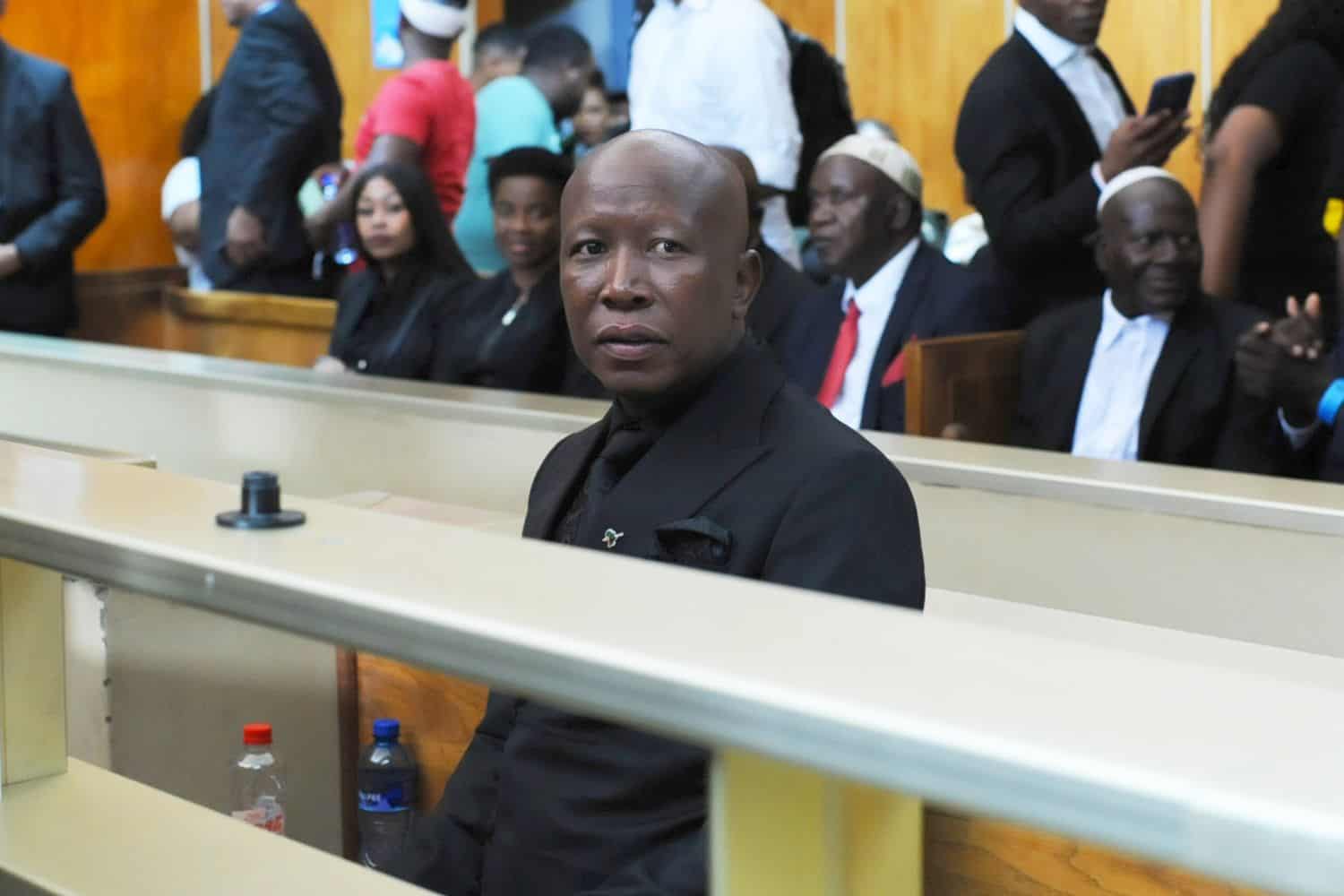
Malema appeared before the East London Regional Court in the Eastern Cape on Friday for pre-sentencing proceedings, drawing significant public and political attention.
Large crowds of EFF supporters filled the streets of East London in a show of solidarity with their leader.
Inside the courtroom, Malema was represented by a high-profile legal team, including Tembeka Ngcukaitobi, Ian Levitt and Laurance Hodes, who have handled his defence throughout the trial.
EFF leader Julius Malema verdict over firearm discharge
The pre-sentencing follows Malema’s conviction by Magistrate Twanet Olivier on 1 October 2025.
He was found guilty on five counts, including unlawful possession of a firearm and ammunition, discharging a firearm in a public place, and reckless endangerment to people or property.
ALSO READ: From rally gunfire to court: how Malema’s firearm case unfolded
The charges stem from an incident on 28 July 2018, when Malema was captured on video firing what appeared to be a rifle during the EFF’s fifth anniversary celebrations at Sisa Dukashe Stadium in Mdantsane.
The footage later went viral.
Malema now faces a possible prison term ranging from a minimum of two years to a maximum of 15 years.
Social worker testifies in mitigation
During the proceedings, Jessi-Ann Thompson, a social worker in private practice, testified for the defence.
She compiled a pre-sentencing report intended to assist the court in determining an appropriate penalty, taking into account Malema’s personal history and broader circumstances.
Thompson told the court that Malema grew up without a father figure and described aspects of his personality and leadership style.
READ MORE: Malema conviction hailed as proof South Africa’s firearm laws work
According to her assessment, Melama has been characterised as a perfectionist with traits associated with leadership, but also as someone capable of “strong emotional responses” when faced with conflict.
“Some of these traits were evident during some of his responses in cross-examination and in relation to some of his comments over his guilty verdict.”
Nature of the incident
The social worker emphasised that the firearm was discharged briefly and without harmful consequences.
She told the court that Malema fired “celebratory shots” for less than a minute, and that no injuries were reported, and no infrastructure was damaged.
“There is no indication that the firearm was acquired illegally for a prolonged period or with any intent to facilitate further criminal activity,” Thompson said.
READ MORE: Would the EFF suffer if Malema is jailed?
Thompson highlighted there was no intention to harm or endanger members of the public.
“While the accused maintains his innocence, he acknowledges the inherent risks of discharging a firearm in a public setting and regrets that the perception could be created that it is acceptable recklessly discharge a firearm.”
Watch the sentencing proceedings below:
She further noted that Malema is a first-time offender and has not been implicated in any criminal conduct in the seven years since the incident.
Thompson also told the court that, despite public warnings about the dangers of celebratory gunfire, no precedent-setting case law dealing with convictions or sentencing in similar circumstances could be found.
“The accused may be the first person charged for discharging a firearm for celebratory purposes.”
Argument against imprisonment
In her submission, Thompson argued that the prescribed minimum sentence should not apply.
She described incarceration as an extreme measure.
“Imprisonment is widely recognised as the harshest form of punishment generally justified by the objectives of retribution and deterrence.”
Referring to an earlier court judgment, she contended that imprisonment remains “a terrible thing” with “profound” and “far-reaching” effects, particularly on families.
READ MORE: Malema claims guilty verdict a ‘badge of honour’, vows to appeal
The court heard that a prison sentence would have serious implications for Malema’s immediate family, including his wife and three children.
“The accused is the main financial provider for his family, therefore, a custodial sentence would directly threaten the family’s financial security.”
The defence also urged the court to consider the political ramifications of sentencing.
Possible ban from parliament
If Malema is sentenced to more than 12 months’ imprisonment without the option of a fine, he would automatically be disqualified from serving as a member of parliament.
“This disqualification will persist for five years following the completion of the sentence, thereby restricting his ability to represent his constituency during his period.
“The accused enjoys notable support within South Africa, with many subscribing to his philosophy and expressing confidence in his leadership within key institutions such as the National Assembly.
“His removal from office would inevitably create a void for the communities he represents, potentially diminishing their voices.”
Thompson asked the court to treat the charges as a collective whole rather than as separate offences, arguing that they all arose from a single incident.
She recommended that Malema be given a suspended fine instead of a prison sentence.
Additional conditions proposed included restricting him from applying for a firearm licence for a defined period and ordering him to make a donation to the non-governmental organisation (NGO), Gun Free South Africa.
NOW READ: ‘I believe he will not survive this’: EFF future on knife edge after Malema guilty verdict