Author: Madrama James | Published: 9 hours ago
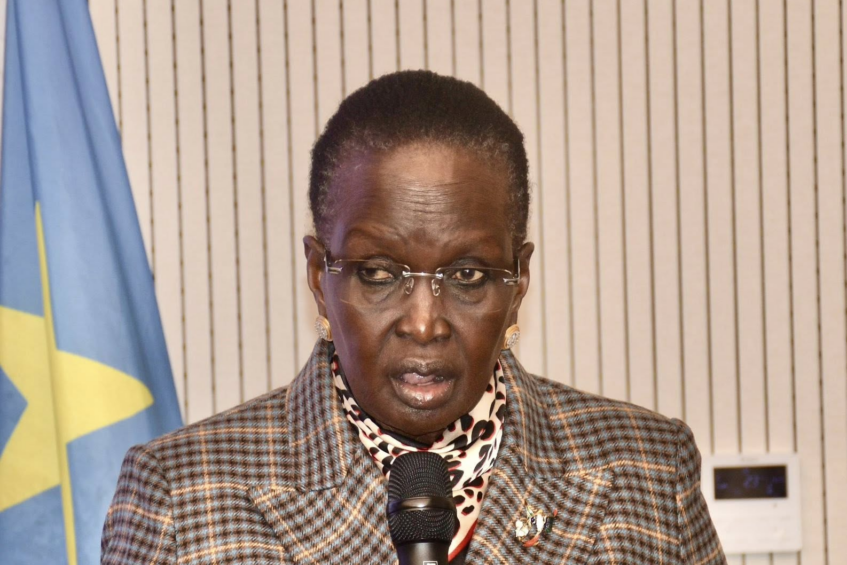
Vice President for the Gender and Youth Cluster and Acting Chair of the Governance Cluster, H.E. Rebecca Nyandeng de Mabior, delivers her keynote address during the Policy Dialogue on Official Statistics in Juba on Wednesday, January 21, 2026 – Credit: Bank of South Sudan
JUBA, South Sudan (Eye Radio) – Vice President Rebecca Nyandeng De Mabior has issued a blunt assessment of South Sudan’s governance, challenging leaders to stop “governing by assumption” and begin using evidence to plan the nation’s future.
Speaking in Juba during the launch of a high-level Policy Dialogue on Official Statistics, the Vice President criticized the country’s weak statistical systems.
She warned that despite having “excellent policy documents,” they are currently “gathering dust on shelves” due to a lack of implementation and reliable data.
The dialogue, organized by the National Bureau of Statistics (NBS), brought together senior government leaders, technocrats, development partners, and civil society to discuss how to harness data and technology for national development.
Nyandeng, who chairs the Gender and Youth Cluster, emphasized that while the government’s intentions are good, they lack the necessary follow-through.
“We said we wanted to govern our country with evidence and not assumptions. But intention must be followed by action,” Nyandeng declared.
“We must also be honest with ourselves. Our national statistical system remains weak, our information is scattered, and our capacity is limited.”
A key concern raised by the Vice President was South Sudan’s over-reliance on external organizations for basic information about its own people and economy.
“Too often, we rely on information and statistics collected from outside the government to plan our own future,” she noted.
Using a powerful metaphor, she compared the country’s current state to the flow of the River Nile, noting that while the water level changes with the seasons, the government must be able to measure and predict those changes through numbers.
“South Sudan took an important step when it made statistics a constitutional matter… but this is the first time I see you sitting down to plan seriously. This is very important,” she added.
Despite being a constitutional requirement, South Sudan’s National Statistical System remains fragmented. The current policy dialogue seeks to address these long-standing weaknesses, aiming to create a centralized, digital, and reliable database that can support accountability and sustainable growth.
The event concluded with a call for all government sectors to collaborate with the National Bureau of Statistics to ensure that the next phase of South Sudan’s development is guided by facts rather than guesswork.