By Amin Kef (Ranger)
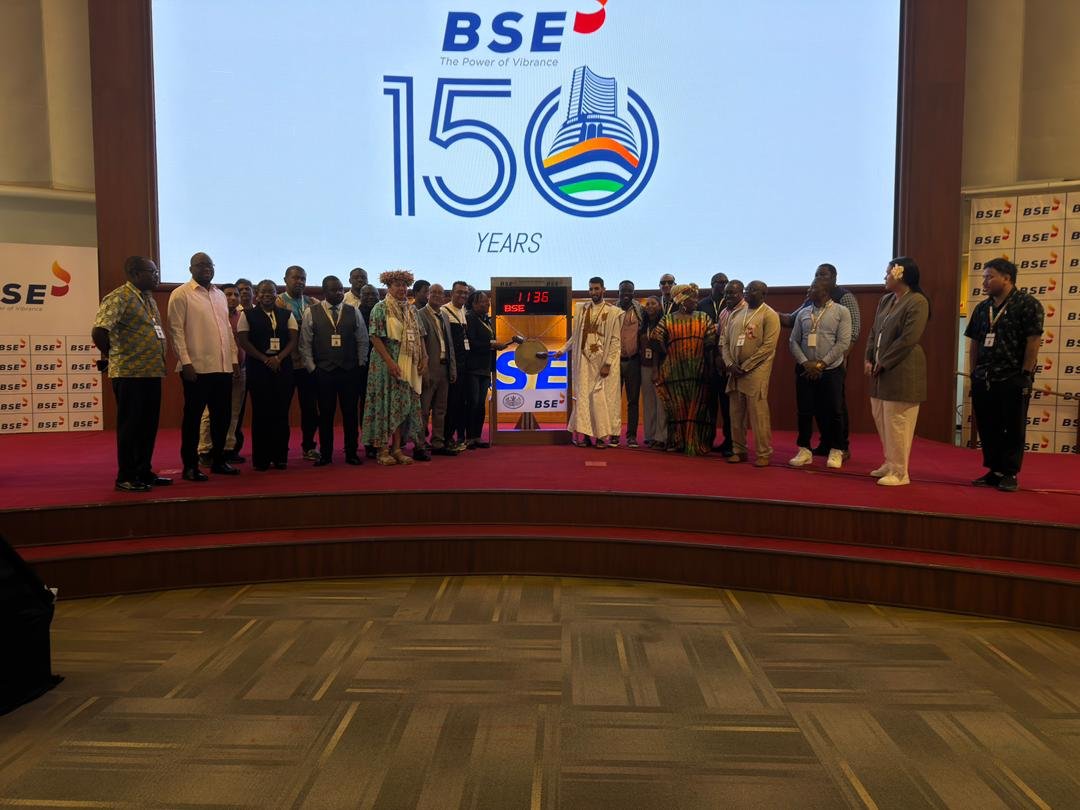
A high-powered delegation of 27 journalists from West Africa, Central Africa and the Pacific Oceania has completed a familiarisation visit to the Bombay Stock Exchange (BSE) on Tuesday, January 20, 2026 in Mumbai, as part of a structured international media exposure programme aimed at strengthening professional understanding of development finance, capital market systems, international cooperation frameworks, and India’s expanding partnerships across the Global South.
The engagement, held at the iconic BSE PJ Towers on Dalal Street, offered the visiting media professionals a rare opportunity to gain direct insight into the operational structure of one of India’s most respected financial institutions and to deepen their understanding of how capital markets contribute to economic growth, investor confidence, transparency and long-term stability.
Participants described the visit as both high-impact and highly informative, emphasising that such first-hand engagements are essential for journalists covering modern economic systems. Many noted that improved knowledge of stock exchange operations and financial regulation is crucial for public-interest reporting in their home countries, where citizens often depend on the media to interpret complex economic policies and development partnerships.
Among the visiting delegation were prominent Sierra Leonean media practitioners, including Alhaji Manika Kamara, President of the Sierra Leone Association of Journalists (SLAJ); Amin Kef Sesay (Ranger), Managing Editor of The Calabash Newspaper; and Thomas Dixon, Managing Editor of The New Age Newspaper. The Sierra Leonean representatives joined colleagues from multiple countries across Africa and the Pacific, reflecting the international scope of the programme and the growing recognition of the media’s role in shaping public understanding of development-focused cooperation.
During the session, Ms. Kamala K., Chief Regulatory Officer at BSE, delivered a detailed presentation explaining how the stock exchange in India operates and the strict regulatory systems that promote market discipline, transparency, accountability and investor protection.
She guided participants through the core processes that drive the exchange, including company listing requirements, trading operations, compliance monitoring, disclosure standards, and the role of regulation in strengthening trust and confidence within the capital market.
Ms. Kamala explained that strong regulatory oversight is fundamental to preventing market manipulation, ensuring accurate and timely information flow, and guaranteeing that listed companies meet governance obligations. She noted that these mechanisms are not only designed to protect investors but also to safeguard the reputation and credibility of the market as a whole.
She further highlighted that the Indian stock market contributes significantly to national economic growth by enabling businesses to raise investment capital, supporting private sector competitiveness, broadening job creation opportunities, and providing citizens with a platform to build wealth through informed investment.
The Bombay Stock Exchange, widely recognised as India’s oldest and one of its largest stock exchanges, serves as a central marketplace where people buy and sell shares of companies across several key sectors such as banking, telecommunications, manufacturing, energy, technology, and pharmaceuticals.
Participants were briefed on the major investment and trading activities carried out on the BSE platform, which include:
- Shares (stocks), representing ownership in companies
- Bonds and debentures, which are investment instruments used by institutions to raise funds
- Mutual funds, offering pooled investment opportunities
- Exchange-Traded Funds (ETFs), allowing diversified investment through a single product
- Derivatives (futures and options), used for risk management and speculation
- SME listings, supporting small and medium enterprises seeking capital
The journalists were also introduced to the meaning and national significance of the BSE Sensex, the exchange’s main market index. The Sensex tracks 30 top companies listed on the BSE and is widely seen as a key indicator of the overall health and direction of India’s stock market.
Officials explained that when the Sensex rises, it generally signals positive performance among major companies, while a decline may indicate market pressure influenced by economic events, global market trends, or investor sentiment.
A major highlight of the engagement was a special corporate communications session led by Mr. Prahlad Salian, Head of Corporate Communications at BSE, who spoke on what he described as the “Power of Vibrance” within India’s capital market ecosystem.
Mr. Salian noted that the “Power of Vibrance” reflects the energy, dynamism and resilience of the Indian market, driven by a combination of innovation, economic diversification, improved technology systems, and expanding investor participation across the country.
He stressed that modern stock exchanges are not only trading centres but also institutions of public trust. According to him, effective corporate communication is not merely about publicity, but about ensuring that accurate market information is accessible, understandable, and transparent to both experienced investors and first-time participants.
He further explained that communication plays a critical role in sustaining confidence during periods of market volatility, global uncertainty, or economic shocks. In such moments, he said, trust becomes the currency of stability, and clear messaging helps investors make informed decisions rather than reacting out of fear.
The session also explored broader issues driving the strength of India’s capital market and its wider economy. Observers highlighted that India’s growth is supported by a combination of factors, including a diverse market structure, a rapidly expanding consumer base, technological advancement, and improving financial inclusion.
Participants were informed that India’s market strength is reinforced by a broad base of domestic investors, increasing mutual fund participation, and a rising number of young investors adopting long-term investment culture.
Key points discussed during the engagement included:
- India’s market is diversified across multiple sectors, making it more resilient
- A strong technology ecosystem supports modern trading and investor access
- Consumer market growth is driving corporate performance and confidence
- Domestic investors are increasingly buying and holding local companies
- The market has expanded significantly since liberalisation reforms in the 1990s
- Millions of unique investors are now actively participating in capital markets
The delegation also discussed India’s digital identity and financial inclusion systems, including Aadhaar, described during the session as a unique identification mechanism that supports banking access, verification, and participation in modern financial services.
The visit featured an interactive question-and-answer segment, allowing participants to examine how India’s exchange system manages complex issues such as investor protection, compliance enforcement, and the relationship between economic growth and market performance.
Several journalists raised critical questions about the influence of domestic investors, mutual fund growth, the rising demographic of young investors, and how India’s market has remained stable despite global uncertainty.
Officials explained that investor confidence is strengthened by a combination of factors, including regulatory discipline, corporate governance expectations, transparency requirements, and technology-based monitoring systems designed to detect suspicious trading behaviour.
The familiarisation visit forms part of broader institutional engagements scheduled for the international media delegation in India, focusing on deepening cooperation, strengthening professional exposure, and improving media capacity to report on development finance and global economic partnerships.
Observers say such engagements reinforce the importance of informed journalism in promoting transparency, strengthening public understanding of international cooperation, and supporting national conversations about investment, economic reforms, and sustainable development.
The journalists expressed appreciation to the organisers for the opportunity and pledged to apply the knowledge gained to improve development-focused reporting that informs citizens, strengthens accountability, and supports responsible public debate across Africa and the Pacific.
As India’s market continues to position itself as a centre of innovation, resilience and global financial relevance, officials say exchanges like the BSE will remain critical not only for securities trading but also for supporting national transformation and expanding economic opportunities.