By Amin Kef Sesay
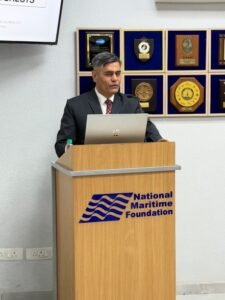
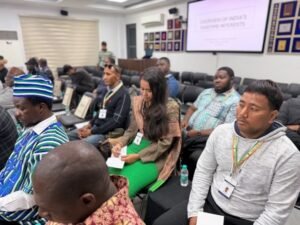
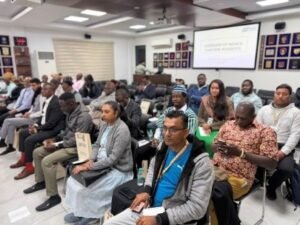
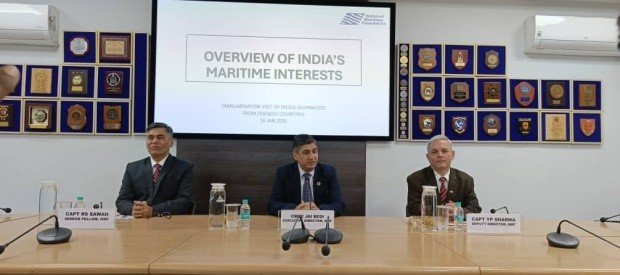
A delegation of 27 journalists from West and Central Africa and Oceania on Friday, January 16, 2026, held a high-level engagement with the National Maritime Foundation (NMF) in New Delhi, India, as part of an ongoing media familiarization and professional exposure programme aimed at strengthening knowledge exchange, deepening international media cooperation and improving journalists’ understanding of development policy and resilient infrastructure conversations.
The engagement brought together media professionals from friendly countries to explore the theme: “Overview of India’s Maritime Interests”, offering participants a timely and practical understanding of why India places strategic significance on the maritime domain; not only for national defence planning but also for trade facilitation, energy security, diplomacy, ocean governance and regional leadership in the wider Indo-Pacific space.
The Sierra Leone delegation included Alhaji Manika Kamara, President of the Sierra Leone Association of Journalists (SLAJ); Amin Kef Sesay, Managing Editor of The Calabash Newspaper and Thomas Dixon, Managing Editor of The New Age Newspaper.
The engagement formed part of a broader international initiative designed to enhance newsroom standards through exposure to global best practices, deepen institutional learning and strengthen journalists’ capacity to report with context, accuracy and balance on complex policy issues increasingly shaping the modern world.
Presentations delivered by officials and experts of the National Maritime Foundation underscored that India’s maritime interests extend far beyond traditional naval operations. Participants were briefed that the sea remains a lifeline for India’s economic growth and connectivity to global markets, making stable sea lanes, secure maritime infrastructure and uninterrupted shipping corridors essential to national prosperity.
The journalists were guided through India’s growing maritime priorities, including the country’s heavy dependence on sea routes for the movement of critical imports and exports, the expansion of offshore economic activity and the rising importance of protecting maritime assets and coastal trade networks.
Experts stressed that modern maritime interests must be understood as a complete strategic framework; linking defence readiness to economic resilience, trade performance, energy supply systems and diplomatic influence. They noted that in an era of shifting global security threats and rising competition for ocean resources, maritime stability has become one of the most decisive determinants of national development outcomes.
During the sessions, participants were also briefed on India’s trade engagement with Africa and how maritime connectivity continues to serve as the backbone of that expanding relationship.
Figures shared during the engagement indicated that India’s overall trade for the 2024/2025 period was estimated at about 1.1 trillion US dollars, reflecting the country’s deep integration into global economic systems and the growing relevance of maritime logistics in sustaining that performance. Presenters also highlighted that India’s trade with Africa in the same period stood at 81.9 billion US dollars, distributed across different regions of the continent, including West Africa, Central Africa and other sub-regions.
The presentation triggered broader discussions among journalists about the opportunities for deeper Africa–India cooperation, especially in areas such as port development, maritime infrastructure, value-added trade, logistics, security partnerships and blue economy expansion for coastal and island nations.
For journalists from countries that rely heavily on ocean trade, fisheries and maritime employment, the engagement helped connect global trade figures to real-world issues such as supply chain vulnerability, coastal governance and investment planning.
A major highlight of the engagement was the briefing on global maritime “choke points”; strategic narrow waterways through which a significant portion of global trade and energy shipments pass.
The National Maritime Foundation presentations identified major choke points in and around the Indian Ocean region, including the Suez Canal, Bab-el-Mandeb, Strait of Hormuz and the Malacca and Singapore Straits, among others. Experts explained that disruptions along any of those routes can trigger far-reaching global economic shocks, including delayed supply chains, increased shipping costs, fuel price volatility and shortages of essential commodities.
Journalists were reminded of the global impact of shipping disruptions, including real-world incidents where blockages in key routes led to major delays and losses, illustrating how fragile global trade can become when strategic sea lanes are compromised.
The sessions emphasized that those risks are not theoretical. They are real challenges confronting international governance, maritime security frameworks and global economic stability; issues that journalists increasingly must interpret and explain to their audiences with clarity.
The briefing also explored non-traditional maritime security threats that continue to influence the Indo-Pacific space and global ocean governance. It was stated that piracy is one f those issues.
Experts noted that those threats undermine trade safety, damage coastal livelihoods, weaken national revenue streams and create openings for organized crime networks operating across sea borders.
The journalists were also told that Illegal, Unreported and Unregulated (IUU) fishing remains one of the most persistent threats to sustainable marine development, particularly in regions where enforcement is weak, surveillance capacity is limited and transnational criminal patterns exploit gaps in maritime governance.
By connecting maritime crime trends with broader governance challenges, the engagement helped participants appreciate the role of intelligence cooperation, modern surveillance systems, coordinated enforcement and regional partnerships in protecting national interests.
Another key segment of the presentation addressed India’s energy security realities and how maritime routes continue to shape national planning.
Officials stressed that a large portion of the world’s energy supply is still transported by sea, making the protection of ocean routes vital; not only for fuel security but also for industrial output, economic growth and reliable household energy access.
The delegation was introduced to discussions surrounding offshore energy production and the maritime pathways through which oil and gas requirements are transported. Presenters explained that as global competition increases and geopolitical tensions impact supply routes, ensuring maritime security becomes a strategic necessity for national development and public stability.
For the visiting journalists, the energy segment provided additional context for understanding how maritime governance intersects with global energy debates, economic diplomacy and climate responsibility conversations.
For many participants, the day’s engagement was more than a formal institutional visit. It was described as a valuable learning opportunity that strengthened understanding of how major state institutions, strategic policy planning, diplomacy and public communication interact in a large democracy.
The programme was also seen as an important step in strengthening cross-border media collaboration between Africa, Oceania and Asia, especially as journalists face the growing challenge of reporting on complex issues such as maritime security, global trade systems, regional diplomacy and infrastructure resilience.
Participants noted that the presentations enhanced their ability to interpret maritime issues beyond headlines, helping them connect sea-based governance to national development priorities and international stability.
The engagement concluded with an interactive question-and-answer session, during which journalists sought further clarity on India’s maritime outlook, policy direction and strategic interests in the wider Indo-Pacific region.
Questions raised during the interaction centred on maritime security cooperation, economic opportunities linked to the blue economy, the future of ocean partnerships and how developing countries can strengthen maritime surveillance and infrastructure systems while supporting sustainable growth.
Organisers described the engagement as part of a larger series of institutional visits in New Delhi aimed at exposing journalists to India’s development frameworks, policy thinking and international cooperation strategies, with the goal of strengthening professional standards and enhancing public-interest reporting.
With the continuation of the familiarization visit, participating journalists are expected to engage additional institutions and policy stakeholders, expanding their understanding of governance models, strategic planning and development partnerships that increasingly shape global conversations on security, economic resilience and sustainable growth.