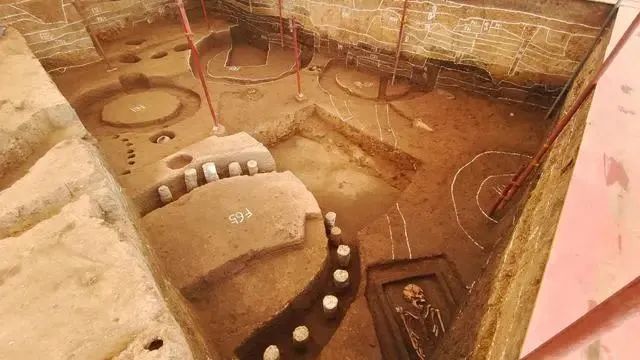
ZHENGZHOU, Jan. 19 — Archaeologists have unearthed the ruins of a large state-run grain storage facility from the Northern Wei Dynasty (386-534) in the city of Luoyang, central China’s Henan Province.
The discovery, found to the east of the imperial palace of the Han-Wei Luoyang Ancient City Site, has been preliminarily identified as part of the “Tai Cang,” or Imperial Granary, the national grain reserve of that era.
According to an archaeological team from the Institute of Archaeology under the Chinese Academy of Social Sciences, a systematic survey of the area has revealed a cluster of 168 storage pits, arranged in 14 columns and 12 rows.
As of Friday, archaeologists had excavated 13 of these pits, each measuring 9 to 11 meters in diameter and about 4 meters in depth.
The location of the ruins aligns with historical descriptions of the Tai Cang, according to the archaeological team.
“This marks another significant discovery at the Han-Wei Luoyang Ancient City Site, following the earlier unearthing of storage facilities within the imperial palace,” said Liu Tao, head of the team.
Liu noted that unlike the storage facilities found inside the imperial palace — which catered to the immediate needs of the imperial household — the Tai Cang served a broader state function, storing grain for officials’ salaries, military supplies and disaster relief efforts.
Based on the dimensions of the excavated pits, archaeologists estimate that each could hold about 120 tonnes of millet, demonstrating the massive scale of the Tai Cang as documented in historical records.
Archaeologists believe that the current findings may represent just one section of the Tai Cang, with more storage pits likely yet to be unearthed in the vicinity.
Further excavation and research at the Han-Wei Luoyang Ancient City Site are underway.
The Han-Wei Luoyang Ancient City was initially constructed during the Western Zhou Dynasty (1046 BC-771 BC) and fell out of use in the early Tang Dynasty (618-907).
It served as the capital for several dynasties, including the Eastern Han (25-220) and the Northern Wei. (Namibia Daily News/Xinhua)
Post Views: 23