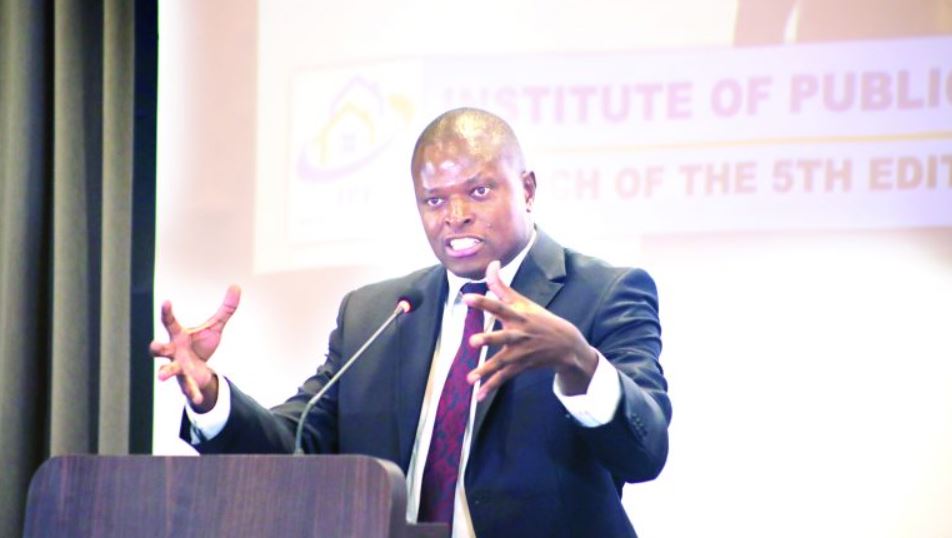
Kiharu Member of Parliament Ndindi Nyoro poked holes into President William Ruto’s vision of turning Kenya into “a Singapore of Africa,” arguing that the two economies differ too fundamentally in size, structure, and development path to make such a comparison meaningful.
Speaking on JKLive on Wednesday night, Nyoro warned that benchmarking Kenya against Singapore risks misleading policy decisions because the two countries operate under vastly different economic realities. He insisted that any serious economic comparison must rely on countries with similar conditions, not headline success stories that ignore context.
Nyoro said Kenya’s economic DNA aligns far more closely with South Korea than with Singapore, especially when it comes to population size, industrial strategy, and long-term development goals.
“In economics, just to bring it in terms of real life, if you’re a banana farmer, you can’t compare how well you’re doing with another banana farmer by using oranges or pears,” he explained.
“The economy that is actually close to what Kenya’s should be is South Korea. If we actually mean to emulate a country, it is South Korea.”
Singapore vs Kenya: A Wealth and Structure Gap
Nyoro pointed to the vast disparity in wealth between the two nations as proof that Singapore is an unrealistic benchmark for Kenya at this stage of development. Singapore’s GDP per capita stands at around USD 90,000, while Kenya’s is approximately USD 3,000, underscoring the gulf in income levels, productivity, and capital accumulation.
He also explained that Singapore’s early success relied heavily on state capitalism, where government-linked companies dominated the economy through entities such as Temasek Holdings. That model, he argued, contradicts Kenya’s current policy direction, which focuses on privatizing state-owned enterprises and reducing direct government involvement in business.
“The point is that the economies are fashioned very differently,” Nyoro noted.
Why South Korea Makes More Sense for Kenya
Nyoro said Kenya and South Korea share a crucial similarity that Singapore does not – population size. Kenya has about 50 million people, a figure that closely mirrors South Korea’s population, while Singapore has just over six million residents.
“If you compare the same with a country like South Korea, more or less, our ideals economically blend more. Our population is in the 50 millions; South Korea is in the 50 millions,” he said.

Beyond demographics, Nyoro pointed out how South Korea’s economic rise followed a carefully sequenced industrial strategy that Kenya could realistically replicate.
Lessons from the Asian Tiger Economies
Nyoro explained that the successful Asian tiger economies, including South Korea, followed a deliberate development path. They first built labor-intensive industries, then gradually transitioned into capital- and technology-intensive sectors. Throughout this process, they aggressively attracted foreign direct investment (FDI) and deliberately nurtured private enterprise.
He warned that Kenya often mislabels remittances as FDI, a confusion that distorts economic planning and policy priorities.
“Remittances are consumer-driven. FDI is investment-driven,” he said.
Nyoro asserted that none of the Asian success stories grew through political patronage or by blending political power with economic rewards.
South Korea’s Chaebol Model
Drawing from South Korea’s history, Nyoro cited the country’s strategic use of chaebols – large, family-controlled conglomerates such as Samsung, Hyundai, and LG – as a cornerstone of its industrial growth.
“If you look at South Korea, that is what it advanced, especially from the rule of General Park, where the economy was so involved in growing the private enterprise that they had to create a cadre of companies called Chaebols,” he said.
These firms became engines of innovation, exports, and industrial upgrading, helping South Korea transform from a poor agrarian society into a global manufacturing and technology powerhouse within a few decades.
Corruption and Human Capital Remain Key Barriers
Nyoro also cautioned against mixing political influence with economic incentives, warning that corruption distorts markets, scares away serious investors, and undermines fair competition.
He concluded by urging Kenya to invest more aggressively in human capital, arguing that skills, education, and productivity form the foundation of any sustainable economic transformation.
With President Ruto continuing to sell a “Singapore-style” future for Kenya, Nyoro’s remarks add a powerful counter-narrative – one that frames South Korea’s development model as a more realistic, data-driven, and structurally compatible roadmap for Kenya’s long-term growth.