By Amin Kef Sesay
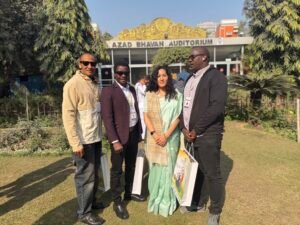
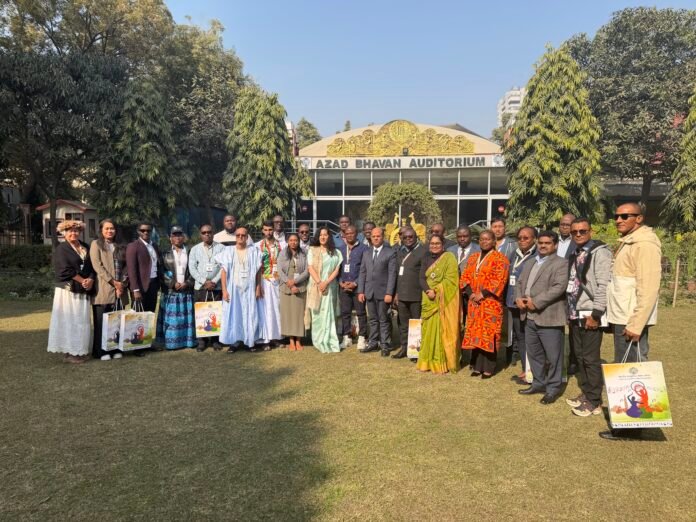
A delegation of journalists from West and Central Africa and Oceania on Thursday, January 15, 2026 undertook a rare, high-impact series of institutional engagements in India’s capital, touring Rashtrapati Bhavan, the official residence of the President of India on Raisina Hill—before proceeding to high-level discussions with officials of the Indian Council for Cultural Relations (ICCR) and a newsroom exposure visit to Asian News International (ANI) in New Delhi, India.
The programme formed part of an ongoing media familiarisation and professional exposure initiative designed to strengthen knowledge exchange, deepen international media cooperation, and improve journalists’ understanding of development policy, governance systems, cultural diplomacy, and resilient infrastructure conversations—themes increasingly shaping global partnerships and public accountability.
For many in the visiting group, the day represented more than a tour-and-talk schedule. It was a practical window into how institutions of state, diplomacy and media interact in a major democracy—and how that interaction can inform newsroom standards, regional reporting depth, and cross-border storytelling between Africa, Oceania and Asia.
The delegation began the day at Rashtrapati Bhavan, the iconic Presidential Estate that stands as both a symbol of the Indian state and a living venue for national ceremonies, diplomatic receptions and key constitutional events. The estate—often described as one of the largest official residences of a head of state in the world—offered the visiting journalists a direct encounter with the history and architecture that frames modern India’s governance identity.
Originally completed in 1929 and designed by Sir Edwin Lutyens, Rashtrapati Bhavan was built as the Viceroy’s House during British rule, later becoming the presidential residence after India’s independence and the country’s transition to a republic. Today, it serves as the official home and principal workplace of the Indian President, Smt. Droupadi Murmu.
The group’s visit aligned with India’s structured public access tours, which allow guided entry into designated circuits—ranging from the main building and central lawn to museum spaces and seasonal access to the famed gardens. Delegates noted the emphasis on organisation, public engagement and the preservation of national heritage—elements relevant not only to tourism and civic education, but also to the way institutions tell their own national story.
While the delegation included journalists from across West and Central Africa and Oceania, the Sierra Leone contingent was led by three media professionals whose participation reflected their country’s growing involvement in international professional exchanges.
The Sierra Leone delegation included Alhaji Manika Kamara, President of the Sierra Leone Association of Journalists (SLAJ); Amin Kef Sesay (Ranger), Managing Editor of The Calabash Newspaper; and Thomas Dixon, Managing Editor of The New Age Newspaper.
Speaking during the engagements, participants described the trip as a strategic opportunity to broaden professional exposure and to strengthen the ability of journalists—especially those covering development and governance—to interpret complex policy frameworks and translate them into public-interest reporting.
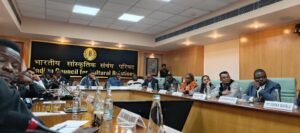
Following the Rashtrapati Bhavan tour, the delegation proceeded to the headquarters of the Indian Council for Cultural Relations (ICCR) for a detailed institutional briefing on India’s cultural diplomacy architecture and its global engagement programmes.
ICCR officials explained that the organisation operates as an autonomous institution under India’s Ministry of External Affairs (MEA), with responsibilities spanning cultural exchanges, academic cooperation, scholarship support, and programmes designed to deepen people-to-people relations across regions.
The delegation received an extensive presentation led by Ambassador K. Nandini Singla, the Additional Secretary and Director General (DG) of ICCR. Officials noted that the DG functions as the principal executive leader of the Council, providing direction and administrative oversight for programmes implemented through Indian missions and cultural centres.
Participants were briefed on ICCR’s approach to strengthening international cooperation through cultural platforms—ranging from exhibitions and performances to academic partnerships and institutional linkages. Beyond showcasing heritage, ICCR officials stressed that the Council’s work is designed to build long-term relationships rooted in mutual understanding, dialogue and sustained engagement.
A major highlight of the ICCR engagement centred on educational outreach, with discussions touching on scholarship opportunities for international students and the role of education as a pillar of international partnership.
Journalists raised questions about how scholarship pathways and alumni networks can translate into measurable development outcomes in partner countries—particularly for African states seeking to expand human capital in key sectors such as public administration, health, engineering, ICT and education.
During the interaction, Amin Kef Sesay appealed for stronger inclusion of African journalists in knowledge exchange opportunities linked to ICCR programmes, describing such access as critical for developing newsroom capacity and strengthening international collaboration.
“We are interested in understanding how India’s cultural diplomacy through ICCR goes beyond exchanges to create real and lasting impact for African countries—especially in human capital development, education, youth empowerment, and stronger people-to-people cooperation,” he said.
He further called for structured pathways that allow journalists—especially in developing democracies—to benefit from training exposure and global best practices that support ethical standards, deeper analysis and stronger storytelling.
Alhaji Manika Kamara, President of the Sierra Leone Association of Journalists (SLAJ), described the engagement as a timely opportunity that highlights the value of international partnerships in strengthening journalism practice. He said such exposure sharpens professional skills, deepens institutional learning, and promotes higher reporting standards through access to global best practices, ultimately enhancing accuracy, balance, and public-interest journalism.
Thomas Dixon, Managing Editor of The New Age Newspaper, also welcomed the engagement, noting that the discussions offered critical context for interpreting development interventions and policy decisions shaping emerging economies. He emphasized that such exchanges improve journalists’ ability to analyse complex issues and communicate their real impact to the public with greater clarity and depth.
For their part, other journalists in the delegation emphasised the importance of professional exchanges that help African and Oceania media practitioners report more accurately on global development initiatives, climate and resilience policy, and the expanding role of South–South cooperation.
The delegation later visited Asian News International (ANI), one of India’s leading private multimedia news agencies, where journalists were taken on a guided tour and introduced to newsroom processes, production workflows and content syndication systems that support multi-platform news distribution.
During the engagement, Ravi Khandelwal, an Executive Producer at ANI, provided an overview of the agency’s operational model, including how multimedia content is gathered, edited and distributed to clients across different media formats.
Participants interacted with ANI personnel and observed aspects of newsroom coordination, video production systems and the speed-driven logistics required to feed breaking news, features, interviews and public-interest stories to a wide range of subscribing outlets.
Journalists described the ANI visit as particularly useful given the changing nature of modern journalism—where digital acceleration, verification pressures and audience fragmentation demand more agile workflows, but also stronger editorial safeguards.
The engagement also created space for broader reflection on contemporary newsroom challenges—copyright, content reuse, trust, credibility, and the ethical responsibilities attached to speed and scale in the information ecosystem. Participants noted that in an era of misinformation and polarised narratives, cross-regional professional exposure can help build a shared commitment to verification, public accountability and responsible storytelling.
By the end of the programme, delegates described the Thursday engagements as a powerful blend of symbolism and skills-building—moving from the physical seat of the Presidency to cultural diplomacy briefings, and finally to newsroom operations and multimedia systems.
For journalists from West and Central Africa and Oceania, the day’s interactions offered not only institutional knowledge, but also a broader professional question: how can media practitioners convert access and exposure into deeper reporting that serves citizens, strengthens democratic accountability, and expands public understanding of development choices?
Delegates said the experience reinforced the importance of sustained partnerships—not as one-off visits, but as continuing professional channels for newsroom development, research-driven reporting and stronger international cooperation.
As the programme continues, participants expressed hope that future engagements will further strengthen journalist-to-journalist linkages across Africa, Oceania and Asia—building networks that elevate standards, expand understanding, and empower the media to report global development with greater clarity, context and credibility.