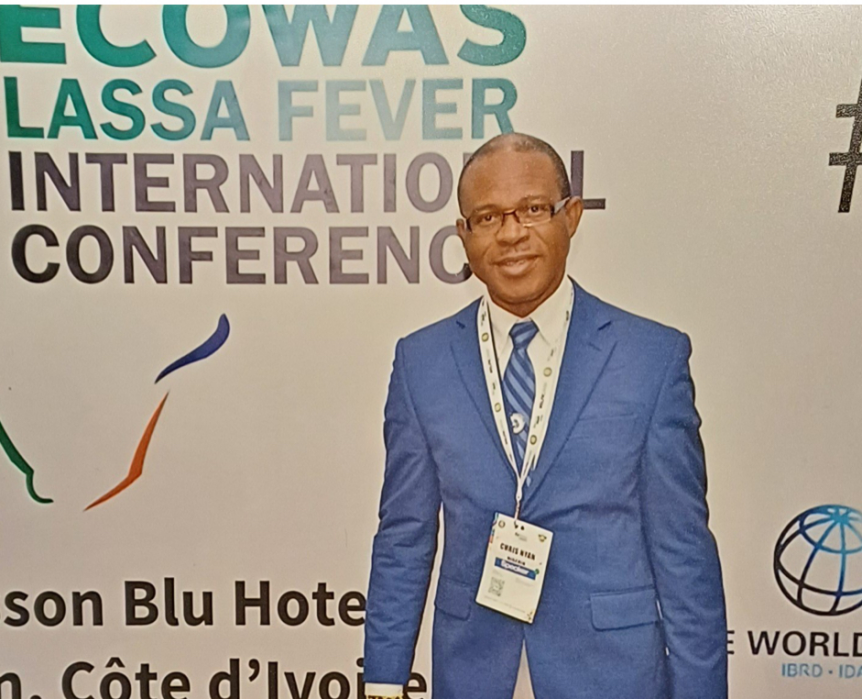
Monrovia — The National Public Health Institute of Liberia (NPHIL) has reported what it describes as substantial progress in 2025 under the leadership of its former Director General, Dr. Dougbeh Christopher Nyan, sharply contradicting claims of “gross inefficiency” cited by the Institute’s Board in a resolution that led to his removal.
The report, covering January to December 2025, is NPHIL’s official annual review submitted to its Board of Directors and the President at the Executive Mansion. Excerpts of the report, titled “NPHIL Reports Progress in 2025,” were published on the Institute’s official social media platforms.
According to the report, NPHIL recorded significant advances in strengthening Liberia’s public health systems, including disease surveillance, laboratory capacity, workforce development, and emergency preparedness, in close collaboration with the Ministry of Health and international partners.
During the period under review, NPHIL detected 278 public health events of national and global concern and responded to multiple outbreaks, including Mpox, Lassa Fever, and Measles across all 15 counties. Mpox response efforts reportedly achieved a recovery rate of about 94 percent, reducing active cases to 81 across 14 counties. Concurrent outbreaks were managed within prescribed response timelines, limiting socio-economic disruptions.
The report also highlights strong performance under the 7-1-7 framework for outbreak detection, reporting, and early response, supported by operational research conducted during the year.
Workforce capacity development featured prominently, with 27 frontline health workers trained through the Field Epidemiology Training Program in disease surveillance and outbreak investigation. Emergency preparedness was strengthened with the establishment of 16 functional Emergency Operations Centers nationwide, equipped with support from the Africa Centres for Disease Control and Prevention (Africa CDC).
Laboratory systems were expanded through the decentralization of Mpox testing to regional laboratories and the introduction of in-country genomic sequencing for Mpox and Lassa Fever. Biosafety and biosecurity were enhanced through nationwide certification of biosafety cabinets and specialized training for laboratory personnel.
Beyond outbreak response, NPHIL advanced research and knowledge-sharing by hosting the 4th Emmet A. Dennis National Scientific Conference and conducting operational research to inform policy decisions and surveillance improvements. Health promotion and risk communication initiatives were also scaled up to support community engagement during disease outbreaks.
Institutional reforms cited in the report include the introduction of biometric attendance systems, revised strategic planning aligned with the AAID Plan, and strengthened performance monitoring mechanisms. NPHIL’s designation by Africa CDC as a center of excellence was also noted as a major institutional milestone.
The report concludes that 2025 marked a year of growth and innovation for NPHIL, laying a strong foundation for improved public health preparedness in 2026. Records indicate that the achievements outlined were driven by Dr. Nyan’s leadership in collaboration with NPHIL divisions and development partners.
These findings contrast sharply with a September 12, 2025 resolution from the NPHIL Board to President Joseph Nyuma Boakai, which alleged “gross inefficiency” at the Institute and called for Dr. Nyan’s removal without publicly providing supporting evidence.
Acting on the Board’s resolution, President Boakai subsequently removed Dr. Nyan from office. Dr. Nyan has maintained that the action violated the NPHIL Act of 2016 and Liberia’s procedural laws. On September 23, 2025, he filed a petition for a Writ of Prohibition before the Supreme Court, alleging wrongful termination, political motivation, and conspiracy.
Following an initial conference before Chambers Justice Jamesetta Howard-Wolokolie on November 13, 2025, the Supreme Court reserved judgment while discussions on possible reinstatement or compensation continued. On December 10, 2025, the Court issued a Writ of Prohibition against the Executive Branch, ordering it to respond on December 18, 2025.