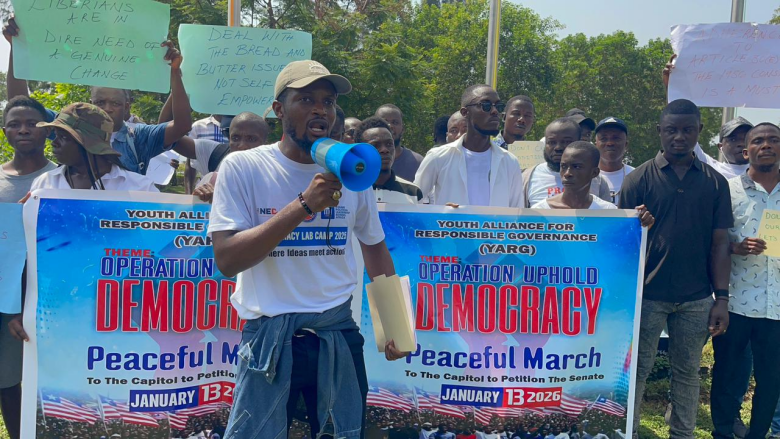
Monrovia – Scores of aggrieved youths on Tuesday, January 13, gathered at the Capitol Building in Monrovia to protest against a proposed expansion of the National Legislature, calling on the Liberian Senate to reject a bill that seeks to create 14 additional electoral districts across the country.
By Obediah Johnson, [email protected]
The peaceful demonstration was marked by chants, placards, and strong warnings to lawmakers against what the protestors described as self-empowerment, greed, and misplaced priorities at a time of deep economic hardship.
The bill, which would increase the number of seats in the House of Representatives, was recently passed by the lower chamber following the submission of a report from a Joint Committee on Elections and Inauguration, Judiciary and Good Governance, and Government Reform. The committee is chaired by Sinoe County District One Representative Thomas Romeo Quioh. With passage in the House secured, the proposed legislation now awaits concurrence from the Liberian Senate.
Protesting under the banner of the Youth Alliance for Responsive Governance, the demonstrators converged on the Capitol grounds carrying placards bearing strong messages directed at lawmakers. Among the inscriptions were statements such as “Lawmakers Are the Real Lawbreakers,” “Create 14 Seats, and We Will Retire You,” “Deal with the Bread-and-Butter Issues, Not Self-Empowerment,” “Liberians Need Genuine Change,” and “We Need More Jobs, Not More Lawmakers.”
The protestors said the creation of additional electoral districts would only deepen Liberia’s economic challenges and further burden taxpayers, while doing little to address unemployment and poor living conditions faced by the majority of citizens, particularly young people.
Speaking to reporters during the protest, YARG Secretary General Jethro Harris sharply criticized the House of Representatives for passing the bill, describing the decision as ill-timed and disconnected from the realities facing ordinary Liberians.
He said the country is currently struggling with widespread unemployment, low wages, and rising living costs, making the proposed expansion of the legislature both irresponsible and insensitive.
According to Harris, the passage of the bill does not reflect the interests of the Liberian people but instead serves the personal and political interests of a select few lawmakers. He accused members of the House of prioritizing self-benefit over national development and public welfare.
Harris urged the Senate to reject the bill outright, arguing that the creation of additional seats violates the Constitution of Liberia and poses serious economic implications for an already strained national budget.
“The creation of 14 additional seats is very inexpedient. It violates the Constitution of the Republic of Liberia. We are here today to speak to our Senators so they do not concur with the House of Representatives on this bill. We do not need additional districts. We need jobs,” Harris said.
He further pointed to the growing number of unemployed graduates as evidence that Liberia’s priorities are misplaced. Harris noted that within a few months, the University of Liberia alone would graduate more than 2,000 students, while other institutions such as AMEU and UMU continue to produce graduates in a job market that is already saturated and unable to absorb them.
“There are no jobs for these young people,” he said. “Yet lawmakers are focused on increasing their numbers instead of addressing the economic crisis.”
Harris also called on lawmakers to exercise their oversight responsibilities more effectively by holding government institutions accountable and pushing for economic reforms that would stimulate growth and create employment opportunities for thousands of Liberians.
In addition, he accused members of the House of Representatives of passing the bill without consulting their constituents, whom he described as their employers. “This bill was crafted and passed in a devilish manner. That is why we are calling on our Senators to listen to the people. We elected them, and we are saying clearly that we do not need additional districts,” Harris stated.
The YARG Secretary General also called for a reduction in the salaries and benefits of lawmakers, arguing that taxpayers can no longer afford the high cost of maintaining what he described as an already bloated and expensive legislature.
“We are already facing difficulties with 73 lawmakers. Why should we increase it to 87 while police officers, doctors, teachers, and other civil servants are struggling with low salaries,” Harris asked.
He warned that creating additional districts would place further strain on the national budget, as each new lawmaker would require staff, office space, and salaries, all funded by taxpayers’ money. According to him, this would worsen economic hardship rather than ease it.
Harris urged the government to prioritize policies that attract foreign investment and promote economic growth, rather than imposing what he described as additional hardship on ordinary Liberians through the expansion of the legislature.
“Job creation should be the priority of the government. By creating 14 new districts, you are also creating new staff positions, and all of their salaries will be paid by taxpayers,” he said.
Tension briefly escalated during the protest when members of the Liberian Senate failed to appear to receive the petition from the aggrieved youths. Frustrated by the absence of senators, the demonstrators temporarily blocked the main entrance to the Senate wing of the Capitol Building.
Security personnel later intervened, and executives of the youth group were escorted to various senators’ offices with the expectation that the petition would be received after the regular legislative sitting. However, by late afternoon, no senator was available to formally accept the petition.
Despite the setback, the youth group vowed to continue engaging lawmakers and mobilizing public support against the proposed expansion of the legislature. They insisted that Liberia’s future depends on job creation, accountability, and responsive governance, rather than an increase in the number of elected officials.