By Amin Kef (Ranger)
The Campaign for Human Rights and Development International (CHRDI) has expressed deep concern over what it describes as persistent failures within Sierra Leone’s judicial system, citing prolonged delays, poor record management and a lack of transparency in the handling of appeals arising from the 2018 Commissions of Inquiry (COIs).
In a statement released on Friday on January 9, 2026, CHRDI said that endemic challenges, including allegations of corruption, inadequate resources, weak accountability mechanisms and limited commitment to human rights protection, continue to undermine public confidence in the country’s courts.
The three Commissions of Inquiry were established in 2018 by President Julius Maada Bio to investigate alleged corruption and governance failures of past administrations. The final reports were submitted in March 2020, with individuals found culpable granted the right to appeal before the courts.
However, nearly seven years after the COIs were constituted and almost five years after the submission of the final reports, a significant number of appeal cases remain unresolved or inadequately documented at the Court of Appeal and the Supreme Court.
CHRDI warned that those delays erode public trust in the judiciary and raise serious questions about efficiency, accountability and respect for the rule of law. “Justice delayed is justice denied,” the organization noted adding that prolonged litigation causes anxiety for litigants, risks the deterioration of evidence and weakens the authority of court judgments.
The rights group recalled that in September 2023, the leadership of the Judiciary issued a directive instructing judges handling COI matters to conclude all cases by mid-October 2023. CHRDI said that directive has not been fully complied with.
In an effort to obtain clarity, CHRDI on August 21, 2025 formally invoked the Right to Access Information Act of 2013, requesting comprehensive updates on COI appeal cases from 2021 to 2025. Following what CHRDI described as initial resistance, partial documents were eventually released after further intervention by the Right to Access Information Commission.
On September 23, 2025, CHRDI lodged a formal complaint with the Commission, accusing the Judiciary of non-compliance with the law. A subsequent directive issued on October 9, 2025 gave the Judiciary a seven-day ultimatum to submit the requested information, warning that failure to comply would trigger legal action.
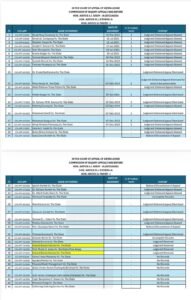
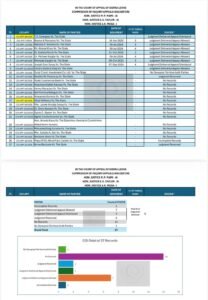
Despite that, the Judiciary failed to meet the deadline and later sought an extension on November 28, 2025, citing a provision that CHRDI says does not exist under the Act. Partial information was eventually submitted on December 17, 2025, covering 108 COI cases across three appellate panels.
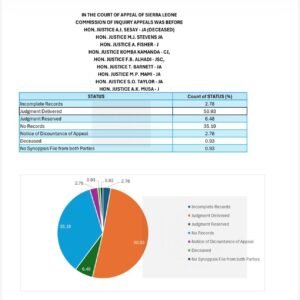
CHRDI’s review of the documents revealed what it described as serious discrepancies, including 38 cases marked “No Record,” representing about 35 percent of the files, as well as three incomplete records. According to the organization, that raises grave concerns about fair hearing guarantees, record-keeping standards and the overall integrity of judicial processes.
CHRDI’s review of the documents revealed significant discrepancies and inaccuracies, including 38 “No Record” case files (35% of COI files) and three incomplete records. The absence of proper records in appellate matters raises serious concerns about fair hearing guarantees, poor record management and the integrity of judicial processes.
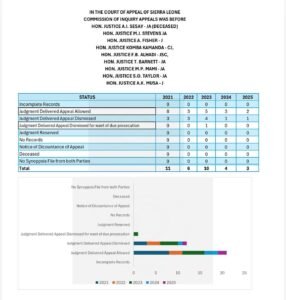
Summary of judgments provided is as follows:
- 2025: 2 appeals allowed; 1 appeal dismissed. (3)
- 2024: 3 appeals allowed; 1 appeal dismissed. (4)
- 2023: 5 appeals allowed; 4 appeals dismissed; 1 dismissed for want of prosecution. (10)
- 2022: 3 appeals allowed; 3 appeals dismissed. (6)
- 2021: 8 appeals allowed; 3 appeals dismissed. (11)
Overall, the Judiciary’s response has been insufficient, raising significant concerns about transparency and accountability in the handling of these cases.
The summary of judgments provided by the Judiciary shows limited progress between 2021 and 2025, with relatively few appeals concluded each year. CHRDI described the response as inadequate and insufficient to assure transparency and accountability.
Commenting on the situation, Abdul M. Fatoma, Chief Executive Officer of CHRDI, warned that continued inaction could have far-reaching consequences. “The Judiciary’s failure to address those issues will undermine the rule of law and diminish citizens’ right to timely justice,” he said. “When corruption penetrates the judicial system, it compromises the fundamental principle of fairness. A judge who accepts a bribe or obstructs justice cannot be considered independent or impartial.”
CHRDI concluded by calling for bold, honest and comprehensive judicial reforms, backed by adequate financial commitment from the Government to restore confidence in what it described as the nation’s “temple of justice” and to ensure timely and fair access to justice for all Sierra Leoneans.