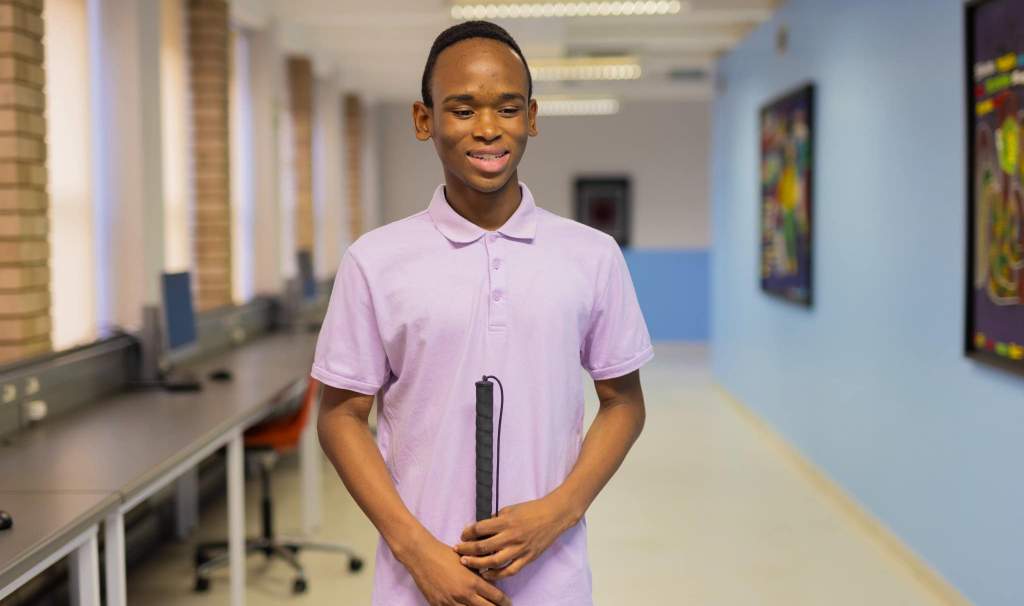
Blind law student Kabelo Kekana, who achieved six matric distinctions in 2024, has completed his first year at Wits University.
Wits – University of the Witwatersrand/Facebook
- Blind law student Kabelo Kekana, who achieved six matric distinctions in 2024, has completed his first year at Wits University.
- The 19-year-old law student aims to educate students about disability while he pursues his studies.
- Kekana’s biggest challenge was time management, and he advises other disabled students to leave their comfort zones for personal growth.
The country’s top special education needs pupil of 2024 has completed his first year at Wits University after a “learning curve” that taught him lessons beyond the lecture halls.
Kabelo Kekana, a 19-year-old law student who achieved six distinctions in matric, knew university would challenge him academically, but he didn’t expect the level of questions about how he operates his day-to-day life from fellow students.
As the only visually impaired student in his residence, Kekana found himself becoming an unexpected teacher about disability. Staff and students were amazed by his independence, though their curiosity sometimes crossed into deeply personal territory.
“There’s this lecturer who never taught me, but he liked me because he always saw me walk around alone,” Kekana recalled with a light laugh.
“He asked me several questions like, how do I take a shower, how do I know the colour of my clothes, how do I go to the toilet, how do I wipe myself, and how do I identify food on the plate.”
Kekana embraced the questions in his stride, having been an advocate for disability rights since his high school days.
Despite such intrusive questioning, Kekana patiently guided people through understanding disability, particularly teaching them appropriate ways to offer assistance.
“Many times I had to tell people that when we are approaching the stairs, don’t be afraid. I know they’re going up or down, you don’t need to tell me,” he explained.
READ | Wheelchair basketball star makes it to France to begin make-or-break opportunity
“Just put your arm around my shoulder and walk with me as a friend and not a blind person.”
Kekana, who has been blind since the age of 10, chose Wits specifically because of the low number of students with disabilities. Most of his high school friends attended the University of Limpopo.
Wits has about 1 000 students with disabilities from its 40 000 enrolled students.
“First year was difficult. It was an exploration time to know how varsity feels and manage the freedom that I had,” Kekana told News24, reflecting on his transition from Limpopo to Johannesburg.
His biggest academic hurdle wasn’t adapting to law school, but rather managing his time effectively.
The former star pupil discovered that his high school methods wouldn’t suffice.
ALSO READ | ‘I was never meant to live this long’: Born with spina bifida, Paula has big dreams
“I procrastinated a lot. I actually came with my high school tactics thinking they would work because in high school I was a smart student and could get away with not putting hard work in it,” he said.
“At varsity, I learnt that I have to put more time into my books.”
The transition from his specialised schools to a mainstream university also meant adapting to new technology.
While he still used braille for graphs in his economics course, most of his studies shifted to digital platforms.
He also discovered campus infrastructure designed for visually impaired students, which he was aware of but had no access to at home, including pedestrian lights that made different sounds depending on traffic conditions.
READ MORE | Defying odds: Michael Best’s journey to academic excellence despite spastic quadriplegia
His worst experience was during an inter-residence detective game, which should have been an evening of fun problem-solving, but it became a stark reminder of the barriers he still faced.
The game required participants to move around reading clues, with people’s names posted above their heads for identification.
As the only visually impaired student in his residence, Kekana found himself paired with fellow res mates who knew about his blindness but had never actually spoken to him before due to what he describes as fear and stigma.
“I felt bad. My emotions were down and [I felt] disappointed, but I consoled myself, saying it’s not their fault, it’s just the stigma they have,” he said.
However, Kekana never doubted his decision to leave Limpopo for Wits.
READ | Teen medic who volunteered hours before matric dance gets the nod for formal training
“It has always been my goal to go somewhere where fewer people are living with disabilities because this thing of spreading info about how people with disabilities live works perfectly,” he said.
Looking ahead to his second year, Kekana plans to focus on academics while joining extracurricular activities, having spent his first year exploring university life before committing to additional responsibilities.
His advice to other students with disabilities considering mainstream universities is simple.
“Staying in your comfort zone will never be a success. People have to get out of their comfort zone and face the challenges – that’s when they’ll discover their real selves.”
If you have an inspiring story to tell, email feelgood@news24.com.