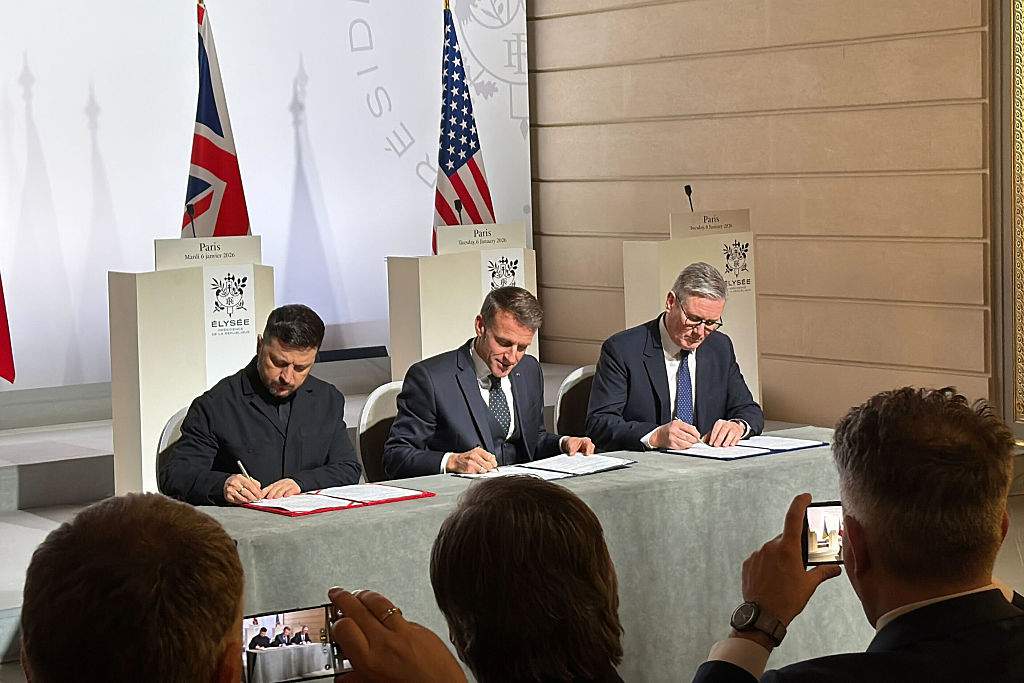
From left: Ukrainian President Volodymyr Zelensky, French President Emmanuel Macron and British Prime Minister Keir Starmer sign a declaration of intent on a multinational force to secure a ceasefire in Ukraine.
Rachel Sommer/picture alliance via Getty Images
- Russia condemned European peacekeeper plans for Ukraine as “dangerous” and labelled Kyiv and allies an “axis of war”.
- Moscow warned NATO peacekeeping troops in Ukraine would be “legitimate military targets” for Russian forces.
- Russian strikes left hundreds of thousands in Ukraine without heat, worsening conditions amid ongoing conflict.
Russia on Thursday slammed a plan for European peacekeepers to be deployed to Ukraine as “dangerous” and dubbed Kyiv and its allies an “axis of war”, dousing hopes the plan could be a step towards ending the almost four-year-war.
US President Donald Trump has been pushing the warring sides to strike a deal to halt the conflict, running shuttle diplomacy between Ukraine’s Volodymyr Zelensky and Russia’s Vladimir Putin in a bid to get an agreement across the line.
An initial 28-point plan, which largely adhered to Moscow’s demands, was criticised by Kyiv and Europe, and now Russia has slammed the attempts to beef up protections for Ukraine should an elusive deal be reached.
Ukraine’s allies said they had agreed on key security guarantees for Kyiv at a summit in Paris earlier this week, including a peacekeeping force.
But in its first comments since the summit, Moscow said the statements were far from anything the Kremlin could accept to end its assault.
Russia’s foreign ministry spokesperson Maria Zakharova said in a statement:
The new militarist declarations of the so-called Coalition of the Willing and the Kyiv regime together form a genuine ‘axis of war’.
She called the plans drafted by Kyiv’s allies “dangerous” and “destructive”.
The remarks come as Russian strikes plunged hundreds of thousands in Ukraine into darkness, leaving families without heat in below-freezing temperatures – attacks that Zelensky said showed Russia was still set on war.
‘Legitimate military targets’
European leaders and US envoys announced earlier this week that post-war guarantees for Ukraine would include a US-led monitoring mechanism and a European multinational force to be deployed when the fighting stops.
But Moscow has repeatedly warned that it would not accept any NATO members sending peacekeeping troops to Ukraine.
“All such units and facilities will be considered legitimate military targets for the Russian Armed Forces,” Zakharova said on Thursday, repeating a threat previously uttered by Putin.
Zelensky also said on Thursday that a bilateral agreement between Kyiv and Washington for US security guarantees was “essentially ready for finalisation at the highest level with the President of the United States” following talks between envoys in Paris this week.
READ | Ukraine reports ‘concrete results’ from talks with Western allies
Kyiv says legally-binding assurances that its allies would come to its defence are essential to convince Russia not to re-attack if a ceasefire is reached.
But specific details on the guarantees, the European force, and how it would engage have not been made public.
Zelensky said earlier this week he had yet to receive an “unequivocal” answer on what they would do if Russia attacked again after a deal.
Zelensky has also stated that the most difficult questions in any settlement – namely, the territorial control of the eastern Donbas region and the fate of the Russian-occupied Zaporizhzhia nuclear power plant – remain unresolved.
Russian strikes cut heating
Ukraine was meanwhile scrambling to restore heating and water to hundreds of thousands of households after a new barrage targeted energy facilities in its Dnipropetrovsk and Zaporizhzhia regions.
Borys Filatov, mayor of Dnipropetrovsk’s capital Dnipro, said on Telegram:
This is truly a national-level emergency.
He announced power was “gradually returning to the hospitals” after the blackouts forced them to run on generators. The city authorities also extended school holidays for children.
Approximately 600 000 households in the region remained without power in Dnipropetrovsk, according to the Ukrainian energy company DTEK.
In a post on social media, Zelensky said the attacks “clearly don’t indicate that Moscow is reconsidering its priorities.”
In addition to the unrelenting pummelling of Dnipropetrovsk, Russia pressed on with its ground assault on the region, claiming to have taken another village there.
It is not one of the five Ukrainian regions that Moscow claims to have annexed.