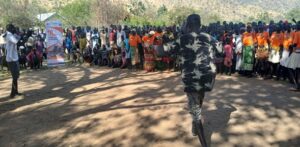
Local artist Junub Juzz performs for community members during the 16 Days of Activism Against Gender-Based Violence in Budi County, Eastern Equatoria State. – Photo credit: Roots of Generation
In Budi County, life moves with the rhythm of tradition, a deep connection to the land, and the shared strength of local languages that bind communities together.
Yet even in these remote villages, a new threat has begun to take hold, digital violence that can reach people far beyond the places where internet access is common.
Most residents rarely use the internet themselves, but false information, online insults, and misused photos can spark real-world conflicts and tension within families and neighbourhoods.
During the 16 Days of Activism Against Gender-Based Violence, Root of Generation (ROG) organized a community gathering to address this invisible danger and explore ways to protect residents.
The event was not held in formal halls or offices but under trees, in village squares, and at returnee gathering points, spaces where the community naturally comes together.
To deliver the message, ROG partnered with local artist Junub Juzz to compose and perform songs in the local dialect, giving voice to concerns that often go unspoken.
The campaign’s message was clear and memorable: “Ibili Joreni ci Interneto” – Let’s stop fighting on the internet.
Recognizing that a conventional social media campaign would not reach these grassroots communities, the initiative relied on music as a cultural bridge to communicate the message effectively.
The songs did more than condemn digital violence; they told stories of real-life consequences, encouraged empathy and respect, and offered practical guidance for safer online behaviour.
Above all, the lyrics provided a unifying call for peace, one that was easily understood and shared across generations.
Music that speaks
The campaign unfolded across the Upper Land in locations where people feel most at home, from village squares to areas welcoming returning residents.
The performances transformed abstract ideas about digital harm into tangible experiences that the community could feel and respond to emotionally.
Women clapped their hands, children swayed to the rhythm, and elders nodded thoughtfully as the message unfolded.
After each performance, facilitators led discussions where elders, women, and youth spoke openly about the ways online rumors and insults could affect their safety and the harmony of their communities.
Simple illustrated guides in the local language were distributed, explaining what digital violence is and how residents can protect themselves and report incidents even when access to the internet is limited.
Over time, the chorus of “Ibili Joreni ci Interneto” became more than just a song, it became a collective pledge to maintain peace both online and offline.
Voices from the field
The impact of the campaign is most evident in the reflections of the people whose lives it touched.
“Before, when someone brought a story from the internet, we would believe it. It would cause big fights between youths. Now, when we hear something, we ask ourselves, ‘Is this true? Is this the ‘internet fighting’ the song warned us about?’ The song gave us a new wisdom,” said one participant.
Cecilia, a returnee from Kenya’s Kakuma refugee settlement, recounted how her image was once misused online to insult her for speaking about life in the camp, and how she had never understood how it had been taken or spread.
“As a young person, I thought the internet was just for fun. The campaign made me understand that my words have power, even on a screen. I am now more careful, and I tell my friends to stop spreading gossip. we have a responsibility to ‘ibili joreni,” she said.
David, a youth leader, said he now encourages his peers to pause and think before sharing any information online.
From a song to a movement
The campaign has shown that creativity, cultural understanding, and local knowledge can bridge gaps to communicate vital messages effectively, even in remote communities.
Though the music eventually fades, its lessons have taken root and continue to influence attitudes, behavior, and community norms.
ROG plans to sustain the initiative by training local champions to continue facilitating dialogues and acting as first responders to incidents of digital harm.
The organization also intends to expand its communication toolkit with radio jingles, street theatre, and other locally sourced materials to reinforce the campaign’s messages.
The initiative has highlighted the urgent need for safer, more equitable digital access for rural communities, coupled with guidance on responsible usage.
Ending gender-based violence, including online abuse, requires inclusive, community-based approaches that speak directly to the people they affect.
By meeting communities where they are, speaking in their language, and using familiar cultural forms, the campaign ensured that no one was left behind.
This work was made possible through the dedication of JUNUB JUZZ, the guidance of community elders, and the support of DCA through Danida SPA.