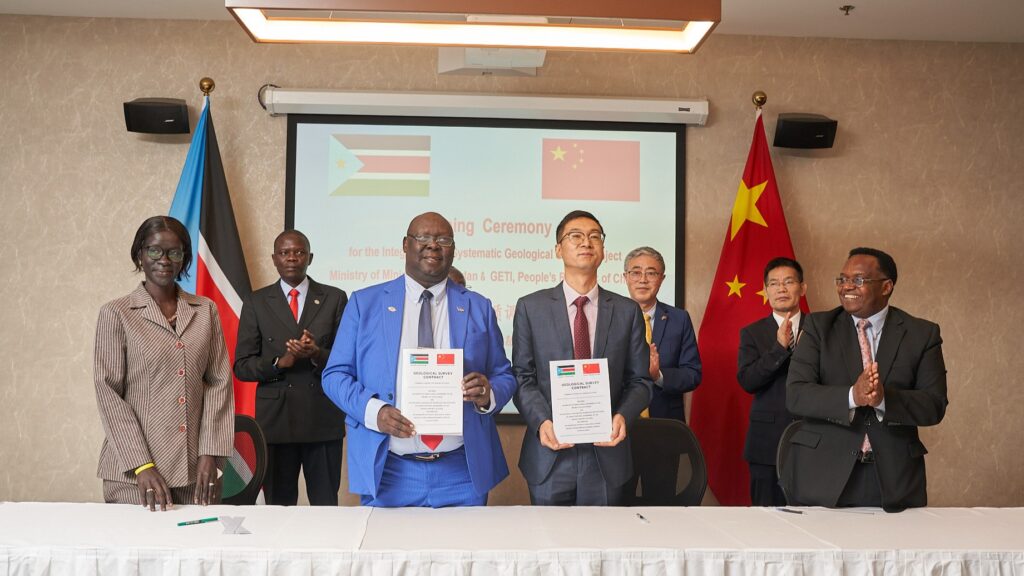
JUBA – South Sudan’s Ministry of Mining has halted the issuance of exploration and small-scale mining licenses in Western Bahr el Ghazal State as the government prepares to finally roll out a long-awaited national geological survey, nearly two years after the project stalled.
In a ministerial order issued on October 30, 2025, Mining Minister Martin Gama Abucha suspended all new Exploration Licenses (EL) and Small-Scale Mining Licenses (SML) in the state, effective November 1. The suspension will remain in force until further notice.
According to the order, the pause is intended to clear the way for the launch of a comprehensive geological survey beginning in Western Bahr el Ghazal—a project seen as critical to mapping South Sudan’s mineral wealth and shaping future investment. Preparatory work is already underway, with the official launch scheduled for January 28, 2026.
The planned survey is part of a seven-year Integrated Systematic Geological Survey agreement the government signed on December 24, 2023 with China’s Geological Exploration Technology Institute (GETI).
The $70 million project was expected to kick off in 2024 but failed to take off, largely due to funding, logistical, and operational delays in Raja County, where the work is based. Raja is believed to host significant mineral deposits, including an estimated eight million tons of copper that remain inaccessible due to poor road infrastructure.
During the 2023 signing ceremony in Juba, former undersecretary Dr. Cosmas Pitia signed the agreement on behalf of the government, while Huang Yan represented GETI.
Senior officials—including Vice President and Economic Cluster Chair Dr. James Wani Igga, Minister Abucha, and Chinese Ambassador Ma Qiang—witnessed the deal, which was branded a milestone toward quantifying the country’s mineral resources for the first time.
With the survey stalled for two years, the ministry is now attempting to reset the process.
On November 8, 2025, officials convened all mining companies operating in Western Bahr el Ghazal for a briefing on the suspension and the upcoming survey.
Minister Abucha urged the private sector to support the process, describing it as essential for building a credible, data-driven mining industry.
A statement obtained by Sudans Post reveals that stakeholders also discussed the formation of a Chamber of Mines—an industry body expected to coordinate sector interests and strengthen policy engagement.
The ministry says the temporary halt on licensing is meant to ensure clear ground conditions for the survey teams and prevent overlapping claims before reliable geological data becomes available. It also pledged transparency as the process unfolds.
The launch of the survey in January is expected to mark South Sudan’s most ambitious attempt yet to systematically map its mineral potential—a long-standing gap that has hindered investment, policymaking, and revenue generation since independence.