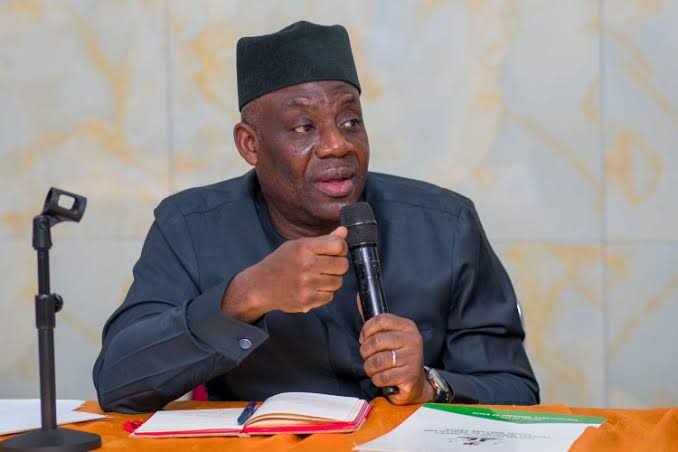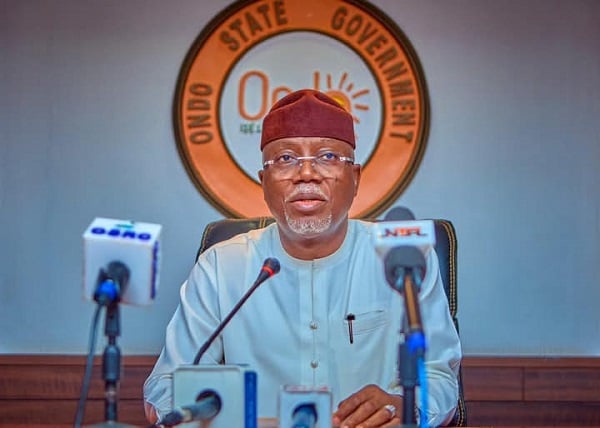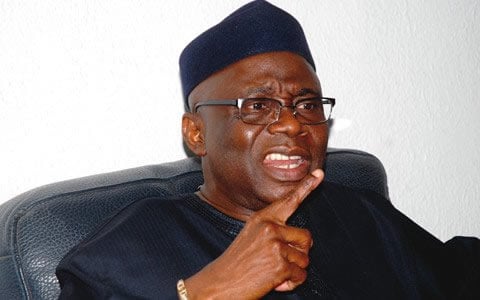
The Serving Overseer of the Citadel Global Community Church, Pastor Tunde Bakare, has claimed that the motive behind President Donald Trump’s recent designation of Nigeria as a “Country of Particular Concern” and his allegations of Christian genocide is the US president’s interest in Nigeria’s oil wealth.
According to Bakare, who spoke during a State of the Nation Address at the Citadel Global Community Church on Sunday, the Trump administration considers Nigeria’s oil wealth, other mineral resources and critical sectors such as real estate as central to its agenda.
He added that Trump was also keen on Nigeria’s role in the value chain of emerging technologies, which he described as major pillars of the American leader’s foreign and economic policy.
The address marked Bakare’s first public reaction since Trump’s October 31 redesignation of Nigeria as a CPC and his subsequent “guns-a-blazing, fast, vicious and sweet attack on terrorists in Nigeria” comments, which triggered swift responses from the President Bola Tinubu administration.
Bakare recalled that shortly after Trump won the 2024 US election, he received a vision in which the American leader arrived in Sabo, Yaba, Lagos, aboard Air Force One, “dressed in Arabian thobe and ghutra” and declaring, “We are here now.”
He said the revelation signalled a “particular interest” Trump would take in Nigeria linked to Middle East politics, oil and gas, real estate, and the country’s expanding technology sector.
Bakare said, “It was clear to us that President Donald Trump was going to have a particular interest in Nigeria.
“Nigeria’s oil wealth and other mineral resources will be critical to the Trump presidency, as will our role in the value chain of emerging technologies.”
He added that the symbolic attire in the vision pointed to “religious implications” that could spark tensions if not properly managed.
“Trump’s Muslim attire was a clear indication that his interest in Nigeria could have serious religious implications, such that could cause religiously motivated social unrest,” he said.
Bakare labelled Trump’s leadership style transactional and urged the Federal Government to respond with a structured economic plan.
“President Donald Trump has proven to be a transactional leader whose threats are usually invitations to the negotiating table,” he said.
“The Nigerian government should present the United States with a mutually beneficial business proposal, one that will facilitate US business interests while guaranteeing Nigeria’s security, educational development, industrialisation and access to cutting-edge technologies.”
He urged the Federal Government to negotiate a strategic business deal with Washington rather than wait to be pressured, stressing that Nigeria must not miss the window of opportunity.
While he did not disclose details of his proposed plan, he insisted that Nigeria’s long-term development depended on striking agreements anchored on national interest.
President Tinubu, last week, appointed National Security Adviser, Nuhu Ribadu, to head Nigeria’s delegation on the US-Nigeria joint working group to deepen collaboration between the two countries on security.
The former Vice-Presidential candidate also warned that the country’s worsening insecurity had exposed deep structural wounds long ignored by successive governments.
He said the Middle Belt, North-West and South-East had become flashpoints of unresolved grievances, banditry, terror networks and communal mistrust.
“To deny that Christians have been targeted in many Middle Belt communities is to turn the truth on its head,” he said.
According to him, the continued killings across Benue, Plateau, Southern Kaduna and other Middle Belt states were a “shame on the Nigerian state.”
He criticised the National Assembly for remaining silent on the insecurity crisis until the US Congress debated the issue, accusing lawmakers of prioritising 2027 politicking and defections over national security.
In the same vein, he faulted the Ministry of Foreign Affairs for being reactive and failing to galvanise diplomatic goodwill to support Nigeria’s war against terror.
He said, “It is a shame on the Nigerian government that these communities would resort to calling on the American government to help because their own government has failed them woefully.
“It is a shame on our National Assembly that it took the United States Congress — not the representatives elected by Nigerians — to convene a hearing on the lived experiences of citizens suffering under insecurity, while those in Abuja were busy with politicking, posturing for political relevance, defecting from one political party to another in their desperate manoeuvres to secure their seats ahead of the 2027 elections.
“It is indeed a shame that Nigeria’s foreign affairs architecture failed all the while to mobilise Nigeria’s dwindling diplomatic goodwill to secure international support for the war on terror, only to respond with excuses when that goodwill reached its lowest ebb.”
Bakare added that tensions in the South-East, exacerbated by the detention and trial of separatist leader Nnamdi Kanu, showed that Nigeria had not healed from the 1967-1970 Civil War.
Bakare said President Bola Tinubu stood at a decisive junction where he must choose between political calculations ahead of 2027 and the tougher path of structural reforms.
Although he acknowledged the President’s efforts to recruit more security personnel and declare limited security emergencies, he insisted that only bold action could stabilise the country.
His proposed measures included a national apology, a Victims and Survivors Register, increased boots on the ground using veterans and paramilitary forces, technology-enabled surveillance, “tech-to-industry diplomacy” to attract American military AI systems and the establishment of state, zonal and community policing systems under federal coordination.
“This would entail the President owning the failure of government over the decades to protect the victims and survivors of banditry, terrorism and other forms of insecurity.
“It would entail opening a Victims and Survivors Register. Then, at the end of three months, in a solemn address to the nation, the President would tender an apology on behalf of the Nigerian state to victimised communities across the nation, calling each community by name, and, possibly, some of the families most gruesomely hit in the attacks.
“Such an acknowledgement would expectably be followed by compensation in the mid-term phase,” Bakare said.
He also urged Tinubu to set up a Presidential Commission for National Reconciliation, Reintegration and Restructuring, insisting that Nigeria’s real challenge was what he called “the Nigeria Question” — identity, dignity, equity, coexistence and governance.
According to him, solving these issues was the foundation for ending decades of instability.
“No nation can be built on denial,” Bakare said. “If we are to sit at the table of brotherhood, we must acknowledge the truth and confront it.”
He warned that Nigeria must move beyond piecemeal responses and embrace long-delayed structural reforms, arguing that the best of the North and South must unite to negotiate a new national settlement.
As part of long-term solutions, Bakare called for the empowerment of zonal, state and local policing systems to ensure faster response times, local accountability and community trust.
He also called for the recalibration of the national security architecture through a “technical non-political Directorate of National Intelligence,” which would free the National Security Adviser to focus on his role as the President’s political appointee.
He emphasised the need for “the establishment of a Zonal Security Council in each of the six geopolitical zones, chaired by governors from the respective zone on a rotating basis, incorporating state and local policing systems into the framework of each Zonal Council.”
He said, “The representation of the Zonal Security Councils in the National Security Council through their serving chairpersons at each point in time.
“The transformation of the federal police force into a national investigative body focused on intelligence gathering, complex investigations and inter-jurisdictional crimes, serving as Nigeria’s premier investigative body.”
In addition, he called for the replacement of the one-year National Youth Service Corps with a two-year scheme, “the first year of which would be deployed towards military training and deployment.”
Bakare further advocated a dual foreign policy architecture – the Trans-Saharan and Trans-Atlantic – with the former engaging the Middle East and Arabian Peninsula for the “progressive acculturation of northern Nigeria and the stabilisation of the Sahel,” and the latter driving cooperation with the West.