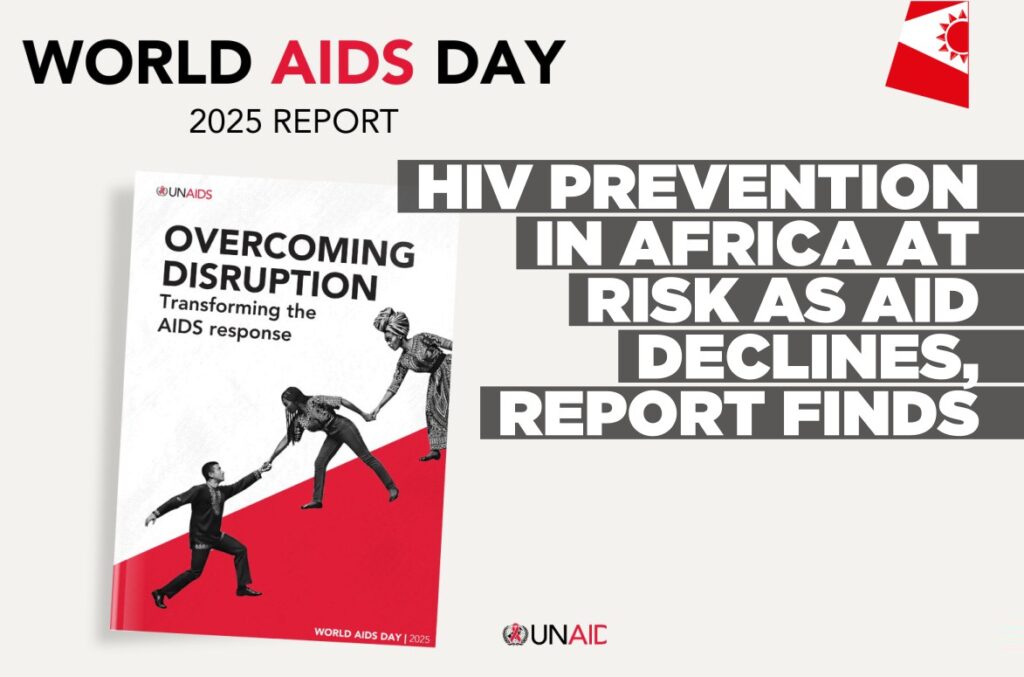
UNAIDS has sounded the alarm over severe disruptions to HIV prevention and treatment services across Africa, driven by a global funding crisis that has left low- and middle-income countries struggling to maintain critical programmes. In its 2025 World AIDS Day report, Overcoming Disruption, Transforming the AIDS Response, the agency says resilience, innovation and renewed global solidarity remain essential if the world is to stay on track to end AIDS.
The report, released in Geneva this month, warns that the global HIV response is facing its most serious setback in decades. Abrupt cuts in international health financing have intensified long-standing shortfalls, hitting African countries—home to the highest HIV burden—especially hard. OECD estimates show external health assistance could drop by 30–40% in 2025 compared to 2023.
“The funding crisis has exposed the fragility of the progress we fought so hard to achieve,” said Winnie Byanyima, UNAIDS Executive Director. “Behind every data point are people—babies missing early diagnosis, young women cut off from prevention support, and communities suddenly left without services.”
Prevention services have been among the hardest hit. Access to pre-exposure prophylaxis (PrEP) has dropped sharply, and declines in voluntary medical male circumcision are widening the protection gap for millions. The dismantling of youth-focused prevention programmes—particularly those supporting adolescent girls and young women in sub-Saharan Africa—has deepened vulnerabilities. In 2024, 570 new infections occurred every day among girls and young women aged 15–24.
Community-led organisations, central to reaching people at highest risk, report widespread closures. More than 60% of women-led groups have suspended essential services. Populations including sex workers, men who have sex with men, transgender people and people who inject drugs have been severely affected.
UNAIDS warns that failure to meet the 2030 global HIV targets could result in an additional 3.3 million new infections between 2025 and 2030.
The funding collapse coincides with a worsening human rights environment. The number of countries criminalising same-sex relations and gender expression has risen for the first time since 2008. Restrictions on civil society—especially groups working with key populations and young women in Africa—are undermining access to life-saving services.
Despite the crisis, several African countries have taken steps to protect their HIV responses. Nigeria, Uganda, Côte d’Ivoire, South Africa and Tanzania have committed to increasing domestic investment. UNAIDS is working with more than 30 countries on sustainability plans to help maintain treatment continuity.
The report highlights promising innovations, including twice-yearly injectable HIV prevention and new partnerships aimed at expanding access to affordable generic medicines. In 2025, major donors—including the Gates Foundation, UNITAID, the Global Fund and PEPFAR—launched initiatives to reduce the cost of essential medicines to as low as USD 40 per person per year.
“We have the tools and the science,” Byanyima said. “What we need now is political courage.”
There have been some positive developments in late 2025. The United States unveiled its America First Global Health Strategy, which includes bilateral agreements to support HIV responses during a gradual transition to domestic financing. The Global Fund’s Eighth Replenishment generated USD 11.34 billion, with additional pledges expected.
UNAIDS is urging global leaders to reaffirm multilateral cooperation, maintain international HIV financing for the countries that need it most, invest in new prevention technologies, and defend human rights—particularly the rights of women and key populations.
Today, 40.8 million people are living with HIV worldwide, 1.3 million new infections occurred in 2024, and 9.2 million people remain without treatment.
“This is our moment to choose,” Byanyima said. “We can allow these shocks to undo decades of gains, or we can unite behind the shared vision of ending AIDS. Millions of lives depend on the choices we make today.”
Read the full report here: https://www.unaids.org/en/2025-world-aids-day
Source: UNAIDS